Ch. 7 - Transcendental Functions
Hass - Thomas' Calculus 15th Edition
Hass15th EditionThomas' CalculusISBN: 9780137616077Non è quello che usi tu?Cambia libro di testo
Capitolo 7, Problema 7.1.68d

In Exercises 67–72, you will explore some functions and their inverses together with their derivatives and tangent line approximations at specified points. Perform the following steps using your CAS:
d. Find the equation for the tangent line to g at the point (f(x_0), x_0) located symmetrically across the 45° line y=x (which is the graph of the identity function). Use Theorem 1 to find the slope of this tangent line.
68. y= (3x+2)/(2x-11), -2 ≤ x ≤ 2, x_0=1/2

Guida verificata passo dopo passo
1
Identify the given function as \( y = f(x) = \frac{3x + 2}{2x - 11} \) and the point \( x_0 = \frac{1}{2} \). The function \( g \) is the inverse of \( f \), so \( g = f^{-1} \). The point on \( g \) corresponding to \( x_0 \) is \( (f(x_0), x_0) \).
Calculate \( f(x_0) \) by substituting \( x_0 = \frac{1}{2} \) into \( f(x) \) to find the coordinates of the point on \( g \): \( (f(x_0), x_0) \).
Use Theorem 1, which states that if \( g = f^{-1} \), then the derivative of \( g \) at \( f(x_0) \) is given by \( g'(f(x_0)) = \frac{1}{f'(x_0)} \). So, find \( f'(x) \) by differentiating \( f(x) \) using the quotient rule:
\[ f'(x) = \frac{(3)(2x - 11) - (3x + 2)(2)}{(2x - 11)^2} \]
Evaluate \( f'(x_0) \) by substituting \( x_0 = \frac{1}{2} \) into the derivative expression.
Find the slope of the tangent line to \( g \) at \( (f(x_0), x_0) \) using \( g'(f(x_0)) = \frac{1}{f'(x_0)} \). Then, write the equation of the tangent line in point-slope form:
\[ y - y_1 = m (x - x_1) \]
where \( (x_1, y_1) = (f(x_0), x_0) \) and \( m = g'(f(x_0)) \). This line is symmetric to the tangent line of \( f \) at \( x_0 \) across the line \( y = x \).

Risposta video verificata per un problema simile:

Questa soluzione video è stata consigliata dai nostri tutor come utile per risolvere questo problema.
Durata del video:
9m

Concetti chiave

Ecco i concetti essenziali che devi comprendere per rispondere correttamente alla domanda.

Inverse Functions and Their Graphs

An inverse function reverses the roles of inputs and outputs of the original function, swapping x and y. Graphically, the inverse function's graph is the reflection of the original function's graph across the line y = x (the 45° line). Understanding this symmetry is crucial for locating points like (f(x₀), x₀) on the inverse function.
Video consigliato:
3:17
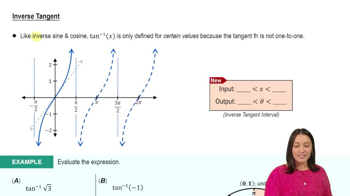
Inverse Tangent

Derivative of an Inverse Function (Theorem 1)

Theorem 1 states that if a function f is differentiable and invertible at x₀, then the derivative of its inverse g at y₀ = f(x₀) is given by g'(y₀) = 1 / f'(x₀). This relationship allows us to find the slope of the tangent line to the inverse function using the derivative of the original function.
Video consigliato:
06:35
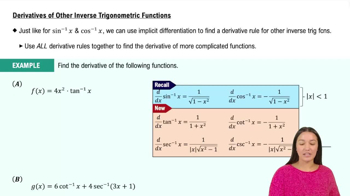
Derivatives of Other Inverse Trigonometric Functions

Tangent Line Equation and Point-Slope Form

The tangent line to a curve at a point is the best linear approximation of the function near that point. Its equation can be found using the point-slope form: y - y₁ = m(x - x₁), where m is the slope (derivative) at the point (x₁, y₁). Applying this to the inverse function requires using the point (f(x₀), x₀) and the slope from Theorem 1.
Video consigliato:
Percorso guidato
05:13
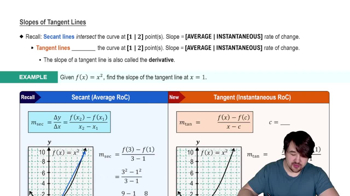
Slopes of Tangent Lines
Pratica correlata
Domanda del libro di testo

1. Express the following logarithms in terms of ln 2 and ln 3.

d. ln ∛9

20
views

Domanda del libro di testo

2. Express the following logarithms in terms of ln 5 and ln 7.

d. ln 1225

14
views
Domanda del libro di testo

In Exercises 67–72, you will explore some functions and their inverses together with their derivatives and tangent line approximations at specified points. Perform the following steps using your CAS:

d. Find the equation for the tangent line to g at the point (f(x_0), x_0) located symmetrically across the 45° line y=x (which is the graph of the identity function). Use Theorem 1 to find the slope of this tangent line.

67. y= √(3x-2), 2/3 ≤ x ≤ 4, x_0=3

25
views
Domanda del libro di testo

155. Which is bigger, πᵉ or e^π?

Calculators have taken some of the mystery out of this once-challenging question.

(Go ahead and check; you will see that it is a very close call.)

You can answer the question without a calculator, though.

d. Conclude that

xᵉ < eˣfor all positivex ≠ e.

27
views
Domanda del libro di testo

In Exercises 67–72, you will explore some functions and their inverses together with their derivatives and tangent line approximations at specified points. Perform the following steps using your CAS:


d. Find the equation for the tangent line to g at the point (f(x_0), x_0) located symmetrically across the 45° line y=x (which is the graph of the identity function). Use Theorem 1 to find the slope of this tangent line.


70. y= x³/(x²+1), -1 ≤ x ≤ 1, x_0=1/2

14
views
Domanda del libro di testo

In Exercises 67–72, you will explore some functions and their inverses together with their derivatives and tangent line approximations at specified points. Perform the following steps using your CAS:

d. Find the equation for the tangent line to g at the point (f(x_0), x_0) located symmetrically across the 45° line y=x (which is the graph of the identity function). Use Theorem 1 to find the slope of this tangent line.

72. y= 2-x-x³, -2 ≤ x ≤ 2, x_0 = 3/2

17
views