
Domanda del libro di testo
Evaluate the integrals in Exercises 67–74 in terms of
b. natural logarithms.
69. ∫(from 5/4 to 2)dx/(1-x²)
19
views

 Guida verificata passo dopo passo
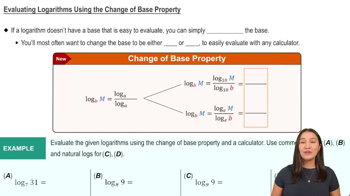
 05:36
05:36
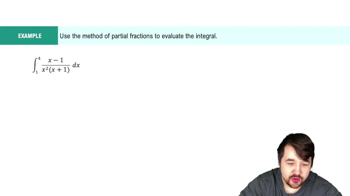 11:15
11:15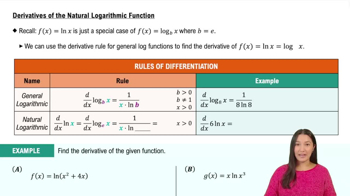 05:18
05:18Evaluate the integrals in Exercises 67–74 in terms of
b. natural logarithms.
69. ∫(from 5/4 to 2)dx/(1-x²)
31. The incidence of a disease (Continuation of Example 4.) Suppose that in any given year the number of cases can be reduced by 25% instead of 20%.
b. How long will it take to eradicate the disease—that is, reduce the number of cases to less than 1?
b. Find the center of mass if, instead of being constant, the density function is δ(x)=4/√x.
Find the inverse of f(x)=x+b (b constant). How is the graph of f^(-1) related to the graph of f?
In Exercises 67–72, you will explore some functions and their inverses together with their derivatives and tangent line approximations at specified points. Perform the following steps using your CAS:
b. Solve the equation y=f(x) for x as a function of y, and name the resulting inverse function g.
67. y= √(3x-2), 2/3 ≤ x ≤ 4, x_0=3
71. Locate and identify the absolute extreme values of cos(ln x) on [1/2, 2]