Ch. 7 - Transcendental Functions
Hass - Thomas' Calculus 15th Edition
Hass15th EditionThomas' CalculusISBN: 9780137616077Non è quello che usi tu?Cambia libro di testo
Capitolo 7, Problema 7.4.31b

31. The incidence of a disease (Continuation of Example 4.) Suppose that in any given year the number of cases can be reduced by 25% instead of 20%.
b. How long will it take to eradicate the disease—that is, reduce the number of cases to less than 1?

Guida verificata passo dopo passo
1
Identify the initial number of cases from the previous example or denote it as \(N_0\) since the problem is a continuation. This will be the starting point for the decay process.
Express the yearly reduction as a decay factor. Since the number of cases is reduced by 25% each year, the remaining fraction after one year is \(1 - 0.25 = 0.75\). So, the number of cases after \(t\) years is given by the exponential decay model: \(N(t) = N_0 \times (0.75)^t\).
Set up the inequality to find the time \(t\) when the number of cases is less than 1: \(N_0 \times (0.75)^t < 1\).
Solve the inequality for \(t\) by isolating the exponential term: \((0.75)^t < \frac{1}{N_0}\). Then take the natural logarithm of both sides to use the logarithmic property: \(t \times \ln(0.75) < \ln\left(\frac{1}{N_0}\right)\).
Finally, solve for \(t\) by dividing both sides by \(\ln(0.75)\), remembering that \(\ln(0.75)\) is negative, so the inequality direction reverses: \(t > \frac{\ln\left(\frac{1}{N_0}\right)}{\ln(0.75)}\). This gives the minimum time needed to reduce the cases to less than 1.

Risposta video verificata per un problema simile:

Questa soluzione video è stata consigliata dai nostri tutor come utile per risolvere questo problema.
Durata del video:
2m

Concetti chiave

Ecco i concetti essenziali che devi comprendere per rispondere correttamente alla domanda.

Exponential Decay

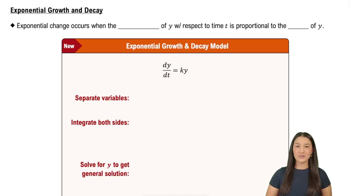
Exponential decay describes processes where a quantity decreases by a fixed percentage over equal time intervals. In this problem, the number of disease cases reduces by 25% each year, meaning the remaining cases are 75% of the previous year’s count. This concept helps model how the disease incidence changes over time.
Video consigliato:
09:29
Exponential Growth & Decay

Decay Rate and Decay Factor

The decay rate is the percentage decrease per time period, here 25%, and the decay factor is the multiplier applied each period, here 0.75. Understanding these allows us to write the number of cases after t years as an initial amount multiplied by the decay factor raised to t, forming the basis for calculating when cases fall below a threshold.
Video consigliato:
09:29
Exponential Growth & Decay

Solving Inequalities with Logarithms

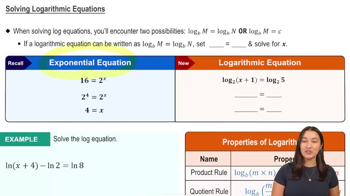
To find the time when cases drop below 1, we set up an inequality involving an exponential expression. Taking logarithms on both sides allows us to solve for the variable t, representing time. This technique is essential for determining the exact duration needed for eradication in exponential decay problems.
Video consigliato:
5:02
Solving Logarithmic Equations