Ch. 7 - Transcendental Functions
Hass - Thomas' Calculus 15th Edition
Hass15th EditionThomas' CalculusISBN: 9780137616077Non è quello che usi tu?Cambia libro di testo
Capitolo 7, Problema 7.5.80b

80. Find all values of c that satisfy the conclusion of Cauchy's Mean Value Theorem for the given functions and interval.
b. f(x) = x, g(x) = x², (a, b) arbitrary

Guida verificata passo dopo passo
1
Recall the statement of Cauchy's Mean Value Theorem: If functions \(f\) and \(g\) are continuous on \([a, b]\) and differentiable on \((a, b)\), then there exists at least one \(c \in (a, b)\) such that \[\frac{f'(c)}{g'(c)} = \frac{f(b) - f(a)}{g(b) - g(a)}.\]
Identify the given functions and compute their derivatives: \[f(x) = x \implies f'(x) = 1,\] \[g(x) = x^2 \implies g'(x) = 2x.\]
Write the equation from Cauchy's Mean Value Theorem using the derivatives and the function values at \(a\) and \(b\): \[\frac{f'(c)}{g'(c)} = \frac{f(b) - f(a)}{g(b) - g(a)} \implies \frac{1}{2c} = \frac{b - a}{b^2 - a^2}.\]
Simplify the right-hand side by factoring the denominator: \[b^2 - a^2 = (b - a)(b + a),\] so the equation becomes \[\frac{1}{2c} = \frac{b - a}{(b - a)(b + a)} = \frac{1}{b + a}.\]
Solve for \(c\) by cross-multiplying: \[\frac{1}{2c} = \frac{1}{b + a} \implies 2c = b + a \implies c = \frac{b + a}{2}.\]

Risposta video verificata per un problema simile:

Questa soluzione video è stata consigliata dai nostri tutor come utile per risolvere questo problema.
Durata del video:
8m

Concetti chiave

Ecco i concetti essenziali che devi comprendere per rispondere correttamente alla domanda.

Cauchy's Mean Value Theorem

Cauchy's Mean Value Theorem generalizes the Mean Value Theorem by relating two functions f and g that are continuous on [a, b] and differentiable on (a, b). It guarantees the existence of a point c in (a, b) where the ratio of their derivatives equals the ratio of their increments: (f(b)-f(a))/(g(b)-g(a)) = f'(c)/g'(c).
Video consigliato:
Percorso guidato
06:11
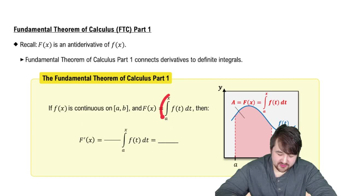
Fundamental Theorem of Calculus Part 1

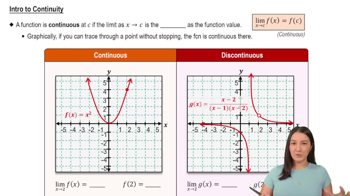
Differentiability and Continuity of Functions

For Cauchy's Mean Value Theorem to apply, both functions must be continuous on the closed interval [a, b] and differentiable on the open interval (a, b). This ensures the derivatives exist and the theorem's conclusion about the existence of c is valid.
Video consigliato:
05:34
Intro to Continuity

Application to Specific Functions f(x) = x and g(x) = x²

Applying the theorem to f(x) = x and g(x) = x² involves computing f'(x) = 1 and g'(x) = 2x, then solving (f(b)-f(a))/(g(b)-g(a)) = f'(c)/g'(c) for c in (a, b). This step requires algebraic manipulation to find the specific value(s) of c that satisfy the theorem.
Video consigliato:
04:56
Derivative of the Natural Exponential Function (e^x)