Ch. 7 - Transcendental Functions
Hass - Thomas' Calculus 15th Edition
Hass15th EditionThomas' CalculusISBN: 9780137616077Non è quello che usi tu?Cambia libro di testo
Capitolo 7, Problema 7.1.70b

In Exercises 67–72, you will explore some functions and their inverses together with their derivatives and tangent line approximations at specified points. Perform the following steps using your CAS:


b. Solve the equation y=f(x) for x as a function of y, and name the resulting inverse function g.


70. y= x³/(x²+1), -1 ≤ x ≤ 1, x_0=1/2

Guida verificata passo dopo passo
1
Start with the given function: \(y = \frac{x^{3}}{x^{2} + 1}\), where \(-1 \leq x \leq 1\).
To find the inverse function \(g(y)\), we need to solve the equation \(y = \frac{x^{3}}{x^{2} + 1}\) for \(x\) in terms of \(y\).
Multiply both sides of the equation by \((x^{2} + 1)\) to clear the denominator: \(y(x^{2} + 1) = x^{3}\).
Rewrite this as a polynomial equation in \(x\): \(x^{3} - y x^{2} - y = 0\).
Solve this cubic equation for \(x\) as a function of \(y\). The solution(s) will define the inverse function(s) \(g(y)\). Since the original function is restricted to \(-1 \leq x \leq 1\), select the root that lies within this domain to define the inverse.

Risposta video verificata per un problema simile:

Questa soluzione video è stata consigliata dai nostri tutor come utile per risolvere questo problema.
Durata del video:
7m

Concetti chiave

Ecco i concetti essenziali che devi comprendere per rispondere correttamente alla domanda.

Inverse Functions

An inverse function reverses the effect of the original function, swapping inputs and outputs. For a function f(x), its inverse g(y) satisfies g(f(x)) = x. Finding the inverse involves solving y = f(x) for x in terms of y, which may require algebraic manipulation and domain restrictions to ensure the inverse is well-defined.
Video consigliato:
4:49
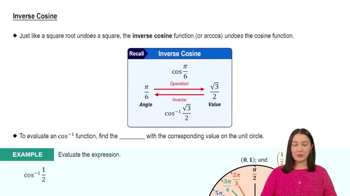
Inverse Cosine

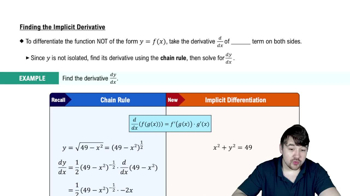
Implicit Differentiation and Derivatives of Inverse Functions

When the inverse function is not given explicitly, implicit differentiation helps find its derivative. The derivative of the inverse at a point is the reciprocal of the derivative of the original function at the corresponding point, i.e., g'(y) = 1 / f'(x). This relationship is crucial for understanding tangent lines and rates of change of inverse functions.
Video consigliato:
Percorso guidato
05:14
Finding The Implicit Derivative

Tangent Line Approximation

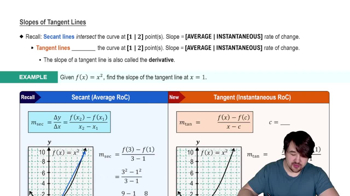
Tangent line approximation uses the derivative at a point to approximate the function near that point with a linear function. For a function f at x₀, the tangent line is y = f(x₀) + f'(x₀)(x - x₀). This concept extends to inverse functions, allowing approximation of g(y) near y₀ using the derivative of g.
Video consigliato:
Percorso guidato
05:13
Slopes of Tangent Lines