Ch. 7 - Transcendental Functions
Hass - Thomas' Calculus 15th Edition
Hass15th EditionThomas' CalculusISBN: 9780137616077Non è quello che usi tu?Cambia libro di testo
Capitolo 7, Problema 7.PE.31

Evaluate the integrals in Exercises 31–78.
31. ∫e^x sin(e^x)dx

Guida verificata passo dopo passo
1
Recognize that the integral is of the form \(\int e^x \sin(e^x) \, dx\), where the argument of the sine function is \(e^x\) and the outside factor is also \(e^x\).
Use substitution by letting \(u = e^x\). Then, compute the differential \(du = e^x \, dx\), which implies \(dx = \frac{du}{e^x} = \frac{du}{u}\).
Rewrite the integral in terms of \(u\): since \(e^x \, dx = du\), the integral becomes \(\int \sin(u) \, du\).
Integrate \(\sin(u)\) with respect to \(u\), which is \(-\cos(u) + C\).
Substitute back \(u = e^x\) to express the answer in terms of \(x\): the integral is \(-\cos(e^x) + C\).

Risposta video verificata per un problema simile:

Questa soluzione video è stata consigliata dai nostri tutor come utile per risolvere questo problema.
Durata del video:
1m

Concetti chiave

Ecco i concetti essenziali che devi comprendere per rispondere correttamente alla domanda.

Integration by Substitution

Integration by substitution is a method used to simplify integrals by changing variables. It involves identifying a part of the integrand as a new variable, which transforms the integral into a simpler form. This technique is especially useful when the integral contains a composite function.
Video consigliato:
04:27
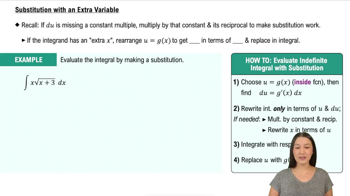
Substitution With an Extra Variable

Chain Rule in Reverse (u-substitution)

The chain rule in differentiation helps find derivatives of composite functions. Integration by substitution is essentially the reverse process, where you recognize the inner function and its derivative within the integral. This allows rewriting the integral in terms of a single variable, facilitating easier integration.
Video consigliato:
05:02
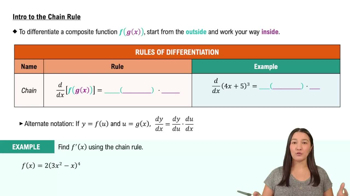
Intro to the Chain Rule

Integration of Trigonometric Functions

Integrating trigonometric functions like sine and cosine often requires recognizing standard integral forms or applying substitution. Understanding how to integrate functions involving sine or cosine, especially when combined with other functions, is crucial for solving integrals like ∫e^x sin(e^x) dx.
Video consigliato:
Percorso guidato
6:04
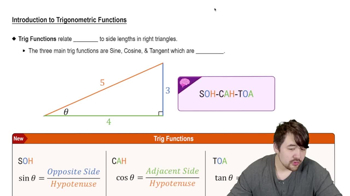
Introduction to Trigonometric Functions