Ch. 7 - Transcendental Functions
Hass - Thomas' Calculus 15th Edition
Hass15th EditionThomas' CalculusISBN: 9780137616077Non è quello che usi tu?Cambia libro di testo
Capitolo 7, Problema 7.6.9

Find the values in Exercises 9–12.
9. sin(arccos((√2)/2))

Guida verificata passo dopo passo
1
Recognize that the expression involves a composition of trigonometric functions: \( \sin(\arccos(x)) \). Here, \( x = \frac{\sqrt{2}}{2} \).
Recall the definition of \( \arccos(x) \): it is the angle \( \theta \) such that \( \cos(\theta) = x \) and \( \theta \) lies in the range \( [0, \pi] \). So, \( \arccos\left(\frac{\sqrt{2}}{2}\right) = \theta \) where \( \cos(\theta) = \frac{\sqrt{2}}{2} \).
Use the Pythagorean identity for sine and cosine: \( \sin^2(\theta) + \cos^2(\theta) = 1 \). Since \( \cos(\theta) = \frac{\sqrt{2}}{2} \), substitute this value to find \( \sin(\theta) \).
Calculate \( \sin(\theta) = \sqrt{1 - \cos^2(\theta)} = \sqrt{1 - \left(\frac{\sqrt{2}}{2}\right)^2} \).
Determine the sign of \( \sin(\theta) \) based on the range of \( \theta = \arccos\left(\frac{\sqrt{2}}{2}\right) \), which lies between 0 and \( \pi \), where sine is non-negative.

Risposta video verificata per un problema simile:

Questa soluzione video è stata consigliata dai nostri tutor come utile per risolvere questo problema.
Durata del video:
2m

Concetti chiave

Ecco i concetti essenziali che devi comprendere per rispondere correttamente alla domanda.

Inverse Trigonometric Functions

Inverse trigonometric functions, like arccos, return the angle whose trigonometric function equals a given value. For example, arccos(x) gives the angle θ such that cos(θ) = x, typically within the range [0, π]. Understanding these functions helps in converting values back to angles.
Video consigliato:
06:35
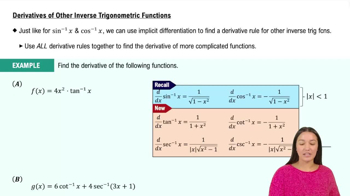
Derivatives of Other Inverse Trigonometric Functions

Trigonometric Identities

Trigonometric identities relate the sine, cosine, and other trig functions of angles. The Pythagorean identity, sin²θ + cos²θ = 1, is especially useful for finding one function value when the other is known, enabling the evaluation of expressions like sin(arccos(x)).
Video consigliato:
7:17
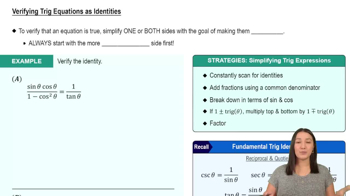
Verifying Trig Equations as Identities

Evaluating Composite Trigonometric Expressions

Evaluating expressions like sin(arccos(x)) involves interpreting the inner function as an angle and then applying trig identities or geometric reasoning to find the outer function's value. This often requires understanding the domain and range of the inverse function and the sign of the resulting sine value.
Video consigliato:
3:48
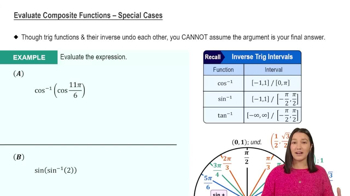
Evaluate Composite Functions - Special Cases