Ch. 7 - Transcendental Functions
Hass - Thomas' Calculus 15th Edition
Hass15th EditionThomas' CalculusISBN: 9780137616077Non è quello che usi tu?Cambia libro di testo
Capitolo 7, Problema 7.6.135a

Find the volumes of the solids in Exercises 135 and 136.
135. The solid lies between planes perpendicular to the x-axis at x=-1 and x=1. The cross-sections perpendicular to the x-axis are
a. circles whose diameters stretch from the curve y=-1/√(1+x²) to the curve y=1/√(1+x²).

Guida verificata passo dopo passo
1
Identify the interval over which the solid extends along the x-axis, which is from \(x = -1\) to \(x = 1\).
Determine the length of the diameter of each circular cross-section at a given \(x\). The diameter stretches from \(y = -\frac{1}{\sqrt{1+x^2}}\) to \(y = \frac{1}{\sqrt{1+x^2}}\), so the diameter length is the difference between these two values.
Calculate the diameter length as \(D(x) = \frac{1}{\sqrt{1+x^2}} - \left(-\frac{1}{\sqrt{1+x^2}}\right) = \frac{2}{\sqrt{1+x^2}}\).
Find the radius of the circular cross-section as half the diameter: \(r(x) = \frac{D(x)}{2} = \frac{1}{\sqrt{1+x^2}}\).
Write the formula for the volume of the solid using the integral of the cross-sectional area: \(V = \int_{-1}^{1} \pi [r(x)]^2 \, dx = \int_{-1}^{1} \pi \left(\frac{1}{\sqrt{1+x^2}}\right)^2 \, dx\).

Risposta video verificata per un problema simile:

Questa soluzione video è stata consigliata dai nostri tutor come utile per risolvere questo problema.
Durata del video:
9m

Concetti chiave

Ecco i concetti essenziali che devi comprendere per rispondere correttamente alla domanda.

Volume of a Solid with Known Cross-Sections

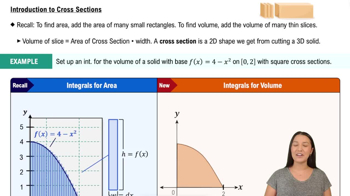
To find the volume of a solid with cross-sections perpendicular to an axis, integrate the area of each cross-section along that axis. The volume V is given by V = ∫ A(x) dx, where A(x) is the area of the cross-section at position x. This method applies when the shape of the cross-section is known as a function of x.
Video consigliato:
05:38
Introduction to Cross Sections

Area of a Circle from Diameter

The area of a circle is A = πr², where r is the radius. If the diameter d is known, the radius is r = d/2, so the area becomes A = π(d/2)² = (π/4)d². In this problem, the diameter is the vertical distance between two curves, which varies with x.
Video consigliato:
05:06
Finding Area When Bounds Are Not Given

Using Curves to Determine Cross-Section Dimensions

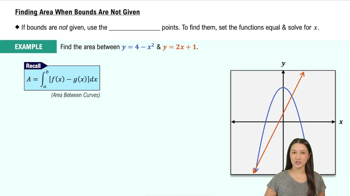
The diameter of each circular cross-section is the distance between two curves y = f(x) and y = g(x). This distance is |f(x) - g(x)|. Here, the curves y = 1/√(1+x²) and y = -1/√(1+x²) define the endpoints of the diameter, so the diameter is the vertical distance between these two functions at each x.
Video consigliato:
05:38
Introduction to Cross Sections