
Domanda del libro di testo
Solve the initial value problems in Exercises 55–58.
57. d²y/dx² = 2e^(−x),y(0) = 1,y′(0) = 0
20
views

 Guida verificata passo dopo passo
 06:30
06:30
 05:36
05:36 05:18
05:18Solve the initial value problems in Exercises 55–58.
57. d²y/dx² = 2e^(−x),y(0) = 1,y′(0) = 0
Since the hyperbolic functions can be expressed in terms of exponential functions, it is possible to express the inverse hyperbolic functions in terms of logarithms, as shown in the following table.
sinh⁻¹x = ln(x + √(x² + 1)), -∞ < x < ∞
cosh⁻¹x = ln(x + √(x² - 1)), x ≥ 1
tanh⁻¹x = (1/2)ln((1+x)/(1-x)), |x| < 1
sech⁻¹x = ln((1+√(1-x²))/x), 0 < x ≤ 1
csch⁻¹x = ln(1/x + √(1+x²)/|x|), x ≠ 1
coth⁻¹x = (1/2)ln((x+1)/(x-1)), |x| > 1
Use these formulas to express the numbers in Exercises 61–66 in terms of natural logarithms.
63. tanh⁻¹(-1/2)
130. Use the identity arccot(u)=π/2 - arctan(u) to derive the formula for the derivative of arccot(u) in Table 7.4 from the formula for the derivative of arctan(u).
In Exercises 25–36, find the derivative of y with respect to the appropriate variable.
31. y = cos⁻¹(x) - x sech⁻¹(x)
Evaluate the integrals in Exercises 91–102.
102. ∫(from -1/3 to 1/√3)(cos(arctan 3x))/(1+9x²) dx
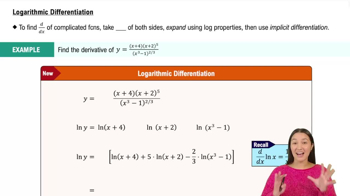
In Exercises 57–70, use logarithmic differentiation to find the derivative of y with respect to the given independent variable.
66. y = θsin(θ)/√(sec(θ))