Ch. 7 - Transcendental Functions
Hass - Thomas' Calculus 15th Edition
Hass15th EditionThomas' CalculusISBN: 9780137616077Non è quello che usi tu?Cambia libro di testo
Capitolo 7, Problema 7.7.63

Since the hyperbolic functions can be expressed in terms of exponential functions, it is possible to express the inverse hyperbolic functions in terms of logarithms, as shown in the following table.
sinh⁻¹x = ln(x + √(x² + 1)), -∞ < x < ∞
cosh⁻¹x = ln(x + √(x² - 1)), x ≥ 1
tanh⁻¹x = (1/2)ln((1+x)/(1-x)), |x| < 1
sech⁻¹x = ln((1+√(1-x²))/x), 0 < x ≤ 1
csch⁻¹x = ln(1/x + √(1+x²)/|x|), x ≠ 1
coth⁻¹x = (1/2)ln((x+1)/(x-1)), |x| > 1
Use these formulas to express the numbers in Exercises 61–66 in terms of natural logarithms.
63. tanh⁻¹(-1/2)

Guida verificata passo dopo passo
1
Identify the formula for the inverse hyperbolic tangent function given in the problem: \(\tanh^{-1} x = \frac{1}{2} \ln \left( \frac{1+x}{1-x} \right)\), valid for \(|x| < 1\).
Substitute the given value \(x = -\frac{1}{2}\) into the formula: \(\tanh^{-1} \left(-\frac{1}{2}\right) = \frac{1}{2} \ln \left( \frac{1 + (-\frac{1}{2})}{1 - (-\frac{1}{2})} \right)\).
Simplify the numerator and denominator inside the logarithm: numerator becomes \(1 - \frac{1}{2}\) and denominator becomes \(1 + \frac{1}{2}\).
Rewrite the expression inside the logarithm as a single fraction: \(\frac{1 - \frac{1}{2}}{1 + \frac{1}{2}}\).
Express the entire result as \(\tanh^{-1} \left(-\frac{1}{2}\right) = \frac{1}{2} \ln \left( \text{simplified fraction} \right)\), completing the expression in terms of natural logarithms.

Risposta video verificata per un problema simile:

Questa soluzione video è stata consigliata dai nostri tutor come utile per risolvere questo problema.
Durata del video:
2m

Concetti chiave

Ecco i concetti essenziali che devi comprendere per rispondere correttamente alla domanda.

Inverse Hyperbolic Functions

Inverse hyperbolic functions, such as sinh⁻¹, cosh⁻¹, and tanh⁻¹, are the inverses of hyperbolic functions. They return the value whose hyperbolic function equals a given number. Understanding their domain and range is essential for correctly applying their logarithmic expressions.
Video consigliato:
4:49
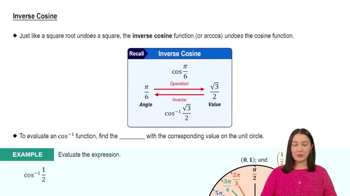
Inverse Cosine

Logarithmic Expressions of Inverse Hyperbolic Functions

Inverse hyperbolic functions can be expressed using natural logarithms, which simplifies evaluation and analysis. For example, tanh⁻¹x = (1/2)ln((1+x)/(1−x)) for |x| < 1. This relationship leverages properties of exponentials and logarithms to rewrite inverse hyperbolic functions in a more manageable form.
Video consigliato:
5:26
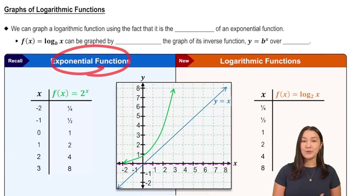
Graphs of Logarithmic Functions

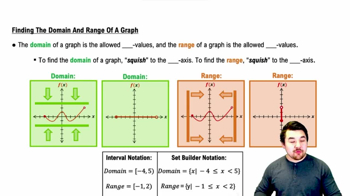
Domain Restrictions and Validity

Each inverse hyperbolic function has specific domain restrictions to ensure the logarithmic expressions are valid and real-valued. For tanh⁻¹x, the domain is |x| < 1, which must be checked before substitution to avoid undefined or complex results.
Video consigliato:
Percorso guidato
5:10
Finding the Domain and Range of a Graph