Ch. 7 - Transcendental Functions
Hass - Thomas' Calculus 15th Edition
Hass15th EditionThomas' CalculusISBN: 9780137616077Non è quello che usi tu?Cambia libro di testo
Capitolo 7, Problema 7.1.42a

In Exercises 41–44:
a. Find f⁻¹(x).


42. f(x) = (x + 2) / (1 − x), a = 1/2

Guida verificata passo dopo passo
1
Start by writing the function as an equation with y: \(y = \frac{x + 2}{1 - x}\).
To find the inverse function \(f^{-1}(x)\), swap the roles of \(x\) and \(y\): \(x = \frac{y + 2}{1 - y}\).
Multiply both sides of the equation by the denominator \((1 - y)\) to eliminate the fraction: \(x(1 - y) = y + 2\).
Distribute \(x\) on the left side: $x - xy = y + 2$.
Group all terms involving \(y\) on one side and constants on the other: $x - 2 = y + xy$. Then factor \(y\) out: \(x - 2 = y(1 + x)\). Finally, solve for \(y\): \(y = \frac{x - 2}{1 + x}\), which is \(f^{-1}(x)\).

Risposta video verificata per un problema simile:

Questa soluzione video è stata consigliata dai nostri tutor come utile per risolvere questo problema.
Durata del video:
1m

Concetti chiave

Ecco i concetti essenziali che devi comprendere per rispondere correttamente alla domanda.

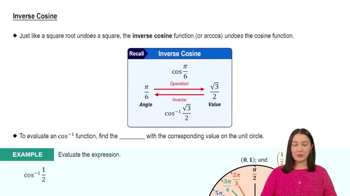
Inverse Functions

An inverse function reverses the effect of the original function, swapping inputs and outputs. To find f⁻¹(x), solve the equation y = f(x) for x in terms of y, then interchange x and y. The inverse exists only if the function is one-to-one (bijective) on the domain considered.
Video consigliato:
4:49
Inverse Cosine

Solving Rational Equations

Finding the inverse of a rational function often requires solving equations involving fractions. This involves clearing denominators, isolating variables, and simplifying expressions carefully to avoid extraneous solutions or domain issues.
Video consigliato:
5:02
Solving Logarithmic Equations

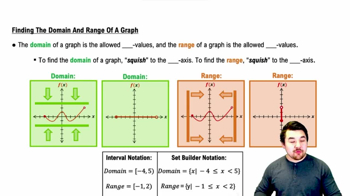
Domain and Range Considerations

When finding inverses, it is crucial to consider the domain of the original function and the range of the inverse. Restrictions on x (like denominators not being zero) affect the domain, and the inverse’s domain corresponds to the original function’s range.
Video consigliato:
Percorso guidato
5:10
Finding the Domain and Range of a Graph