Ch. 7 - Transcendental Functions
Hass - Thomas' Calculus 15th Edition
Hass15th EditionThomas' CalculusISBN: 9780137616077Non è quello che usi tu?Cambia libro di testo
Capitolo 7, Problema 7.1.41a

In Exercises 41–44:
a. Find f⁻¹(x).


41. f(x) = 2x + 3, a = −1

Guida verificata passo dopo passo
1
Start with the given function: \(f(x) = 2x + 3\).
To find the inverse function \(f^{-1}(x)\), replace \(f(x)\) with \(y\): \(y = 2x + 3\).
Swap the variables \(x\) and \(y\) to get \(x = 2y + 3\); this step reflects the idea that the inverse function reverses the roles of inputs and outputs.
Solve the equation \(x = 2y + 3\) for \(y\): subtract 3 from both sides to get \(x - 3 = 2y\), then divide both sides by 2 to isolate \(y\): \(y = \frac{x - 3}{2}\).
Rewrite \(y\) as \(f^{-1}(x)\) to express the inverse function: \(f^{-1}(x) = \frac{x - 3}{2}\).

Risposta video verificata per un problema simile:

Questa soluzione video è stata consigliata dai nostri tutor come utile per risolvere questo problema.
Durata del video:
56s

Concetti chiave

Ecco i concetti essenziali che devi comprendere per rispondere correttamente alla domanda.

Inverse Functions

An inverse function reverses the effect of the original function, swapping inputs and outputs. For a function f(x), its inverse f⁻¹(x) satisfies f(f⁻¹(x)) = x. Finding the inverse involves solving the equation y = f(x) for x in terms of y.
Video consigliato:
4:49
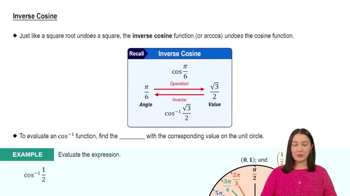
Inverse Cosine

Solving Linear Equations

To find the inverse of a linear function like f(x) = 2x + 3, you solve for x by isolating it on one side of the equation. This involves algebraic manipulation such as subtracting constants and dividing by coefficients to express x as a function of y.
Video consigliato:

Domain and Range Considerations

When finding an inverse, it's important to consider the domain and range of the original function and its inverse. For linear functions, the domain and range are typically all real numbers, but specifying points like a = -1 helps evaluate the inverse at particular values.
Video consigliato:
Percorso guidato
5:10
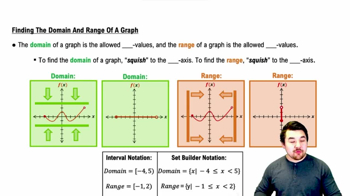
Finding the Domain and Range of a Graph