Ch. 7 - Transcendental Functions
Hass - Thomas' Calculus 15th Edition
Hass15th EditionThomas' CalculusISBN: 9780137616077Non è quello che usi tu?Cambia libro di testo
Capitolo 7, Problema 7.4.17

Solve the differential equation in Exercises 9–22.
17. (dy/dx) = 2x(y - 1), y > 1

Guida verificata passo dopo passo
1
Recognize that the given differential equation \( \frac{dy}{dx} = 2x(y - 1) \) is separable because the right-hand side can be expressed as a product of a function of \( x \) and a function of \( y \).
Rewrite the equation to separate variables: divide both sides by \( y - 1 \) and multiply both sides by \( dx \) to get \( \frac{1}{y - 1} dy = 2x \, dx \).
Integrate both sides: integrate \( \int \frac{1}{y - 1} dy \) on the left and \( \int 2x \, dx \) on the right.
After integration, express the result as \( \ln|y - 1| = x^2 + C \), where \( C \) is the constant of integration.
Since the problem states \( y > 1 \), you can drop the absolute value and solve for \( y \) by exponentiating both sides to get \( y - 1 = e^{x^2 + C} \), then rewrite as \( y = 1 + Ce^{x^2} \) where \( C = e^C \) is a new constant.

Risposta video verificata per un problema simile:

Questa soluzione video è stata consigliata dai nostri tutor come utile per risolvere questo problema.
Durata del video:
3m

Concetti chiave

Ecco i concetti essenziali che devi comprendere per rispondere correttamente alla domanda.

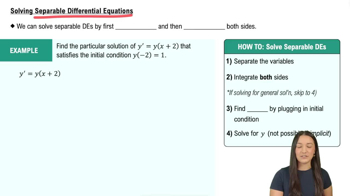
Separable Differential Equations

A separable differential equation can be written as a product of a function of x and a function of y, allowing variables to be separated on opposite sides of the equation. This enables integration with respect to each variable independently to find the solution.
Video consigliato:
06:06
Solving Separable Differential Equations

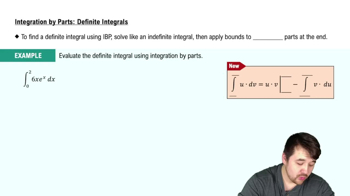
Integration Techniques

Solving separable equations requires integrating both sides after separation. Familiarity with basic integration rules and methods, such as substitution or recognizing standard integral forms, is essential to find the explicit solution.
Video consigliato:
Percorso guidato
06:18
Integration by Parts for Definite Integrals

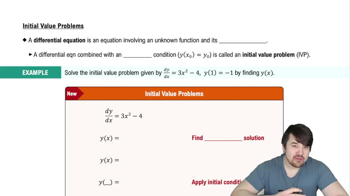
Initial Conditions and Domain Restrictions

The problem specifies y > 1, which restricts the solution domain. Understanding how initial conditions or domain constraints affect the solution ensures the correct branch of the solution is chosen and the solution is valid within the given context.
Video consigliato:
Percorso guidato
05:03
Initial Value Problems