Ch. 7 - Transcendental Functions
Hass - Thomas' Calculus 15th Edition
Hass15th EditionThomas' CalculusISBN: 9780137616077Non è quello che usi tu?Cambia libro di testo
Capitolo 7, Problema 7.4.44

44. Silver cooling in air The temperature of an ingot of silver is 60°C above room temperature right now. Twenty minutes ago, it was 70°C above room temperature. How far above room temperature will the silver be
b. 2 hours from now?

Guida verificata passo dopo passo
1
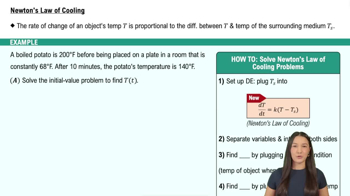
Identify the problem as an application of Newton's Law of Cooling, which states that the rate of change of temperature of an object is proportional to the difference between its temperature and the ambient temperature (room temperature in this case). The formula is: \[\frac{dT}{dt} = -k (T - T_{room})\] where \(T\) is the temperature of the object, \(T_{room}\) is the room temperature, and \(k\) is a positive constant.
Express the temperature difference from room temperature as a function of time: let \[y(t) = T(t) - T_{room}\]. Then Newton's Law of Cooling simplifies to \[\frac{dy}{dt} = -k y\], which is a first-order linear differential equation.
Solve the differential equation to get the general solution: \[y(t) = y_0 e^{-k t}\], where \(y_0\) is the initial temperature difference at time \(t=0\). Here, you need to define your time reference point carefully. For example, let \(t=0\) be the current time, so \(y(0) = 60\)°C.
Use the information from 20 minutes ago to find the constant \(k\). Since 20 minutes ago corresponds to $t = -20\( minutes, and the temperature difference then was 70°C, set up the equation: \[y(-20) = 70 = 60 e^{20 k}\]. Solve this equation for \)k$.
Once $k\( is found, use the formula \[y(t) = 60 e^{-k t}\] to find the temperature difference 2 hours (120 minutes) from now by substituting \)t = 120$. This will give the temperature difference above room temperature at that time.

Risposta video verificata per un problema simile:

Questa soluzione video è stata consigliata dai nostri tutor come utile per risolvere questo problema.
Durata del video:
7m

Concetti chiave

Ecco i concetti essenziali che devi comprendere per rispondere correttamente alla domanda.

Newton's Law of Cooling

Newton's Law of Cooling describes how the temperature of an object changes over time as it approaches the ambient temperature. It states that the rate of temperature change is proportional to the difference between the object's temperature and the surrounding temperature.
Video consigliato:
10:44
Newton's Law of Cooling

Exponential Decay Model

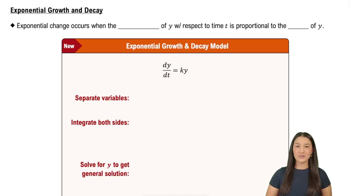
The temperature difference between the object and the environment decreases exponentially over time. This model uses an exponential function to represent how the temperature approaches room temperature, typically expressed as T(t) = T_env + (T_initial - T_env) * e^(-kt).
Video consigliato:
09:29
Exponential Growth & Decay

Determining the Cooling Constant

The cooling constant (k) quantifies how quickly the object cools and can be found using known temperature values at specific times. By substituting given temperatures and times into the exponential decay formula, k can be solved, enabling prediction of future temperatures.
Video consigliato:
10:44
Newton's Law of Cooling