Ch. 7 - Transcendental Functions
Hass - Thomas' Calculus 15th Edition
Hass15th EditionThomas' CalculusISBN: 9780137616077Non è quello che usi tu?Cambia libro di testo
Capitolo 7, Problema 7.6.5c

Use reference triangles in an appropriate quadrant to find the angles in Exercises 1–8.
5. c. arccos(√3/2)

Guida verificata passo dopo passo
1
Recall that the function arccos(x) gives the angle \( \theta \) whose cosine is \( x \), and its principal value range is \( 0 \leq \theta \leq \pi \) (or 0 to 180 degrees).
Identify the value inside the arccos function: \( \sqrt{3}/2 \). Recognize this as a common cosine value from special angles in the unit circle.
Recall the reference triangle or unit circle values where \( \cos \theta = \sqrt{3}/2 \). This corresponds to an angle of \( \pi/6 \) radians (or 30 degrees) in the first quadrant.
Since arccos returns values in the range \( [0, \pi] \), consider the angle in the first quadrant where cosine is positive, which is \( \theta = \pi/6 \).
Conclude that \( \arccos(\sqrt{3}/2) = \pi/6 \) radians, based on the reference triangle and the principal value range of arccos.

Risposta video verificata per un problema simile:

Questa soluzione video è stata consigliata dai nostri tutor come utile per risolvere questo problema.
Durata del video:
2m

Concetti chiave

Ecco i concetti essenziali che devi comprendere per rispondere correttamente alla domanda.

Inverse Trigonometric Functions

Inverse trigonometric functions, like arccos, return the angle whose trigonometric ratio matches a given value. For arccos(x), the output is the angle in [0, π] whose cosine is x. Understanding their domain and range is essential for correctly interpreting the angle values.
Video consigliato:
06:35
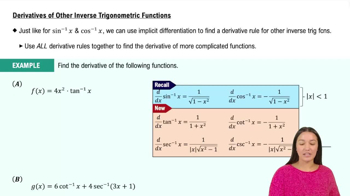
Derivatives of Other Inverse Trigonometric Functions

Reference Triangles

Reference triangles are right triangles used to relate trigonometric ratios to specific angles in different quadrants. By using known side ratios, they help find angles corresponding to given trigonometric values, especially when dealing with angles beyond the first quadrant.
Video consigliato:
Percorso guidato
6:04
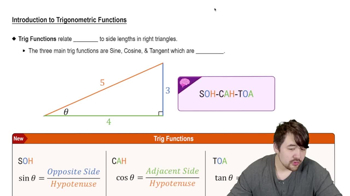
Introduction to Trigonometric Functions

Quadrants and Angle Significance

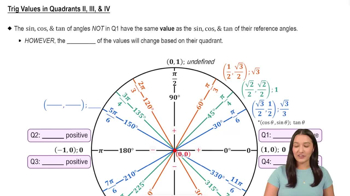
The unit circle is divided into four quadrants, each with specific signs for sine, cosine, and tangent. Knowing which quadrant an angle lies in helps determine the correct angle measure from an inverse trig value, especially when multiple angles share the same cosine value.
Video consigliato:
5:30
Trig Values in Quadrants II, III, & IV