Ch. 8 - Techniques of Integration
Hass - Thomas' Calculus 15th Edition
Hass15th EditionThomas' CalculusISBN: 9780137616077Non è quello che usi tu?Cambia libro di testo
Capitolo 8, Problema 8.2.56

Evaluate the integrals in Exercises 31–56. Some integrals do not require integration by parts.
∫ (sin⁻¹ x)² / √(1 - x²) dx

Guida verificata passo dopo passo
1
Recognize that the integral is \( \int \frac{(\sin^{-1} x)^2}{\sqrt{1 - x^2}} \, dx \). Notice that the denominator \( \sqrt{1 - x^2} \) is related to the derivative of \( \sin^{-1} x \).
Make the substitution \( t = \sin^{-1} x \). Then, by definition, \( x = \sin t \) and \( dx = \cos t \, dt \). Also, \( \sqrt{1 - x^2} = \sqrt{1 - \sin^2 t} = \cos t \).
Rewrite the integral in terms of \( t \): replace \( (\sin^{-1} x)^2 \) with \( t^2 \), and \( \frac{1}{\sqrt{1 - x^2}} dx \) with \( \frac{1}{\cos t} \cdot \cos t \, dt = dt \). So the integral becomes \( \int t^2 \, dt \).
Integrate \( \int t^2 \, dt \) using the power rule for integration: \( \int t^n \, dt = \frac{t^{n+1}}{n+1} + C \). Here, \( n = 2 \), so the integral is \( \frac{t^3}{3} + C \).
Finally, substitute back \( t = \sin^{-1} x \) to express the answer in terms of \( x \): the integral is \( \frac{(\sin^{-1} x)^3}{3} + C \).

Risposta video verificata per un problema simile:

Questa soluzione video è stata consigliata dai nostri tutor come utile per risolvere questo problema.
Durata del video:
2m

Concetti chiave

Ecco i concetti essenziali che devi comprendere per rispondere correttamente alla domanda.

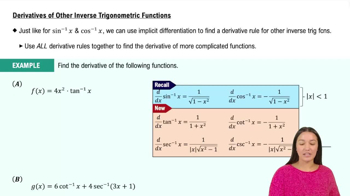
Inverse Trigonometric Functions

Inverse trigonometric functions, like sin⁻¹(x), are the inverses of the standard trig functions and return angles. Understanding their properties and derivatives is essential, especially since sin⁻¹(x) appears inside the integral and its derivative involves a square root expression.
Video consigliato:
06:35
Derivatives of Other Inverse Trigonometric Functions

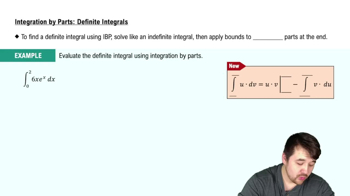
Integration by Parts

Integration by parts is a technique based on the product rule for differentiation, used to integrate products of functions. It is often applied when the integral involves a function multiplied by another function's derivative, such as (sin⁻¹ x)² combined with a function of x.
Video consigliato:
Percorso guidato
06:18
Integration by Parts for Definite Integrals

Substitution Method

The substitution method simplifies integrals by changing variables to transform the integral into a more manageable form. Recognizing when to use substitution, especially with expressions involving √(1 - x²), can simplify the integral or reduce it to a standard form.
Video consigliato:
07:33
Euler's Method