Ch. 8 - Techniques of Integration
Hass - Thomas' Calculus 15th Edition
Hass15th EditionThomas' CalculusISBN: 9780137616077Non è quello che usi tu?Cambia libro di testo
Capitolo 8, Problema 8.3.76

Volume: Find the volume of the solid formed by revolving the region bounded by the graphs of y = sin x + sec x, y = 0, x = 0, and x = π/3 about the x-axis.

Guida verificata passo dopo passo
1
Identify the region bounded by the curves: the upper curve is given by \(y = \sin x + \sec x\), the lower boundary is \(y = 0\), and the vertical boundaries are \(x = 0\) and \(x = \frac{\pi}{3}\).
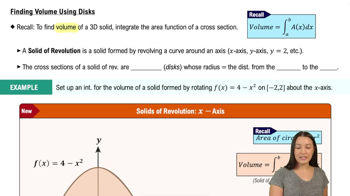
Since the solid is formed by revolving this region about the x-axis, use the disk method to find the volume. The volume element is a disk with radius equal to the function value \(y\) at each \(x\), so the volume is given by integrating the area of these disks along the x-axis.
Write the volume integral as \(V = \pi \int_{0}^{\frac{\pi}{3}} \left( \sin x + \sec x \right)^2 \, dx\), where the integrand is the square of the radius function.
Expand the integrand \(\left( \sin x + \sec x \right)^2\) to simplify the integral before integrating. This will give \(\sin^2 x + 2 \sin x \sec x + \sec^2 x\).
Set up the integral with the expanded terms and prepare to integrate each term separately over the interval \([0, \frac{\pi}{3}]\). Remember to use appropriate trigonometric identities and integration techniques for each term.

Risposta video verificata per un problema simile:

Questa soluzione video è stata consigliata dai nostri tutor come utile per risolvere questo problema.
Durata del video:
4m

Concetti chiave

Ecco i concetti essenziali che devi comprendere per rispondere correttamente alla domanda.

Volume of Solids of Revolution

This concept involves finding the volume of a 3D solid formed by rotating a 2D region around an axis. The volume can be computed using methods like the disk/washer or shell method, which integrate cross-sectional areas perpendicular to the axis of rotation.
Video consigliato:
04:48
Finding Volume Using Disks

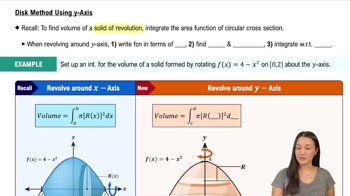
Disk Method

The disk method calculates volume by slicing the solid into thin disks perpendicular to the axis of rotation. Each disk's volume is approximated by π(radius)^2 times thickness, and integrating these volumes over the interval gives the total volume.
Video consigliato:
06:30
Disk Method Using y-Axis

Integration of Trigonometric and Secant Functions

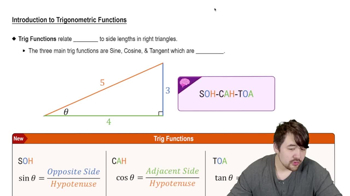
Evaluating the volume requires integrating expressions involving sin x and sec x. Understanding how to integrate these functions, either directly or using substitution and identities, is essential to solving the problem accurately.
Video consigliato:
Percorso guidato
6:04
Introduction to Trigonometric Functions