Ch. 8 - Techniques of Integration
Hass - Thomas' Calculus 15th Edition
Hass15th EditionThomas' CalculusISBN: 9780137616077Non è quello che usi tu?Cambia libro di testo
Capitolo 8, Problema 8.PE.34

Evaluate the integrals in Exercises 33–36.
∫ [1 / (x(9 - x²))] dx

Guida verificata passo dopo passo
1
Start by recognizing that the integral involves a rational function with a quadratic expression in the denominator: \(\int \frac{1}{x(9 - x^{2})} \, dx\).
Use partial fraction decomposition to rewrite the integrand. Express \(\frac{1}{x(9 - x^{2})}\) as \(\frac{A}{x} + \frac{Bx + C}{9 - x^{2}}\).
Multiply both sides by the common denominator \(x(9 - x^{2})\) to get an equation without denominators: \(1 = A(9 - x^{2}) + (Bx + C)x\).
Expand and group like terms by powers of \(x\): \(1 = 9A - A x^{2} + B x^{2} + C x\).
Equate coefficients of corresponding powers of \(x\) on both sides to form a system of equations for \(A\), \(B\), and \(C\). Then solve this system to find the values of \(A\), \(B\), and \(C\).

Risposta video verificata per un problema simile:

Questa soluzione video è stata consigliata dai nostri tutor come utile per risolvere questo problema.
Durata del video:
7m

Concetti chiave

Ecco i concetti essenziali che devi comprendere per rispondere correttamente alla domanda.

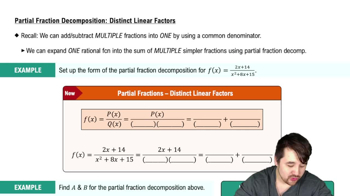
Partial Fraction Decomposition

Partial fraction decomposition is a technique used to break down complex rational functions into simpler fractions that are easier to integrate. It involves expressing the integrand as a sum of fractions with simpler denominators, often linear or quadratic, facilitating straightforward integration.
Video consigliato:
Percorso guidato
10:07
Partial Fraction Decomposition: Distinct Linear Factors

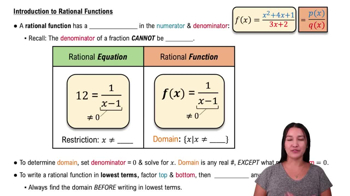
Integration of Rational Functions

Integrating rational functions often requires algebraic manipulation such as partial fractions or substitution. Recognizing the form of the integrand helps determine the appropriate method, enabling the evaluation of integrals involving polynomials in numerator and denominator.
Video consigliato:
6:04
Intro to Rational Functions

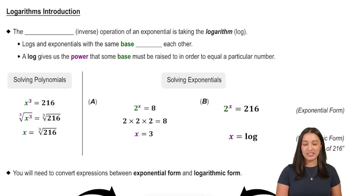
Logarithmic Integration

Logarithmic integration arises when integrating functions of the form 1/u, where u is a differentiable function of x. The integral results in a natural logarithm, ln|u| + C, which is common when integrating terms obtained after partial fraction decomposition.
Video consigliato:
7:30
Logarithms Introduction
Pratica correlata
Domanda del libro di testo

4. What substitutions are made to evaluate integrals of sin(mx)sin(nx), sin(mx)cos(nx), and cos(mx)cos(nx)? Give an example of each case.

17
views

Domanda del libro di testo

Finding volume: Find the volume of the solid generated by revolving the region in the first quadrant bounded by the coordinate axes, the curve y = e^(-x), and the line x = 1.

a. About the y-axis.

45
views
Domanda del libro di testo

Heat capacity of a gas

Heat capacity 

C_v

is the amount of heat required to raise the temperature of a given mass of gas with constant volume by 1°C, measured in units of cal/deg-mol (calories per degree gram molecular weight).

The heat capacity of oxygen depends on its temperature T and satisfies the formula

C_v = 8.27 + 10^(-5) * (26T − 1.87T²)

Use Simpson’s Rule to find the average value of C_v and the temperature at which it is attained for

20°C ≤ T ≤ 675°C.

20
views
Domanda del libro di testo

Evaluate the integrals in Exercises 29–32 (b) using a trigonometric substitution.

∫ [x / √(4 − x²)] dx

28
views
Domanda del libro di testo

Evaluate the integrals in Exercises 69–134. The integrals are listed in random order so you need to decide which integration technique to use.

∫ sinx·cos²x dx

22
views
Domanda del libro di testo

In Exercises 11–22, estimate the minimum number of subintervals needed to approximate the integrals with an error of magnitude less than 10^-4 by (a) the Trapezoidal Rule (The integrals in Exercises 11–18 are the integrals from Exercises 1–8.)

∫ from -2 to 0 of (x² - 1) dx

30
views