Ch. 8 - Techniques of Integration
Hass - Thomas' Calculus 15th Edition
Hass15th EditionThomas' CalculusISBN: 9780137616077Non è quello che usi tu?Cambia libro di testo
Capitolo 8, Problema 8.2.60a

Finding volume: Find the volume of the solid generated by revolving the region in the first quadrant bounded by the coordinate axes, the curve y = e^(-x), and the line x = 1.
a. About the y-axis.

Guida verificata passo dopo passo
1
Identify the region to be revolved: it is bounded by the x-axis (y=0), y-axis (x=0), the curve \(y = e^{-x}\), and the vertical line \(x = 1\) in the first quadrant.
Since the solid is generated by revolving the region about the y-axis, consider using the method of cylindrical shells. The formula for the volume using shells is \(V = \int_a^b 2\pi \cdot (\text{radius}) \cdot (\text{height}) \, dx\).
Determine the radius and height of a typical shell: the radius is the distance from the y-axis, which is \(x\), and the height is the value of the function \(y = e^{-x}\).
Set up the integral for the volume: \(V = \int_0^1 2\pi x e^{-x} \, dx\).
Evaluate the integral using integration by parts or an appropriate method to find the volume (do not compute the final value here).

Risposta video verificata per un problema simile:

Questa soluzione video è stata consigliata dai nostri tutor come utile per risolvere questo problema.
Durata del video:
10m

Concetti chiave

Ecco i concetti essenziali che devi comprendere per rispondere correttamente alla domanda.

Volume of Solids of Revolution

This concept involves finding the volume of a 3D solid formed by rotating a 2D region around an axis. The volume can be computed using integral methods such as the disk/washer or shell method, depending on the axis of rotation and the shape of the region.
Video consigliato:
04:48
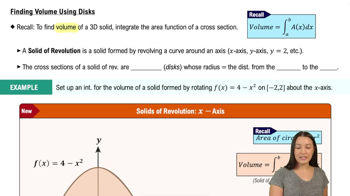
Finding Volume Using Disks

Shell Method

The shell method calculates volume by integrating cylindrical shells formed by revolving vertical slices around a vertical axis. It is especially useful when rotating around the y-axis and when the function is given in terms of x, simplifying the integral setup.
Video consigliato:
07:33
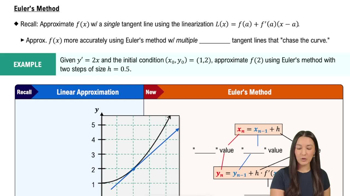
Euler's Method

Exponential Functions and Their Properties

Understanding the behavior of the function y = e^(-x) is crucial, as it defines the boundary of the region. Knowing its decay and how to integrate expressions involving e^(-x) helps in setting up and evaluating the integral for volume.
Video consigliato:
Percorso guidato
06:21
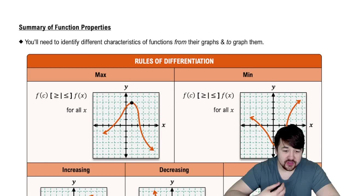
Properties of Functions