Ch. 8 - Techniques of Integration
Hass - Thomas' Calculus 15th Edition
Hass15th EditionThomas' CalculusISBN: 9780137616077Non è quello che usi tu?Cambia libro di testo
Capitolo 8, Problema 8.9.18

Find the value of the constant c so that the given function is a probability density function for a random variable X over the specified interval.
f(x) = (1/x) over [c, c + 1]

Guida verificata passo dopo passo
1
Recall that for a function \(f(x)\) to be a probability density function (pdf) over an interval \([a, b]\), it must satisfy the condition: \(\int_a^b f(x) \, dx = 1\).
In this problem, the function is \(f(x) = \frac{1}{x}\) defined over the interval \([c, c+1]\). We need to find the value of \(c\) such that \(\int_c^{c+1} \frac{1}{x} \, dx = 1\).
Set up the integral: \(\int_c^{c+1} \frac{1}{x} \, dx = \left[ \ln|x| \right]_c^{c+1} = \ln(c+1) - \ln(c)\).
Use the logarithm property to combine the difference: \(\ln(c+1) - \ln(c) = \ln\left( \frac{c+1}{c} \right)\).
Set the integral equal to 1 and solve for \(c\): \(\ln\left( \frac{c+1}{c} \right) = 1\). From here, exponentiate both sides to isolate \(c\) and solve the resulting equation.

Risposta video verificata per un problema simile:

Questa soluzione video è stata consigliata dai nostri tutor come utile per risolvere questo problema.
Durata del video:
6m

Concetti chiave

Ecco i concetti essenziali che devi comprendere per rispondere correttamente alla domanda.

Probability Density Function (PDF)

A probability density function describes the likelihood of a continuous random variable taking on a specific value. For a function to be a valid PDF, it must be non-negative over its domain and its total integral over the specified interval must equal 1.
Video consigliato:
Percorso guidato
06:21
Properties of Functions

Definite Integral and Area Under the Curve

The definite integral of a function over an interval represents the area under its curve between two points. In the context of PDFs, integrating the function over its domain must yield 1, ensuring the total probability sums to one.
Video consigliato:
Percorso guidato
05:43
Definition of the Definite Integral

Solving for Constants Using Integral Equations

When a function includes an unknown constant, we use integral equations to solve for it by setting the integral equal to 1 (for PDFs). This involves integrating the function with the constant over the interval and solving the resulting equation.
Video consigliato:
5:47
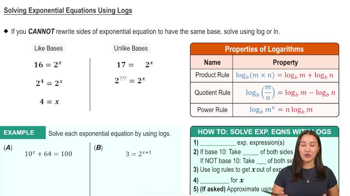
Solving Exponential Equations Using Logs