

Ch. 8 - Techniques of Integration
Hass - Thomas' Calculus 15th Edition
Hass15th EditionThomas' CalculusISBN: 9780137616077Non è quello che usi tu?Cambia libro di testo
Capitolo 8, Problema 8.2.58a

Finding area
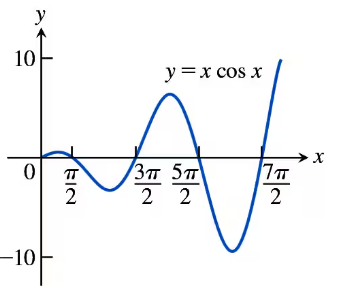
Find the area of the region enclosed by the curve y = x cos(x) and the x-axis (see the accompanying figure) for:
a. π/2 ≤ x ≤ 3π/2.
Graph of y = x cos x from 0 to 7π/2 showing oscillations crossing the x-axis between -10 and 10.

Guida verificata passo dopo passo
1
Identify the function and the interval: The function given is \(y = x \cos x\), and the interval is \(\frac{\pi}{2} \leq x \leq \frac{3\pi}{2}\).
Analyze the graph to determine where the function is above or below the x-axis in the given interval. From the graph, \(y = x \cos x\) is negative between \(\frac{\pi}{2}\) and \(\frac{3\pi}{2}\) because \(\cos x\) is negative in this interval and \(x\) is positive.
Since the function is below the x-axis in this interval, the area enclosed by the curve and the x-axis is the integral of the absolute value of the function. This means we need to integrate \(-x \cos x\) over \(\left[ \frac{\pi}{2}, \frac{3\pi}{2} \right]\).
Set up the integral for the area: \(\text{Area} = \int_{\frac{\pi}{2}}^{\frac{3\pi}{2}} -x \cos x \, dx\).
To solve the integral, use integration by parts where you let \(u = x\) and \(dv = \cos x \, dx\). Then compute $du = dx$ and \(v = \sin x\). Apply the integration by parts formula: \(\int u \, dv = uv - \int v \, du\).

Risposta video verificata per un problema simile:

Questa soluzione video è stata consigliata dai nostri tutor come utile per risolvere questo problema.
Durata del video:
5m

Concetti chiave

Ecco i concetti essenziali che devi comprendere per rispondere correttamente alla domanda.

Definite Integral for Area Calculation

The definite integral of a function over an interval gives the net area between the curve and the x-axis. When the function crosses the x-axis, the integral sums positive and negative areas, so the absolute value or splitting the integral is needed to find the total enclosed area.
Video consigliato:
Percorso guidato
05:43
Definition of the Definite Integral

Behavior of the Function y = x cos(x)

The function y = x cos(x) oscillates and crosses the x-axis at points where cos(x) = 0, such as x = π/2 and 3π/2. Understanding these zeros helps determine the limits for integration and whether the function is above or below the x-axis in the given interval.
Video consigliato:
03:39
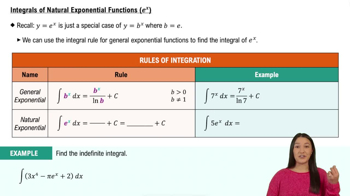
Integrals of Natural Exponential Functions (e^x)

Splitting the Integral at Zeros of the Function

To find the total area enclosed by the curve and the x-axis when the function changes sign, split the integral at the zeros of the function. Calculate the integral over each sub-interval and take the absolute value before summing to get the total area.
Video consigliato:
05:11
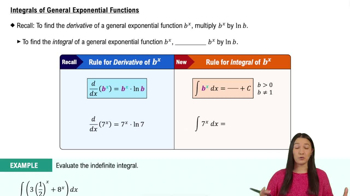
Integrals of General Exponential Functions
Pratica correlata
Domanda del libro di testo

In Exercises 11–22, estimate the minimum number of subintervals needed to approximate the integrals with an error of magnitude less than 10^-4 by (a) the Trapezoidal Rule (The integrals in Exercises 11–18 are the integrals from Exercises 1–8.)

∫ from 2 to 4 of 1/(s - 1)² ds

30
views
Domanda del libro di testo

Lifetime of a tire Assume the random variable L in Example 2f is normally distributed with mean μ = 22,000 miles and σ = 4,000 miles.

a. In a batch of 4000 tires, how many can be expected to last for at least 18,000 miles?

20
views
Domanda del libro di testo

In Exercises 11–22, estimate the minimum number of subintervals needed to approximate the integrals with an error of magnitude less than 10^-4 by (a) the Trapezoidal Rule (The integrals in Exercises 11–18 are the integrals from Exercises 1–8.)

∫ from 1 to 3 of (2x - 1) dx

27
views
Domanda del libro di testo

In Exercises 11–22, estimate the minimum number of subintervals needed to approximate the integrals with an error of magnitude less than 10^-4 by (a) the Trapezoidal Rule (The integrals in Exercises 11–18 are the integrals from Exercises 1–8.)

∫ from -1 to 1 of (t³ + 1) dt

30
views
Domanda del libro di testo

In Exercises 11–22, estimate the minimum number of subintervals needed to approximate the integrals with an error of magnitude less than 10^-4 by (a) the Trapezoidal Rule (The integrals in Exercises 11–18 are the integrals from Exercises 1–8.)

∫ from 0 to 2 of (t³ + t) dt

25
views
Domanda del libro di testo

Evaluate ∫ sec θ dθ by:

a. Multiplying by (sec θ + tan θ) / (sec θ + tan θ) and then using a u-substitution.

24
views