
Ch. 8 - Techniques of Integration
Hass - Thomas' Calculus 15th Edition
Hass15th EditionThomas' CalculusISBN: 9780137616077Non è quello che usi tu?Cambia libro di testo
Capitolo 8, Problema 8.7.15a

In Exercises 11–22, estimate the minimum number of subintervals needed to approximate the integrals with an error of magnitude less than 10^-4 by (a) the Trapezoidal Rule (The integrals in Exercises 11–18 are the integrals from Exercises 1–8.)
∫ from 0 to 2 of (t³ + t) dt

Guida verificata passo dopo passo
1
Identify the function to be integrated: \(f(t) = t^{3} + t\) over the interval \([0, 2]\).
Recall the error bound formula for the Trapezoidal Rule: \(|E_{T}| \leq \frac{(b - a)^{3}}{12 n^{2}} \max_{a \leq t \leq b} |f''(t)|\), where \(n\) is the number of subintervals.
Compute the second derivative of the function: \(f''(t) = \frac{d^{2}}{dt^{2}}(t^{3} + t) = 6t\).
Find the maximum value of \(|f''(t)|\) on the interval \([0, 2]\): since \(f''(t) = 6t\) is increasing, the maximum is at \(t=2\), so \(\max |f''(t)| = 12\).
Set up the inequality for the error bound to be less than \(10^{-4}\) and solve for \(n\): \(\frac{(2 - 0)^{3}}{12 n^{2}} \times 12 < 10^{-4}\). Simplify and solve for \(n\) to find the minimum number of subintervals needed.

Risposta video verificata per un problema simile:

Questa soluzione video è stata consigliata dai nostri tutor come utile per risolvere questo problema.
Durata del video:
10m

Concetti chiave

Ecco i concetti essenziali che devi comprendere per rispondere correttamente alla domanda.

Trapezoidal Rule

The Trapezoidal Rule is a numerical method to approximate definite integrals by dividing the interval into subintervals and approximating the area under the curve as trapezoids. The sum of these trapezoidal areas estimates the integral, with accuracy improving as the number of subintervals increases.
Video consigliato:
5:50
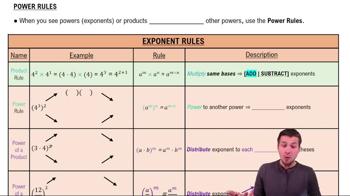
Power Rules

Error Bound for the Trapezoidal Rule

The error bound for the Trapezoidal Rule depends on the second derivative of the function being integrated. Specifically, the error magnitude is at most (K(b - a)^3) / (12n^2), where K is the maximum absolute value of the second derivative on [a, b], and n is the number of subintervals. This formula helps determine how many subintervals are needed to achieve a desired accuracy.
Video consigliato:
Percorso guidato
04:57
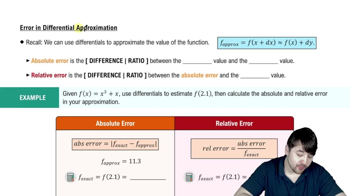
Determining Error and Relative Error

Second Derivative and Its Role in Error Estimation

The second derivative of the integrand measures the function's concavity and affects the accuracy of the Trapezoidal Rule. A larger maximum second derivative on the interval implies a larger potential error, so calculating or estimating this value is essential for applying the error bound and deciding the number of subintervals.
Video consigliato:
06:02
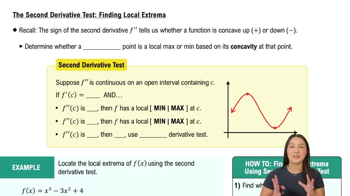
The Second Derivative Test: Finding Local Extrema