
Ch. 9 - First-Order Differential Equations
Hass - Thomas' Calculus 15th Edition
Hass15th EditionThomas' CalculusISBN: 9780137616077Non è quello che usi tu?Cambia libro di testo
Capitolo 9, Problema 9.PE.19

In Exercises 1–22, solve the differential equation.


dy + x(2y - e^(x-x²))dx = 0

Guida verificata passo dopo passo
1
Rewrite the given differential equation in the form \(M(x,y)\,dx + N(x,y)\,dy = 0\). Here, the equation is \(dy + x(2y - e^{x - x^{2}})\,dx = 0\), which can be rearranged as \(x(2y - e^{x - x^{2}})\,dx + dy = 0\).
Identify the functions \(M(x,y)\) and \(N(x,y)\) from the equation: \(M(x,y) = x(2y - e^{x - x^{2}})\) and \(N(x,y) = 1\).
Check if the differential equation is exact by verifying if \(\frac{\partial M}{\partial y} = \frac{\partial N}{\partial x}\). Compute \(\frac{\partial M}{\partial y}\) and \(\frac{\partial N}{\partial x}\).
If the equation is not exact, look for an integrating factor that depends on either \(x\) or \(y\) to make it exact. Determine the integrating factor by using the formula involving \(\frac{\partial M}{\partial y}\) and \(\frac{\partial N}{\partial x}\).
Once the equation is exact (either originally or after multiplying by the integrating factor), find the potential function \(\Psi(x,y)\) such that \(\frac{\partial \Psi}{\partial x} = M\) and \(\frac{\partial \Psi}{\partial y} = N\). Integrate \(M\) with respect to \(x\) and include a function of \(y\), then differentiate with respect to \(y\) and equate to \(N\) to find that function. Finally, write the implicit solution \(\Psi(x,y) = C\).

Risposta video verificata per un problema simile:

Questa soluzione video è stata consigliata dai nostri tutor come utile per risolvere questo problema.
Durata del video:
5m

Concetti chiave

Ecco i concetti essenziali che devi comprendere per rispondere correttamente alla domanda.

Differential Equations

A differential equation relates a function with its derivatives. Solving it means finding the function that satisfies this relationship. In this problem, the equation involves dy and dx terms, indicating a first-order differential equation.
Video consigliato:
07:39
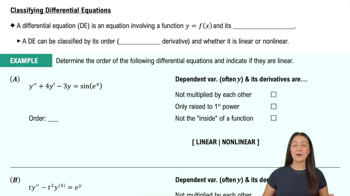
Classifying Differential Equations

Exact Differential Equations

An exact differential equation can be written as the total differential of some function equal to zero. To check exactness, verify if the partial derivatives of the involved functions satisfy a specific equality. If exact, the solution is found by integrating these functions.
Video consigliato:
07:39
Classifying Differential Equations

Integrating Factor

If a differential equation is not exact, an integrating factor is a function used to multiply the equation to make it exact. Finding the correct integrating factor often depends on the variables involved and simplifies solving the equation.
Video consigliato:
Percorso guidato
06:18
Integration by Parts for Definite Integrals