Ch. 9 - First-Order Differential Equations
Hass - Thomas' Calculus 15th Edition
Hass15th EditionThomas' CalculusISBN: 9780137616077Non è quello che usi tu?Cambia libro di testo
Capitolo 9, Problema 9.PE.15

In Exercises 1–22, solve the differential equation.


(x + 3y²) dy + y dx = 0 (Hint: d(xy) = y dx + x dy)

Guida verificata passo dopo passo
1
Rewrite the given differential equation \((x + 3y^{2}) \, dy + y \, dx = 0\) to isolate terms involving \(dx\) and \(dy\). This can be expressed as \(y \, dx + (x + 3y^{2}) \, dy = 0\).
Recognize the hint \(d(xy) = y \, dx + x \, dy\) and try to express part of the equation in terms of \(d(xy)\) to simplify the problem.
Rewrite the equation as \(y \, dx + x \, dy + 3y^{2} \, dy = 0\), which becomes \(d(xy) + 3y^{2} \, dy = 0\).
Integrate both sides with respect to the appropriate variables: integrate \(d(xy)\) directly and integrate \(3y^{2} \, dy\) separately.
After integration, combine the results to form an implicit solution involving \(xy\) and \(y^{3}\), then solve for the general solution of the differential equation.

Risposta video verificata per un problema simile:

Questa soluzione video è stata consigliata dai nostri tutor come utile per risolvere questo problema.
Durata del video:
2m

Concetti chiave

Ecco i concetti essenziali che devi comprendere per rispondere correttamente alla domanda.

Exact Differential Equations

An exact differential equation can be written in the form M(x,y) dx + N(x,y) dy = 0, where there exists a function F(x,y) such that dF = M dx + N dy. Solving involves finding F(x,y) = C, which implicitly defines the solution. Recognizing exactness often simplifies solving differential equations.
Video consigliato:
07:39
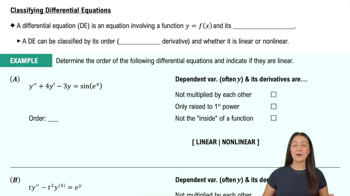
Classifying Differential Equations

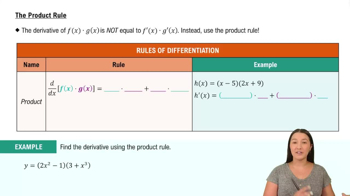
Using the Product Rule for Differentials

The product rule states d(uv) = u dv + v du for functions u and v. In this problem, the hint d(xy) = y dx + x dy helps rewrite terms to identify exact differentials or simplify the equation, facilitating integration and solution.
Video consigliato:
05:18
The Product Rule

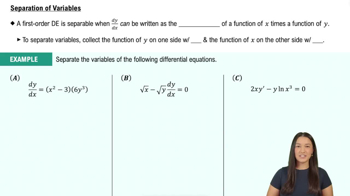
Separation and Rearrangement of Variables

Rearranging terms to isolate dy and dx or grouping expressions helps in identifying integrable forms or exact differentials. This step is crucial for transforming the given equation into a solvable form, either by direct integration or applying known solution methods.
Video consigliato:
07:15
Separation of Variables
Pratica correlata
Domanda del libro di testo

In Exercises 1–22, solve the differential equation.


dy + x(2y - e^(x-x²))dx = 0

4
views

Domanda del libro di testo

In Exercises 43 and 44, let S represent the pounds of salt in a tank at time t minutes. Set up a differential equation representing the given information and the rate at which S changes. Then solve for S and answer the particular questions.

Pure water flows into a tank at the rate of 4 gal/min, and the well-stirred mixture flows out of the tank at the rate of 5 gal/min. The tank initially holds 200 gal of solution containing 50 pounds of salt.

b. How many pounds of salt are in the tank after 1 minute? after 30 minutes?

17
views
Domanda del libro di testo

In Exercises 43 and 44, let S represent the pounds of salt in a tank at time t minutes. Set up a differential equation representing the given information and the rate at which S changes. Then solve for S and answer the particular questions.


Pure water flows into a tank at the rate of 4 gal/min, and the well-stirred mixture flows out of the tank at the rate of 5 gal/min. The tank initially holds 200 gal of solution containing 50 pounds of salt.


c. When will the tank have exactly 5 pounds of salt and how many gallons of solution will be in the tank?

26
views
Domanda del libro di testo

In Exercises 1–22, solve the differential equation.


y' = sin³ x cos² y

7
views
Domanda del libro di testo

In Exercises 1–22, solve the differential equation.

2y' - y = xe^(x/2)

18
views
Domanda del libro di testo

In Exercises 1–22, solve the differential equation.


y' = (y²-1)x⁻¹

26
views