Ch. 9 - First-Order Differential Equations
Hass - Thomas' Calculus 15th Edition
Hass15th EditionThomas' CalculusISBN: 9780137616077Non è quello che usi tu?Cambia libro di testo
Capitolo 9, Problema 9.5.11

Show that (0, 0) and (c/d, a/b) are equilibrium points. Explain the meaning of each of these points.

Guida verificata passo dopo passo
1
Identify the system of differential equations or functions involved, typically given in the form \(\frac{dx}{dt} = f(x,y)\) and \(\frac{dy}{dt} = g(x,y)\), where \(x\) and \(y\) are variables and \(a\), \(b\), \(c\), \(d\) are constants.
To find equilibrium points, set the derivatives equal to zero: solve the system \(f(x,y) = 0\) and \(g(x,y) = 0\) simultaneously. This means finding points \((x,y)\) where the system does not change over time.
Substitute \((0,0)\) into both \(f(x,y)\) and \(g(x,y)\) and verify that both equal zero. This confirms that \((0,0)\) is an equilibrium point.
Similarly, substitute \((\frac{c}{d}, \frac{a}{b})\) into \(f(x,y)\) and \(g(x,y)\) and check that both expressions equal zero, confirming this is also an equilibrium point.
Interpret the meaning of these equilibrium points: they represent states where the system is in balance and no change occurs. For example, \((0,0)\) might represent the absence of quantities or populations, while \((\frac{c}{d}, \frac{a}{b})\) could represent a steady-state or coexistence condition depending on the context of the system.

Risposta video verificata per un problema simile:

Questa soluzione video è stata consigliata dai nostri tutor come utile per risolvere questo problema.
Durata del video:
3m

Concetti chiave

Ecco i concetti essenziali che devi comprendere per rispondere correttamente alla domanda.

Equilibrium Points in Dynamical Systems

Equilibrium points are values of variables where the system does not change over time, meaning all derivatives are zero. They represent steady states where the system remains constant if undisturbed. Identifying these points involves setting the system's differential equations to zero and solving for the variables.
Video consigliato:
03:52
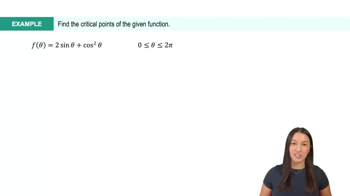
Critical Points Example 2

Solving Systems of Equations

To find equilibrium points, one must solve a system of equations derived from setting derivatives to zero. This often involves algebraic manipulation and substitution to find all possible solutions. Understanding how to solve linear or nonlinear systems is essential for locating these points.
Video consigliato:
5:02
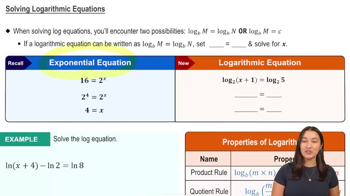
Solving Logarithmic Equations

Interpretation of Equilibrium Points

Each equilibrium point has a physical or theoretical meaning depending on the context, such as population levels in biology or concentrations in chemistry. Explaining their meaning involves describing what the steady state represents in the modeled system and its implications for system behavior.
Video consigliato:
04:50
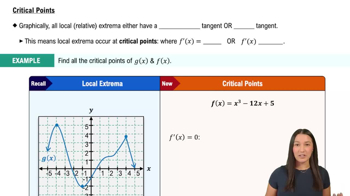
Critical Points