
Domanda del libro di testo
Integral Equations
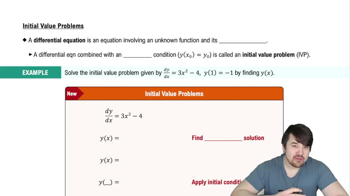
In Exercises 7–12, write an equivalent first-order differential equation
and initial condition for y.
y = ln x + ∫ₓᵉ √ (t² + (y(t))²) dt
16
views

 Guida verificata passo dopo passo
 07:33
07:33
 05:03
05:03 06:30
06:30Integral Equations
In Exercises 7–12, write an equivalent first-order differential equation
and initial condition for y.
y = ln x + ∫ₓᵉ √ (t² + (y(t))²) dt
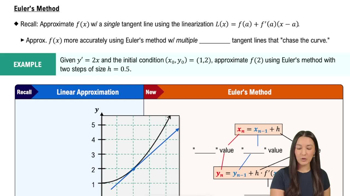
In Exercises 39–42, use Euler’s method with the specified step size to estimate the value of the solution at the given point x*. Find the value of the exact solution at x*.
y' = 2xexp(x²) , y(0) = 2, dx = 0.1, x* = 1
Using Euler’s Method
In Exercises 15–20, use Euler’s method to calculate the first three approximations to the given initial value problem for the specified increment size. Calculate the exact solution and investigate the accuracy of your approximations. Round your results to four decimal places.
y' = x(1-y), y(1) = 0, dx = 0.2
Write the formula for a logistic function that has values between y = 0 and y = 1, crosses the line y = 1/2 at x = 0, and has slope 5 at this point.
In Exercises 39–42, use Euler’s method with the specified step size to estimate the value of the solution at the given point x*. Find the value of the exact solution at x*.
y' = 2y²(x-1), y(2) = -1/2, dx = 0.1, x* = 3
Show that (0, 0) and (c/d, a/b) are equilibrium points. Explain the meaning of each of these points.