Ch. 9 - First-Order Differential Equations
Hass - Thomas' Calculus 15th Edition
Hass15th EditionThomas' CalculusISBN: 9780137616077Non è quello che usi tu?Cambia libro di testo
Capitolo 9, Problema 9.1.16

Using Euler’s Method
In Exercises 15–20, use Euler’s method to calculate the first three approximations to the given initial value problem for the specified increment size. Calculate the exact solution and investigate the accuracy of your approximations. Round your results to four decimal places.


y' = x(1-y), y(1) = 0, dx = 0.2

Guida verificata passo dopo passo
1
Identify the differential equation and initial condition: \(y' = x(1 - y)\) with \(y(1) = 0\). Here, \(y'\) represents the derivative \(\frac{dy}{dx}\), and the initial point is at \(x = 1\) with \(y = 0\).
Set the step size \(\Delta x = 0.2\). Euler's method uses the formula \(y_{n+1} = y_n + \Delta x \cdot f(x_n, y_n)\), where \(f(x, y) = y'\) is the right-hand side of the differential equation.
Calculate the first approximation: Evaluate \(f(x_0, y_0) = x_0 (1 - y_0)\) at the initial point \((x_0, y_0) = (1, 0)\), then compute \(y_1 = y_0 + 0.2 \times f(x_0, y_0)\).
Calculate the second approximation: Update \(x_1 = x_0 + 0.2\), then evaluate \(f(x_1, y_1)\) using the previously found \(y_1\), and compute \(y_2 = y_1 + 0.2 \times f(x_1, y_1)\).
Calculate the third approximation: Update \(x_2 = x_1 + 0.2\), evaluate \(f(x_2, y_2)\), and compute \(y_3 = y_2 + 0.2 \times f(x_2, y_2)\). After these steps, find the exact solution by solving the differential equation analytically and compare the approximations to assess accuracy.

Risposta video verificata per un problema simile:

Questa soluzione video è stata consigliata dai nostri tutor come utile per risolvere questo problema.
Durata del video:
6m

Concetti chiave

Ecco i concetti essenziali che devi comprendere per rispondere correttamente alla domanda.

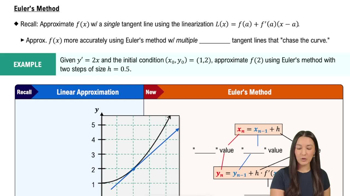
Euler's Method

Euler's Method is a numerical technique to approximate solutions of first-order differential equations. Starting from an initial point, it uses the slope given by the differential equation to estimate the next value by moving a small step size along the tangent. This iterative process provides approximate values of the solution at discrete points.
Video consigliato:
07:33
Euler's Method

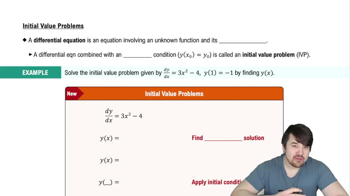
Initial Value Problem (IVP)

An Initial Value Problem specifies a differential equation along with a starting condition, or initial value, for the unknown function. The solution must satisfy both the differential equation and the initial condition, which anchors the solution curve at a specific point, enabling numerical or analytical methods to find the function.
Video consigliato:
Percorso guidato
05:03
Initial Value Problems

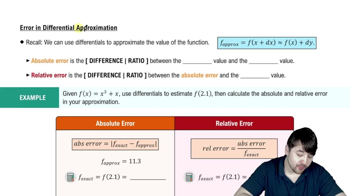
Exact Solution and Error Analysis

The exact solution is the precise function satisfying the differential equation and initial condition, often found analytically. Comparing Euler’s approximations to the exact solution helps assess accuracy. Error analysis involves measuring the difference between approximate and exact values, which typically decreases with smaller step sizes.
Video consigliato:
Percorso guidato
04:57
Determining Error and Relative Error