 Indietro
Bioenergetics and Thermodynamics in Cell Biology
Guida di studio - Note intelligenti
 Appunti personalizzati basati sui tuoi materiali, ampliati con definizioni chiave, esempi e contesto.
Bioenergetics: The Flow of Energy in the Cell
Essential Needs of Cells
Cells require four fundamental resources to sustain life and function efficiently:
Molecular building blocks: Small molecules and ions used to construct macromolecules and cellular structures.
Chemical catalysts (enzymes): Proteins that accelerate biochemical reactions.
Information to guide activities: Genetic instructions encoded in DNA and RNA.
Energy to drive reactions and processes: Required for biosynthesis, movement, transport, and other cellular activities.
Definition of Energy and Biological Work
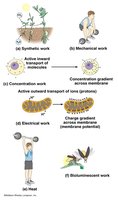
Energy is defined as the ability to cause specific change or perform work. In biological systems, energy is required for various types of work:
Chemical work: Synthesis of complex molecules.
Mechanical work: Movement of cells or cellular components.
Concentration work: Accumulation of substances against a concentration gradient.
Electrical work: Separation of charges across membranes.
Heat: Maintenance of body temperature in homeothermic organisms.
Bioluminescence: Production of light by living organisms.
Thermodynamics in Biological Systems
Open Systems and Energy Flow
Biological systems are open systems, meaning they exchange both energy and matter with their surroundings. The primary source of energy for life on Earth is the sun, and energy flows unidirectionally through ecosystems. Energy conversions are not 100% efficient, and some energy is always lost as heat.
Oxidation-Reduction Reactions
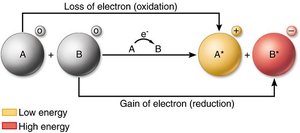
Energy transfer in cells often involves oxidation-reduction (redox) reactions, where electrons are transferred from one molecule to another. Oxidation is the loss of electrons, while reduction is the gain of electrons. These reactions are fundamental to cellular respiration and photosynthesis.
Thermodynamics: Laws and Concepts
Thermodynamics is the study of energy transformations in chemical reactions. Two main laws govern these processes:
First Law (Law of Conservation of Energy): Energy cannot be created or destroyed, only transformed from one form to another.
Second Law (Law of Thermodynamic Spontaneity): The entropy (disorder) of the universe tends to increase; spontaneous processes are those that increase the overall entropy.
Enthalpy (H) and Energy Changes
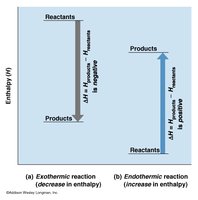
Enthalpy (H) is the total heat content of a system. In biological reactions, pressure and volume changes are negligible, so the change in enthalpy (ΔH) is approximately equal to the change in internal energy (ΔE):
ΔH can be positive (endothermic) or negative (exothermic).
Entropy (S) and Free Energy (G)
Entropy (S) measures the disorder or randomness of a system. All chemical reactions tend toward increased entropy, but the entropy of an individual system may increase, decrease, or remain unchanged. Gibbs Free Energy (G) is the energy available to do work in a chemical reaction.
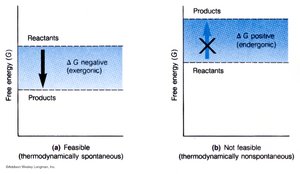
Spontaneous (exergonic) reactions have a negative ΔG.
Nonspontaneous (endergonic) reactions have a positive ΔG.
Synthesis and Oxidation of Glucose
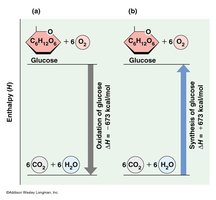
The synthesis and oxidation of glucose are classic examples of energy transformations in cells. Oxidation of glucose is exergonic and increases entropy, while synthesis is endergonic and decreases entropy.
Assessing Thermodynamic Spontaneity
Whether a reaction can proceed spontaneously is determined by changes in entropy and free energy. Entropy alone is not always a reliable measure for chemical spontaneity; free energy change (ΔG) is more informative.
Relationship Between ΔH, ΔS, and ΔG
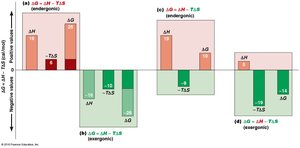
The sign and magnitude of ΔH and TΔS determine the spontaneity of a reaction:
If ΔH is negative and TΔS is positive, ΔG is always negative (spontaneous).
If ΔH is positive and TΔS is negative, ΔG is always positive (nonspontaneous).
Other combinations depend on the relative values of ΔH and TΔS.
Chemical Reactions and Equilibrium
Reversibility and Equilibrium
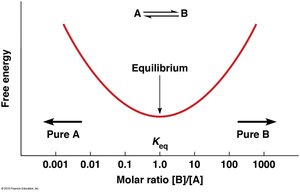
All chemical reactions are reversible and tend toward equilibrium, where the rates of the forward and reverse reactions are equal. The equilibrium constant (Keq) is defined as:
Free energy is minimized at equilibrium; reactions far from equilibrium have higher free energy.
Calculating Free Energy Changes
The total free energy change for a reaction can be calculated and used to predict reaction direction:
Standard free energy change:
Where R is the gas constant (1.987 cal/mol·K), T is temperature in Kelvin, and Keq is the equilibrium constant.
At standard temperature (298 K), cal/mol.
For non-standard conditions:
Interpreting ΔG and ΔG°'
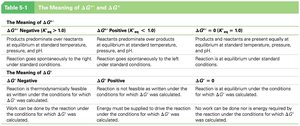
The meaning of ΔG and ΔG°' depends on their sign and the value of Keq. The table below summarizes these relationships:
ΔG°' Negative; Keq > 1.0 | ΔG°' Positive; Keq < 1.0 | ΔG°' = 0; Keq = 1.0 |
|---|---|---|
Products predominate over reactants at equilibrium under standard temperature, pressure, and pH. Reaction proceeds to the right under standard conditions. | Reactants predominate over products at equilibrium under standard temperature, pressure, and pH. Reaction goes spontaneously to the left under standard conditions. | Products and reactants are present equally at equilibrium under standard temperature, pressure, and pH. Reaction is at equilibrium under standard conditions. |
ATP and Coupled Reactions
Role of ATP in Energy Coupling
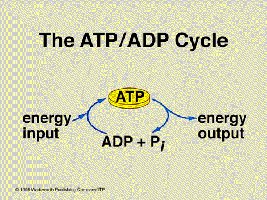
Cells use free energy released from exergonic reactions to drive endergonic reactions through coupled reactions. ATP (adenosine triphosphate) acts as the primary energy currency, linking energy-releasing and energy-consuming processes via the ATP/ADP cycle:
ATP hydrolysis releases energy for cellular work.
ADP is phosphorylated to regenerate ATP using energy from catabolic reactions.
Life and the Steady State
Cells maintain a steady state rather than equilibrium. Cellular reactions are kept away from equilibrium to allow continuous energy flow and sustain life processes.
