 Indietro
Bioenergetics: The Flow of Energy in the Cell (Sections 5.1 & 5.2) – Study Notes
Guida di studio - Note intelligenti
 Appunti personalizzati basati sui tuoi materiali, ampliati con definizioni chiave, esempi e contesto.
Bioenergetics: The Flow of Energy in the Cell
Introduction to Bioenergetics
Bioenergetics is the study of how energy flows through living systems, particularly cells. It is essential for understanding how cells obtain, convert, and utilize energy to perform work and maintain life. This section covers the basic principles of energy, metabolism, and thermodynamics as they apply to biological systems.
Classification of Organisms by Energy and Carbon Source
Energy and Carbon Acquisition Strategies
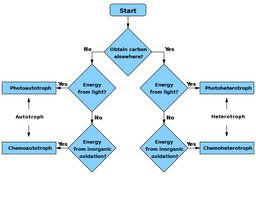
Organisms are classified based on how they obtain energy and carbon for cellular processes. The two main energy sources are light (phototrophs) and chemical compounds (chemotrophs), while carbon sources are either inorganic (autotrophs) or organic (heterotrophs).
Phototrophs: Use light as an energy source.
Chemotrophs: Obtain energy from the oxidation of chemical compounds.
Autotrophs: Use inorganic carbon (CO2) as a carbon source.
Heterotrophs: Require organic molecules as a carbon source.
Metabolism: Anabolic vs. Catabolic Pathways
Overview of Metabolic Pathways
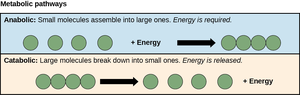
Metabolism encompasses all chemical reactions in a cell, divided into two main types:
Anabolic pathways: Build complex molecules from simpler ones; require energy input.
Catabolic pathways: Break down complex molecules into simpler ones; release energy.
Potential vs. Kinetic Energy in Biological Systems
Definitions and Examples
Energy exists in two primary forms:
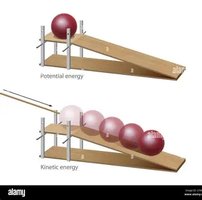
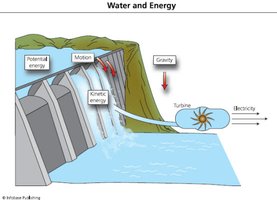
Potential energy: Stored energy due to position or structure (e.g., chemical bonds, concentration gradients).
Kinetic energy: Energy of motion (e.g., movement of molecules, muscle contraction).
Chemical Potential Energy and Gibbs Free Energy
Chemical Bonds as Energy Stores
Chemical potential energy is stored in the bonds of molecules. The usable portion of this energy is called Gibbs Free Energy (G). Cells harness this energy to perform work.
Gibbs Free Energy (G): The energy available to do work in a system at constant temperature and pressure.
Bioenergetics and Cellular Work
Types of Cellular Work
Cells require energy to perform six main types of work, all of which involve kinetic energy:
Synthetic work: Formation of new chemical bonds (biosynthesis).
Mechanical work: Movement of cells or cellular components (e.g., muscle contraction, cilia movement).
Concentration work: Transport of molecules against concentration gradients.
Electrical work: Movement of ions to generate membrane potentials.
Heat production: Maintaining body temperature in homeotherms.
Bioluminescence: Production of light by living organisms.
Enzymes and Activation Energy
Role of Enzymes in Metabolism
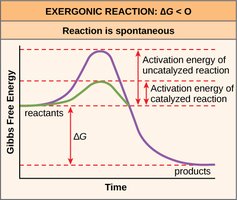
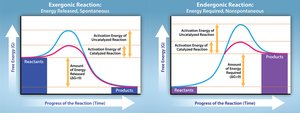
Enzymes are biological catalysts that lower the activation energy required for chemical reactions, allowing them to proceed at physiologically relevant rates without altering the overall free energy change (ΔG).
Exergonic and Endergonic Reactions
Energy Changes in Chemical Reactions
Reactions are classified based on their free energy change (ΔG):
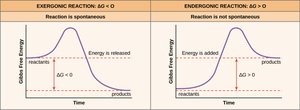
Exergonic reactions: Release energy (ΔG < 0); spontaneous.
Endergonic reactions: Require energy input (ΔG > 0); non-spontaneous.
Thermodynamics in Biological Systems
First Law of Thermodynamics (Energy Conservation)
The first law states that energy cannot be created or destroyed, only transformed. In cells, chemical energy from nutrients is converted into ATP, work, and heat.
Internal energy (E): Total energy stored in a system.
Enthalpy (H): Heat content of a system;
Second Law of Thermodynamics (Entropy)
The second law states that the entropy (disorder) of the universe tends to increase. Biological systems maintain order by increasing the entropy of their surroundings, usually by releasing heat.
Entropy (S): Measure of disorder or randomness.
Spontaneous processes increase the total entropy of the universe.
Gibbs Free Energy and Reaction Spontaneity
Calculating Free Energy Change
The change in free energy (ΔG) determines whether a reaction is spontaneous:
ΔG < 0: Spontaneous (exergonic)
ΔG > 0: Non-spontaneous (endergonic)
Exergonic vs. Exothermic Reactions
Comparison Table
Exergonic and exothermic reactions are related but distinct concepts:
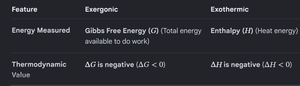
Feature | Exergonic | Exothermic |
|---|---|---|
Energy Measured | Gibbs Free Energy (G) | Enthalpy (H) |
Thermodynamic Value | ΔG is negative (ΔG < 0) | ΔH is negative (ΔH < 0) |
Spontaneity | Always spontaneous | Not necessarily spontaneous |
Opposite Term | Endergonic (ΔG > 0) | Endothermic (ΔH > 0) |

Biological Example: Oxidation and Synthesis of Glucose
Free Energy Changes in Glucose Metabolism
The oxidation of glucose is a highly exergonic process, releasing energy used by cells:
Under standard conditions: kcal/mol, kcal/mol, kcal/mol
The reverse reaction (glucose synthesis) is endergonic: kcal/mol
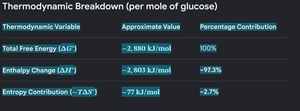
Summary Table: Thermodynamic Breakdown (per mole of glucose)
Thermodynamic Variable | Approximate Value | Percentage Contribution |
|---|---|---|
Total Free Energy (ΔG) | −2,880 kJ/mol | 100% |
Enthalpy Change (ΔH) | −2,803 kJ/mol | 97.3% |
Entropy Contribution (−TΔS) | −77 kJ/mol | 2.7% |
Key Concepts and Applications
Metabolism: ΔG explains why glucose oxidation releases energy and why ATP hydrolysis powers cellular work.
Macromolecule Formation: Synthesis of DNA, RNA, and proteins requires coupling to exergonic reactions.
Membrane Transport: Thermodynamics explains passive and active transport, and the storage of potential energy in gradients.
Protein Folding: Driven by enthalpy and entropy changes, especially the hydrophobic effect.
Homeostasis: Cells maintain non-equilibrium steady states by continuous energy flow.
Sample Multiple Choice Questions
Under standard biochemical conditions, what is the temperature used for reporting ΔG°′? Correct answer: 25°C (298 K)
Which term describes organisms that obtain energy by oxidizing chemical compounds? Correct answer: Chemotrophs
Which organisms use CO₂ as their carbon source and sunlight as their energy source? Correct answer: Photoautotrophs
In biological systems, which form of energy is stored in chemical bonds? Correct answer: Potential energy
A reaction with a negative ΔG is best described as: Correct answer: Spontaneous
A reaction that requires an input of energy to proceed is: Correct answer: Non‑spontaneous
Which type of cellular work involves moving ions or molecules across membranes against a gradient? Correct answer: Transport work
Bioluminescence in organisms (e.g., fireflies) results from: Correct answer: A chemical reaction that produces light
Fluorescence differs from bioluminescence because fluorescence: Correct answer: Requires absorption of external light before emission
In redox reactions, the molecule that loses electrons is: Correct answer: Oxidized
Summary
Bioenergetics explains how cells obtain and use energy to drive life processes.
Thermodynamic principles (ΔG, ΔH, ΔS) determine reaction spontaneity and directionality.
Cells maintain order and function by coupling energy-releasing and energy-requiring reactions, using enzymes to control rates and pathways.
