 Indietro
Bioenergetics: The Flow of Energy in the Cell – Study Notes
Guida di studio - Note intelligenti
 Appunti personalizzati basati sui tuoi materiali, ampliati con definizioni chiave, esempi e contesto.
Bioenergetics: The Flow of Energy in the Cell
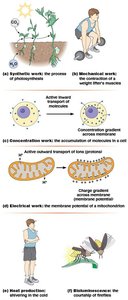
Types of Cellular Work
Cells perform various types of work to sustain life, each requiring energy input and involving distinct biological processes.
Synthetic Work: The process of photosynthesis in plants converts solar energy into chemical energy, forming organic molecules.
Mechanical Work: Muscle contraction and movement require energy for the displacement of cellular structures.
Concentration Work: Active transport of molecules across membranes creates concentration gradients, essential for cellular function.
Electrical Work: The movement of ions across membranes generates membrane potentials, crucial for processes like nerve impulse transmission.
Heat Production: Organisms generate heat to maintain body temperature, a byproduct of metabolic reactions.
Bioluminescence: Some organisms produce light through biochemical reactions, such as fireflies.
Energy Flow in Biological Systems
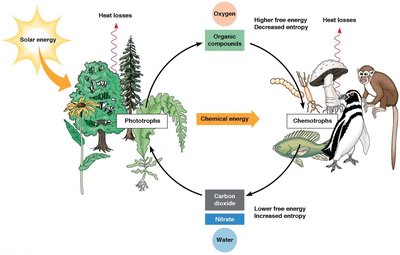
Energy flows through ecosystems via phototrophs and chemotrophs, with solar energy being converted to chemical energy and then utilized by various organisms.
Phototrophs: Organisms (plants, algae) that capture solar energy and convert it into organic compounds.
Chemotrophs: Organisms (animals, fungi) that obtain energy by oxidizing organic compounds.
Energy Transformation: Solar energy is transformed into chemical energy, which is then used by chemotrophs, resulting in heat loss and changes in entropy.
Oxidation States of Carbon and Energy Availability
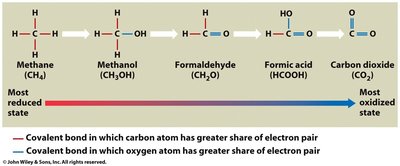
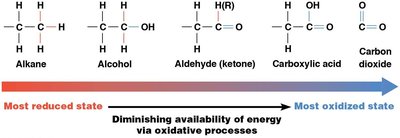
The oxidation state of carbon atoms in organic molecules determines their energy content. As carbon becomes more oxidized, the molecule's energy decreases.
Most Reduced State: Methane (CH4) contains carbon in its most reduced form, with maximum energy.
Most Oxidized State: Carbon dioxide (CO2) represents the most oxidized state, with minimal energy.
Energy Release: Oxidative processes release energy as carbon transitions from reduced to oxidized states.
Energy Storage in Fatty Acids
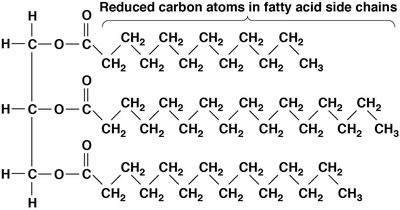
Fatty acids are rich in reduced carbon atoms, making them efficient energy storage molecules in cells.
Structure: Fatty acids consist of long hydrocarbon chains with many reduced carbon atoms.
Energy Content: The abundance of reduced carbons allows fatty acids to store large amounts of energy, released during oxidation.
Isomerization Reactions in Metabolism
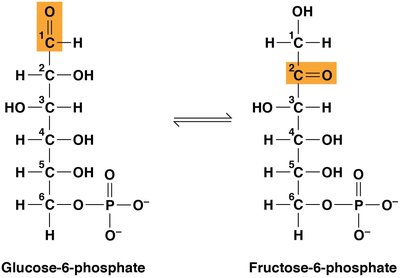
Isomerization reactions, such as the conversion of glucose-6-phosphate to fructose-6-phosphate, are essential in metabolic pathways like glycolysis.
Definition: Isomerization involves the rearrangement of atoms within a molecule, changing its structure but not its molecular formula.
Example: Glucose-6-phosphate is converted to fructose-6-phosphate, facilitating subsequent steps in glycolysis.
Open vs. Closed Systems in Thermodynamics
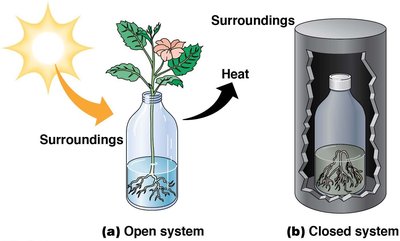
Biological systems are typically open, exchanging energy and matter with their surroundings, unlike closed systems which do not exchange matter.
Open System: Allows exchange of energy and matter (e.g., living organisms).
Closed System: Allows energy exchange but not matter (e.g., sealed container).
Free Energy Changes in Biological Reactions
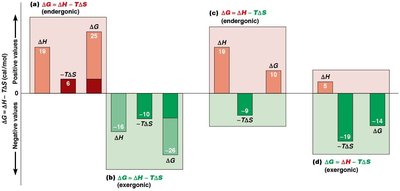
The change in free energy () determines whether a reaction is spontaneous or requires energy input. Endergonic reactions require energy, while exergonic reactions release energy.
Endergonic Reaction: ; not spontaneous, requires energy input.
Exergonic Reaction: ; spontaneous, releases energy.
Equation:
Equilibrium and Free Energy
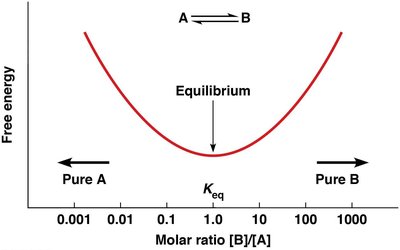
At equilibrium, the free energy of a system is minimized, and the ratio of products to reactants is constant. The equilibrium constant () reflects this balance.
Equilibrium: No net change in concentrations of reactants and products.
Free Energy: Lowest at equilibrium; reactions proceed toward equilibrium.
Equation:
Interpretation of and
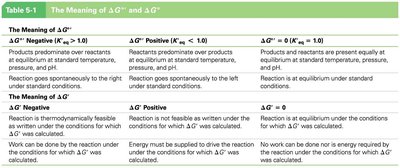
The sign and magnitude of and indicate the spontaneity and feasibility of reactions under standard and cellular conditions.
Negative: Products predominate at equilibrium; reaction proceeds spontaneously.
Positive: Reactants predominate; reaction does not proceed spontaneously.
Zero: Reactants and products are equal at equilibrium.
The Meaning of | Negative () | Positive () | = 0 ( = 1.0) |
|---|---|---|---|
Equilibrium | Products predominate | Reactants predominate | Products and reactants equal |
Spontaneity | Reaction proceeds spontaneously | Reaction does not proceed spontaneously | Reaction is at equilibrium |
The Meaning of | Negative | Positive | = 0 |
|---|---|---|---|
Feasibility | Reaction is thermodynamically feasible | Reaction is not feasible | Reaction is at equilibrium |
Work | Work can be done by the reaction | Energy must be supplied | No work can be done |
ATP/ADP Ratio and Cellular Energy State
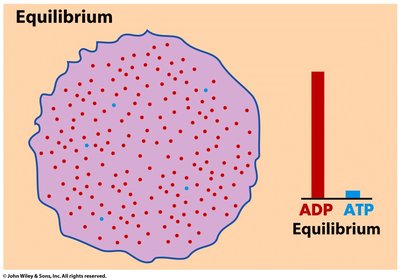
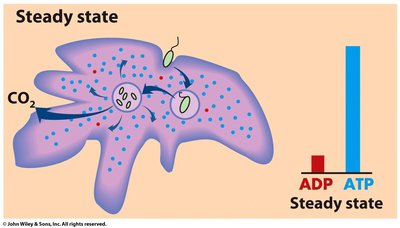
The ATP/ADP ratio in cells is typically high (~5:1), reflecting a steady state maintained by continuous energy input. At equilibrium, the ratio would be much lower, indicating energy depletion.
Steady State: High ATP/ADP ratio, maintained by metabolic processes.
Equilibrium: Low ATP/ADP ratio, occurs when energy input ceases.
Equation:
Equilibrium Constant:
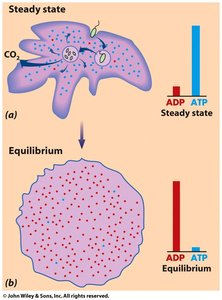
Additional info: The maintenance of a high ATP/ADP ratio is essential for cellular function, as ATP serves as the primary energy currency for most cellular processes.
