 Indietro
Chapter 1: A Preview of Cell Biology – Foundations, Methods, and Modern Approaches
Guida di studio - Note intelligenti
 Appunti personalizzati basati sui tuoi materiali, ampliati con definizioni chiave, esempi e contesto.
Overview of Cell Biology
The Cell as the Fundamental Unit of Life
Cell biology is the study of cells, the basic structural and functional units of all living organisms. Cells are dynamic entities, constantly undergoing changes in structure and function. The integration of cytology, genetics, and biochemistry has propelled cell biology into a leading scientific discipline.
Cell: The smallest unit capable of independent life and reproduction.
Modern cell biology: Emerged from the convergence of studies in cell structure, function, and heredity.
The Cell Theory: Historical Foundations
Development of the Cell Theory
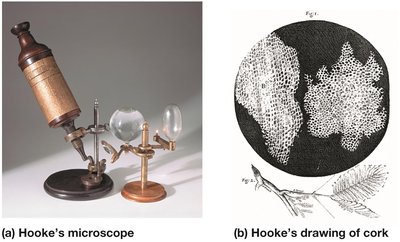
The cell theory is a cornerstone of biology, describing the properties and significance of cells in all living organisms. Its development was enabled by advances in microscopy and careful observation.
Robert Hooke (1665): First observed and named 'cells' in cork tissue using a microscope.
Robert Brown: Identified the nucleus in plant cells.
Matthias Schleiden & Thomas Schwann: Concluded that all plants and animals are composed of cells.
Rudolf Virchow (1855): Added that all cells arise from preexisting cells.
All organisms consist of one or more cells.
The cell is the basic unit of structure for all organisms.
All cells arise only from preexisting cells.
Microscopy and the Study of Cells
Advances in Microscopy
Microscopy has been essential for the study of cells, allowing scientists to observe structures invisible to the naked eye. Improvements in magnification and resolution have expanded our understanding of cellular architecture.
Compound microscopes: Use two lenses for improved magnification and resolution (down to 1 µm).
Resolution: The ability to distinguish two points as separate; higher resolution reveals finer details.
Types of Microscopy
Light (Brightfield) Microscopy: Uses visible light; suitable for stained, fixed samples.
Phase-Contrast & Differential Interference Contrast: Enhance contrast in living cells without staining.
Fluorescence Microscopy: Detects specific molecules labeled with fluorescent tags or proteins (e.g., GFP).
Confocal Microscopy: Uses lasers to obtain sharp images from specific focal planes.
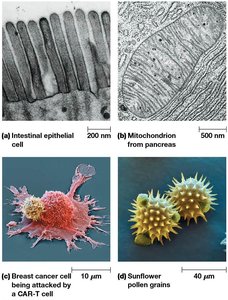
Electron Microscopy: Uses electron beams for much higher resolution (up to 100,000× magnification).
Cellular Dimensions and Measurement Units
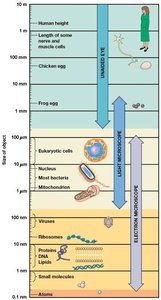
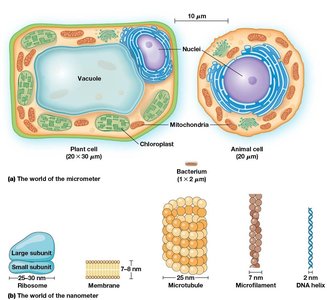
Cells and their components are measured in micrometers (µm) and nanometers (nm). Understanding these units is crucial for interpreting microscopic images and cellular structures.
Micrometer (µm): 1 µm = 10−6 m; used for cells and organelles.
Nanometer (nm): 1 nm = 10−9 m; used for molecules and subcellular structures.
Angstrom (Å): 1 Å = 0.1 nm; used for atomic-scale measurements.
The Emergence of Modern Cell Biology
Three Strands of Inquiry
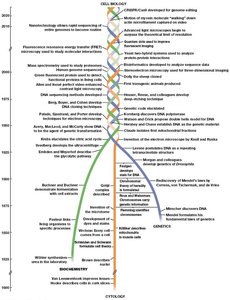
Modern cell biology integrates three major strands: cytology, biochemistry, and genetics. Each provides unique insights into cellular structure, function, and information flow.
Cytology: Focuses on cellular structure using optical techniques.
Biochemistry: Studies the chemical processes and molecules within cells.
Genetics: Examines heredity, gene function, and information transfer.
Biochemical Methods in Cell Biology
Key Techniques
Biochemical methods allow scientists to isolate, analyze, and characterize cellular molecules and structures.
Subcellular Fractionation: Uses centrifugation to separate cellular components.
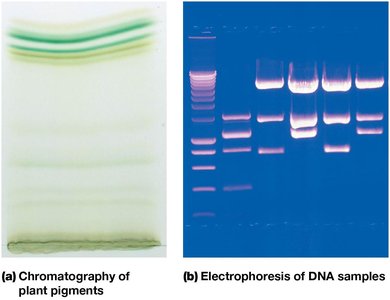
Chromatography: Separates molecules based on size, charge, or affinity.
Electrophoresis: Uses electric fields to separate DNA, RNA, or proteins by size/charge.
Mass Spectrometry: Determines the size and composition of proteins.
Genetics and Information Flow
Classical and Molecular Genetics
Genetics explores how traits are inherited and how genetic information is stored, replicated, and expressed.
Genes: Units of heredity, first described by Mendel.
Chromosome Theory: Genes are located on chromosomes.
DNA: Identified as the genetic material through experiments in the 20th century.
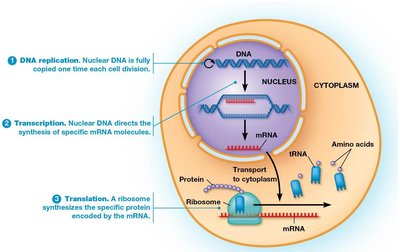
Central Dogma: Information flows from DNA to RNA to protein.
Modern Genetic Techniques
Recombinant DNA Technology: Uses restriction enzymes to cut and recombine DNA from different sources.
DNA Cloning: Produces many copies of a DNA sequence.
DNA Sequencing: Determines the order of nucleotides in DNA; enables whole-genome analysis.
Bioinformatics: Applies computational tools to analyze large biological datasets (genomics, proteomics, transcriptomics, etc.).
Genome Editing: CRISPR
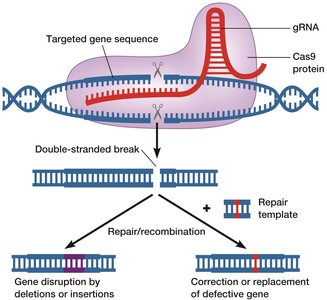
CRISPR is a revolutionary genome editing tool derived from a prokaryotic immune system. It allows precise modifications of DNA sequences in living cells.
Guide RNA (gRNA): Directs the Cas9 protein to a specific DNA sequence.
Double-stranded break: Induced at the target site, repaired by the cell, often introducing mutations or allowing template-directed repair.
Scientific Method and Model Organisms
Scientific Inquiry in Cell Biology
Scientific knowledge is built through hypothesis-driven experimentation. Well-designed experiments alter only one variable at a time and use model organisms to study cellular processes.
Hypothesis: A testable explanation for an observation.
Controlled Experiment: Only one variable (independent variable) is changed; the outcome (dependent variable) is measured.
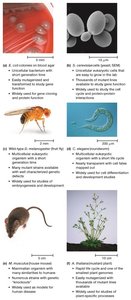
Model Organisms: Species that are easy to manipulate and widely studied (e.g., E. coli, yeast, fruit fly, mouse, Arabidopsis).
In vivo: Experiments in living organisms.
In vitro: Experiments outside living organisms (e.g., in test tubes).
Summary Table: Key Microscopy Methods
Microscopy Type | Principle | Resolution | Sample State |
|---|---|---|---|
Light (Brightfield) | Visible light through stained sample | ~200 nm | Fixed, stained |
Phase-Contrast/DIC | Enhances contrast in living cells | ~200 nm | Living |
Fluorescence | Fluorescent tags/proteins | ~200 nm | Fixed or living |
Electron (TEM/SEM) | Electron beams | ~2 nm (TEM), ~10 nm (SEM) | Fixed, special prep |
Conclusion
Cell biology is a multidisciplinary science that integrates structural, biochemical, and genetic approaches to understand the fundamental unit of life. Advances in microscopy, molecular biology, and computational analysis continue to drive discoveries in this dynamic field.
