 Indietro
Enzymes: The Catalysts of Life – Structure, Function, and Regulation
Guida di studio - Note intelligenti
 Appunti personalizzati basati sui tuoi materiali, ampliati con definizioni chiave, esempi e contesto.
Enzymes: The Catalysts of Life
Introduction to Enzymes
Enzymes are biological catalysts, primarily proteins, that accelerate chemical reactions in living cells without being consumed in the process. They are essential for nearly all cellular processes, enabling reactions to occur at rates compatible with life.
Definition: An enzyme is a biological macromolecule (usually a protein) that catalyzes specific chemical reactions.
Substrate: The reactant(s) upon which an enzyme acts.
Catalyst: A substance that increases the rate of a chemical reaction without being permanently altered.
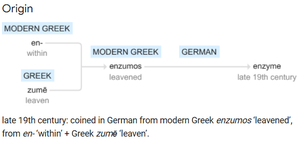
Enzyme Structure and Composition
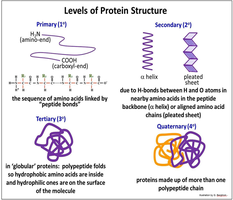
Most enzymes are proteins, composed of one or more polypeptide chains folded into a specific three-dimensional structure. A small fraction of enzymes are catalytic RNA molecules known as ribozymes.
Protein Enzymes: 95–99% of known enzymes are proteins.
Ribozymes: RNA molecules with catalytic activity, such as self-splicing introns and peptidyl transferase in ribosomes.
Role of Enzymes in Cellular Reactions
Enzymes are required for most cellular chemical reactions. They determine which reactions occur and at what rate, making life possible by overcoming the inherent unreactivity of many biological molecules.
Thermodynamics vs. Kinetics: Many reactions are thermodynamically feasible but do not proceed at appreciable rates without enzymes due to high activation energy barriers.
Metastable State: Reactants may be thermodynamically unstable but remain unreactive without sufficient activation energy.
Activation Energy and Enzyme Catalysis
Activation Energy Barrier
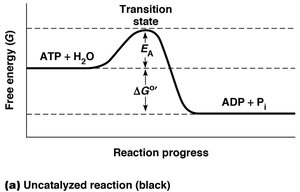
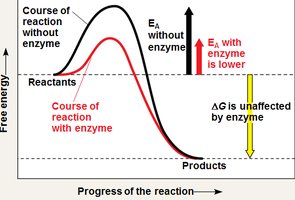
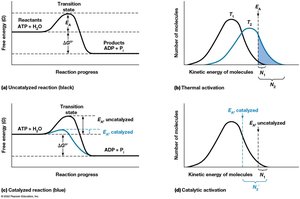
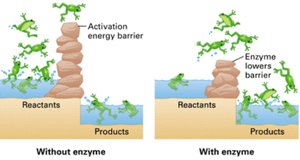
Every chemical reaction requires an initial input of energy, called the activation energy (EA), to reach the transition state. Enzymes function by lowering this barrier, allowing reactions to proceed more rapidly at cellular temperatures.
Transition State: An intermediate state with higher free energy than reactants.
Free Energy Change (ΔG): The difference in free energy between products and reactants; enzymes do not alter ΔG.
How Enzymes Lower Activation Energy
Enzymes provide a surface for substrate binding, orienting reactants and stabilizing the transition state, thereby reducing the activation energy required for the reaction.
Mechanisms: Substrate orientation, bond distortion, proton transfer, and electron transfer.
Effect: Increases the fraction of molecules able to react at physiological temperatures.
Properties and Specificity of Enzymes
Active Site and Substrate Binding
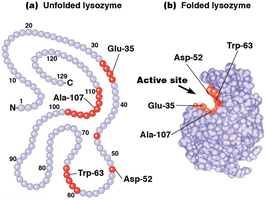
The active site is a specific region of the enzyme where substrates bind and catalysis occurs. The shape and chemical environment of the active site confer high specificity for particular substrates.
Active Site: Usually a groove or pocket formed by the 3D folding of the protein.
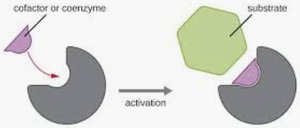
Cofactors and Coenzymes: Nonprotein components (metal ions or organic molecules) required for some enzymes' activity.
Enzyme Specificity
Enzymes are highly specific, often catalyzing only one particular reaction or acting on a specific substrate due to the precise fit between the enzyme and its substrate.
Substrate Specificity: Determined by the active site's shape and chemical properties.
Naming: Enzymes are often named for their substrate or function, typically ending in "-ase" (e.g., protease, amylase).
Major Classes of Enzymes
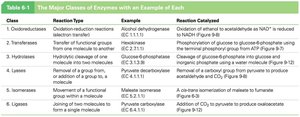
Enzymes are classified into six major classes based on the type of reaction they catalyze.
Class | Reaction Type | Example | Reaction Catalyzed |
|---|---|---|---|
Oxidoreductases | Oxidation-reduction | Alcohol dehydrogenase | Oxidation of ethanol to acetaldehyde |
Transferases | Transfer of functional groups | Hexokinase | Phosphorylation of glucose |
Hydrolases | Hydrolysis reactions | Carboxypeptidase | Cleavage of peptide bonds |
Lyases | Removal of groups without hydrolysis | Pyruvate decarboxylase | Decarboxylation of pyruvate |
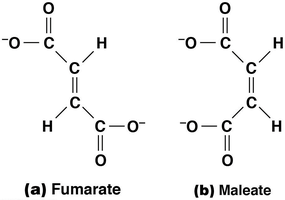
Isomerases | Isomerization | Maleate isomerase | Cis-trans isomerization |
Ligases | Joining of two molecules | Pyruvate carboxylase | Addition of CO2 to pyruvate |
Factors Affecting Enzyme Activity
Temperature
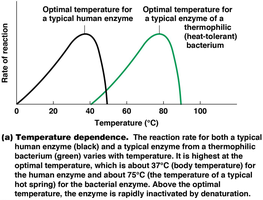
Enzyme activity increases with temperature up to an optimal point, beyond which the enzyme denatures and loses activity. The optimal temperature varies among organisms.
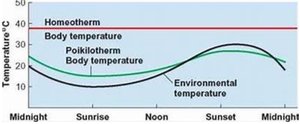
Homeotherms: Maintain constant body temperature (e.g., mammals, birds).
Poikilotherms: Body temperature varies with the environment (e.g., fish, reptiles).
pH
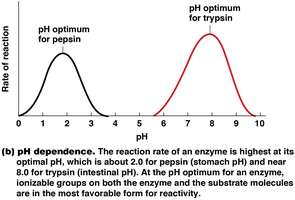
Each enzyme has an optimal pH range, typically spanning 3–4 units. Deviations from this range can denature the enzyme or alter the charge of amino acids at the active site, affecting activity.
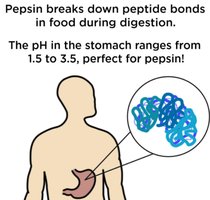
Example: Pepsin (stomach enzyme) is most active at pH 2; trypsin (intestinal enzyme) at pH 8.
Other Factors
Substrate Concentration: Increasing substrate increases reaction rate until the enzyme is saturated.
Enzyme Concentration: More enzyme increases the maximum possible reaction rate (Vmax).
Inhibitors and Activators: Molecules that decrease or increase enzyme activity by binding to the enzyme.
Ionic Strength: Affects hydrogen bonding and ionic interactions necessary for enzyme structure and function.
Mechanisms of Enzyme Action
Enzyme-Substrate Complex and Induced Fit Model
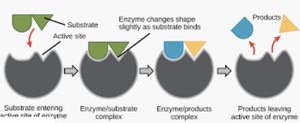
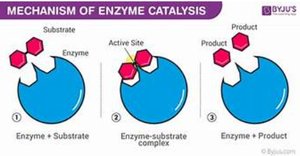
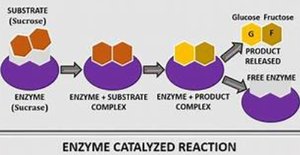
Enzymes bind substrates to form an enzyme-substrate complex. The induced fit model describes how substrate binding induces a conformational change in the enzyme, optimizing the active site for catalysis.
Lock-and-Key Model: Substrate fits exactly into the rigid active site (now considered oversimplified).
Induced Fit Model: Active site changes shape to fit the substrate upon binding.
Sequence of Catalytic Events
Substrate randomly collides and binds to the active site.
Binding induces a conformational change, facilitating catalysis.
Products are released from the active site.
Enzyme returns to its original conformation, ready for another cycle.
Enzyme Kinetics
Michaelis-Menten Kinetics
Enzyme kinetics studies the rates of enzyme-catalyzed reactions. The Michaelis-Menten equation describes how reaction velocity (v) depends on substrate concentration ([S]).
Vmax: Maximum reaction velocity at saturating substrate concentration.
Km: Substrate concentration at which the reaction proceeds at half Vmax.
The Michaelis-Menten equation:
At low [S], v is proportional to [S].
At high [S], v approaches Vmax and is independent of [S].
Turnover Number (kcat)
The turnover number is the number of substrate molecules converted to product per enzyme molecule per unit time at Vmax.
Enzyme Inhibition
Types of Inhibition
Irreversible Inhibitors: Bind covalently, permanently inactivating the enzyme (e.g., heavy metals, nerve gases).
Reversible Inhibitors: Bind noncovalently and can dissociate; include competitive and noncompetitive inhibitors.
Competitive Inhibition
Competitive inhibitors bind the active site, directly competing with the substrate. They increase the apparent Km but do not affect Vmax.
Noncompetitive Inhibition
Noncompetitive inhibitors bind elsewhere on the enzyme, causing a conformational change that reduces activity. They decrease Vmax but do not affect Km.
Allosteric Regulation and Feedback Inhibition
Allosteric regulation involves effectors binding to sites other than the active site, stabilizing either the active or inactive conformation of the enzyme. Feedback inhibition is a form of allosteric regulation where the end product of a pathway inhibits an early enzyme in the pathway.
Allosteric Enzymes: Often have multiple subunits and conformations.
Effectors: Can be activators or inhibitors.
Covalent Modification and Proteolytic Activation
Covalent Modification
Enzyme activity can be regulated by the reversible addition or removal of chemical groups, such as phosphorylation (by kinases) and dephosphorylation (by phosphatases).
Phosphorylation: Addition of phosphate groups, often activating or inhibiting enzymes.
Dephosphorylation: Removal of phosphate groups, reversing the effect.
Proteolytic Cleavage
Some enzymes are synthesized as inactive precursors (zymogens) and activated by irreversible proteolytic cleavage. This mechanism is common for digestive enzymes and blood clotting factors.
Zymogen: Inactive enzyme precursor.
Example: Trypsinogen is activated to trypsin in the small intestine.
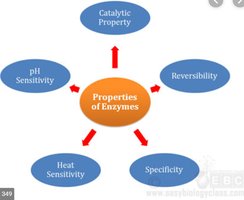
Summary Table: Properties of Enzymes
Property | Description |
|---|---|
Catalytic Property | Increase reaction rates by lowering activation energy |
Specificity | High substrate and reaction specificity |
Reversibility | Form transient, reversible complexes with substrates |
pH Sensitivity | Active within a narrow pH range |
Heat Sensitivity | Denature at high temperatures |
Additional info: This guide covers the essential aspects of enzyme structure, function, kinetics, regulation, and inhibition, providing a comprehensive overview for cell biology students.
