 Indietro
The Chemistry of the Cell: Foundations for Cell Biology
Guida di studio - Note intelligenti
 Appunti personalizzati basati sui tuoi materiali, ampliati con definizioni chiave, esempi e contesto.
The Chemistry of the Cell
Introduction
This chapter explores the chemical principles underlying cell structure and function, focusing on the unique properties of carbon, water, biological macromolecules, and the assembly of cellular components. Understanding these chemical foundations is essential for grasping how cells maintain life processes.
Characteristics of Carbon
Valence and Bonding Properties
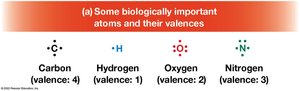
Carbon has a valence of 4, allowing it to form up to four covalent bonds with other atoms, including hydrogen, oxygen, nitrogen, and sulfur.
This versatility enables the formation of a wide variety of stable organic molecules essential for life.
Covalent Bonds
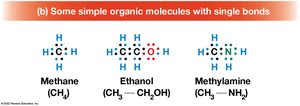
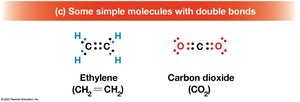
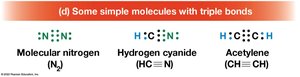
Single bonds involve one pair of shared electrons, double bonds involve two pairs, and triple bonds involve three pairs.
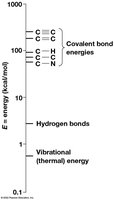
Double and triple bonds are stronger and more stable than single bonds, reflected in their higher bond energies.
Bond Energies
Bond energy is the amount of energy required to break a bond between two atoms.
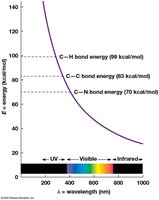
Examples: C–C (83 kcal/mol), C–H (99 kcal/mol), C–N (70 kcal/mol), C=C (146 kcal/mol), C≡C (212 kcal/mol).
These high bond energies contribute to the stability of organic molecules under physiological conditions.
Effect of UV Light on Covalent Bonds
Ultraviolet (UV) light contains enough energy to break covalent bonds, which can lead to molecular damage in cells.
This is why cells have evolved protective mechanisms against UV radiation.
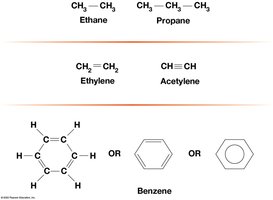
Hydrocarbons
Hydrocarbons are chains or rings composed only of carbon and hydrogen.
They serve as the backbone for more complex biological molecules.
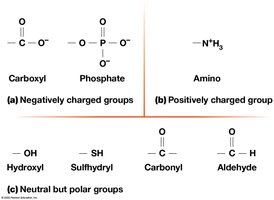
Functional Groups in Biological Compounds
Biological molecules often contain functional groups (e.g., carboxyl, amino, phosphate, hydroxyl, sulfhydryl, carbonyl, aldehyde) that confer specific chemical properties and reactivity.
These groups are critical for the structure and function of macromolecules.
Stereoisomers
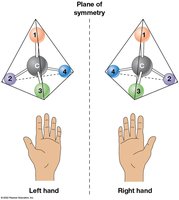
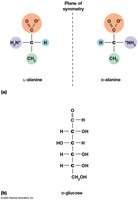
Stereoisomers are molecules with the same molecular formula but different spatial arrangements of atoms, making them non-superimposable mirror images (enantiomers).
The number of possible stereoisomers is given by , where n is the number of asymmetric (chiral) carbons.
Characteristics of Water
Polarity and Hydrogen Bonding
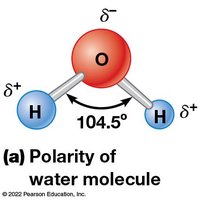
Water is a polar molecule, with a partial negative charge on oxygen and partial positive charges on hydrogen atoms.
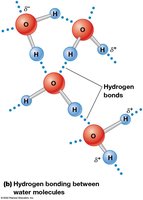
This polarity allows water molecules to form hydrogen bonds with each other, contributing to its unique properties.
Cohesion, Surface Tension, and Temperature Stabilization
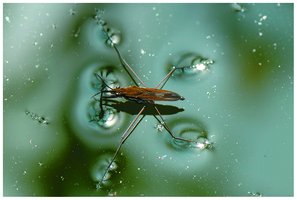
Hydrogen bonding leads to cohesion among water molecules, resulting in high surface tension and the ability to support small objects on its surface.
Water has a high specific heat and heat of vaporization, allowing it to stabilize temperature in cells and organisms.
Water as a Solvent
Water is known as the universal solvent due to its ability to dissolve a wide range of substances, especially polar and ionic compounds.
Hydrophilic substances dissolve readily, while hydrophobic substances do not.
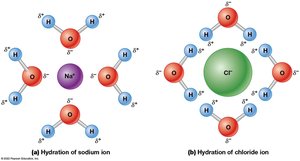
Ions in solution are surrounded by spheres of hydration, stabilizing them in the aqueous environment.
Selectively Permeable Membranes
Membrane Structure and Composition
Biological membranes are primarily composed of phospholipids, glycolipids, membrane proteins, and sterols (e.g., cholesterol in animals, ergosterol in fungi, phytosterol in plants).
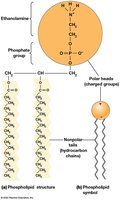
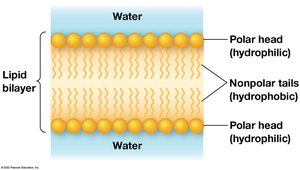
Phospholipids are amphipathic, containing both hydrophilic (polar) heads and hydrophobic (nonpolar) tails, which drives the formation of lipid bilayers.
Membrane Permeability
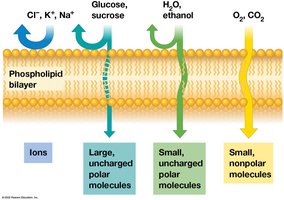
Membranes are selectively permeable, allowing small nonpolar molecules (e.g., O2, CO2) and some small uncharged polar molecules to pass freely, while restricting ions and most polar molecules.
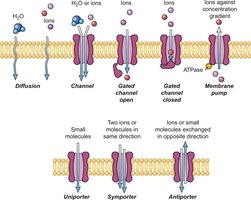
Transport proteins facilitate the movement of impermeable substances across the membrane.
Synthesis by Polymerization of Small Molecules
Macromolecules and Polymerization
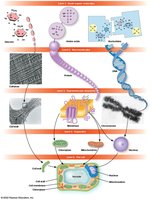
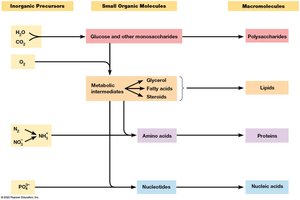
Macromolecules such as proteins, nucleic acids, and polysaccharides are polymers formed by the polymerization of small organic monomers.
Lipids, while not true polymers, are also essential macromolecules in cells.
Types of Biological Macromolecules
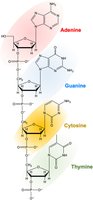
Nucleic acids are polymers of nucleotides and serve as informational molecules (DNA, RNA).
Proteins are polymers of amino acids with diverse functions including catalysis, structure, and signaling.
Polysaccharides are polymers of monosaccharides, functioning in energy storage and structural support.
Polymerization Mechanism
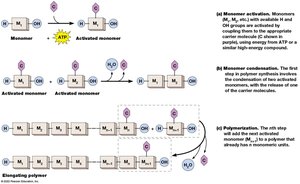
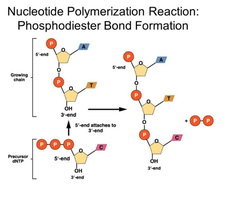
Macromolecules are synthesized by condensation reactions, which join monomers by removing water.
Monomers are often activated by coupling to carrier molecules (e.g., tRNA for amino acids, ADP/UDP for sugars) and require energy input, typically from ATP.
Polymers have directionality, meaning their ends are chemically distinct.
Condensation and Hydrolysis
Condensation reactions build polymers by removing water, while hydrolysis breaks polymers by adding water.
Self-Assembly and Protein Folding
Forces in Protein Folding
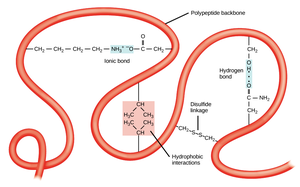
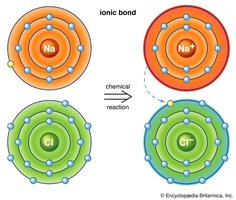
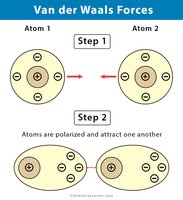
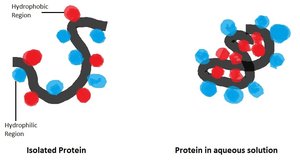
Protein folding is driven by hydrogen bonds, ionic bonds, van der Waals interactions, and hydrophobic interactions.
These non-covalent interactions stabilize the three-dimensional structure of proteins.
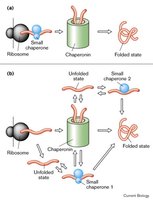
Protein Folding and Chaperones
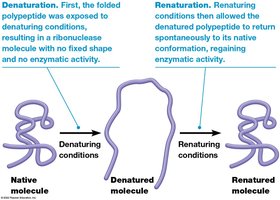
Proteins can fold spontaneously into their functional conformations, but some require assistance from molecular chaperones.
Denaturation is the loss of structure and function, while renaturation is the regaining of native structure under suitable conditions.
Concept Checks and Applications
Key Questions
What is an amphipathic molecule? An amphipathic molecule contains both hydrophilic and hydrophobic regions, crucial for membrane structure and function.
Why are membranes lipid bilayers and not monolayers? Bilayers form spontaneously due to the amphipathic nature of phospholipids, creating a stable barrier in aqueous environments.
What does it mean for a membrane to be selectively permeable? It allows certain molecules to pass while restricting others, maintaining cellular homeostasis.
Application Example
If a drug is large and polar and cannot cross the membrane, strategies such as encapsulation in liposomes, conjugation to carrier molecules, or use of transport proteins can facilitate its entry into cells.
Experimental Observations
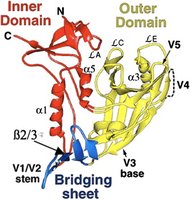
Mixing RNA and coat protein from the same strain of TMV forms infectious virions, indicating self-assembly and specificity of viral components.
Mixing RNA from one strain with coat protein from another yields infectious particles of the RNA strain, showing that genetic information is carried by RNA.
Coat protein monomers can self-assemble into helical structures even without RNA, demonstrating the intrinsic self-assembly properties of proteins.
