 Indietro
The Macromolecules of the Cell: Structure, Function, and Biological Importance
Guida di studio - Note intelligenti
 Appunti personalizzati basati sui tuoi materiali, ampliati con definizioni chiave, esempi e contesto.
The Macromolecules of the Cell
Introduction
Macromolecules are large, complex molecules essential for life, including proteins, nucleic acids, polysaccharides, and lipids. They are primarily polymers, synthesized by linking small monomeric units through condensation reactions. Understanding their structure and function is fundamental to cell biology.
Proteins
Classes and Functions of Proteins
Proteins are ubiquitous and versatile macromolecules, classified into nine major functional groups:
Enzymes: Catalyze biochemical reactions, increasing reaction rates.
Structural proteins: Provide physical support and shape to cells and tissues.
Motility proteins: Involved in cellular movement and contraction.
Regulatory proteins: Control and coordinate cellular functions.
Transport proteins: Facilitate movement of substances across membranes.
Signaling proteins: Mediate communication between cells.
Receptor proteins: Detect and respond to chemical stimuli.
Defensive proteins: Protect against disease (e.g., antibodies).
Storage proteins: Serve as reservoirs of amino acids.
Amino Acids: The Monomers of Proteins
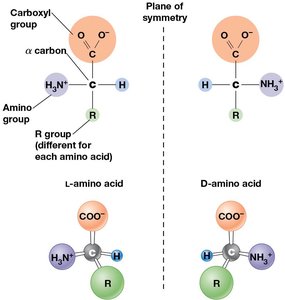
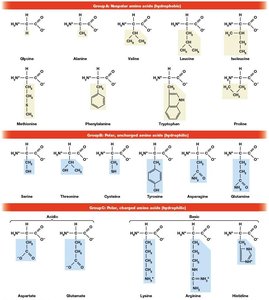
Proteins are polymers of amino acids. There are 20 standard amino acids, each with a central (α) carbon, an amino group, a carboxyl group, a hydrogen atom, and a unique side chain (R group). The properties of amino acids are determined by their R groups, which can be nonpolar (hydrophobic), polar uncharged, or polar charged (acidic or basic).
Peptide Bond Formation and Polypeptides
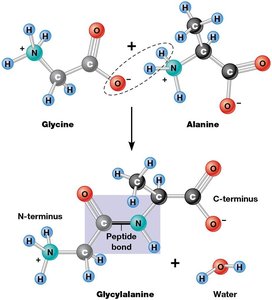
Amino acids are linked by peptide bonds formed through dehydration (condensation) reactions, resulting in a polypeptide chain with directionality: the N-terminus (amino end) and C-terminus (carboxyl end).
Protein Structure: Levels of Organization
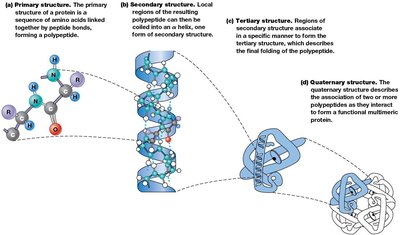
Protein structure is described at four hierarchical levels:
Primary structure: Linear sequence of amino acids.
Secondary structure: Local folding into α helices and β sheets, stabilized by hydrogen bonds.
Tertiary structure: Overall three-dimensional conformation, determined by interactions among R groups.
Quaternary structure: Association of multiple polypeptide subunits into a functional protein complex.
Bonds and Interactions in Protein Folding
Protein folding and stability depend on both covalent and noncovalent interactions:
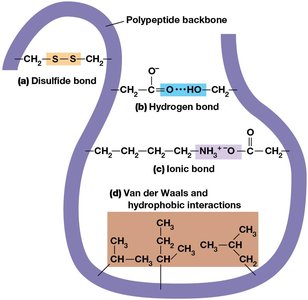
Disulfide bonds: Covalent bonds between cysteine residues, stabilizing structure.
Hydrogen bonds: Between backbone or side chain groups, stabilizing secondary and tertiary structures.
Ionic bonds: Between charged side chains (electrostatic interactions).
Van der Waals interactions: Weak attractions between nonpolar groups.
Hydrophobic interactions: Nonpolar side chains aggregate to avoid water.
Examples of Protein Structure
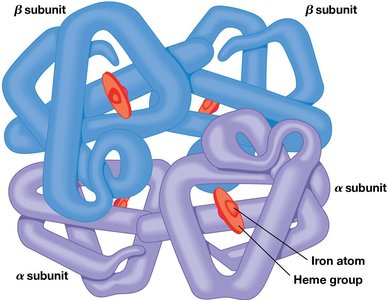
Hemoglobin: A tetrameric protein with two α and two β subunits, each containing a heme group for oxygen binding.
Secondary Structure: α Helix and β Sheet
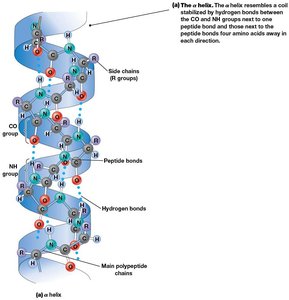
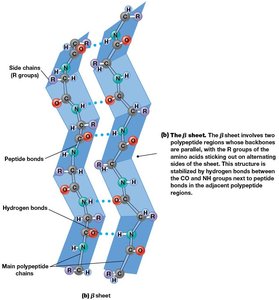
The α helix is a right-handed coil stabilized by hydrogen bonds every fourth amino acid. The β sheet consists of extended strands connected laterally by hydrogen bonds, forming parallel or antiparallel arrangements.
Motifs and Domains
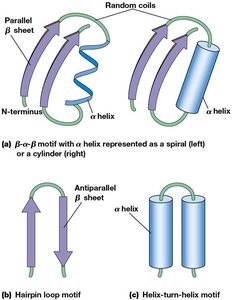
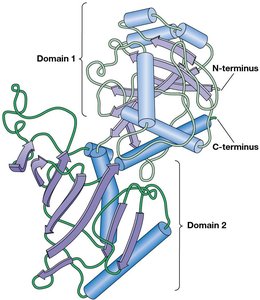
Motifs are combinations of secondary structures (e.g., β–α–β, hairpin loop, helix-turn-helix) found in many proteins. Domains are discrete, functionally and structurally independent units within a protein, often associated with specific functions.
Nucleic Acids
Structure and Function
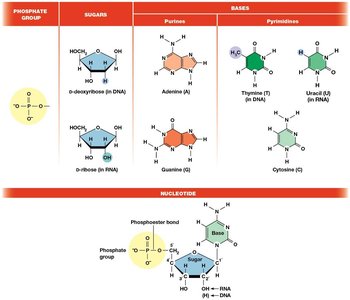
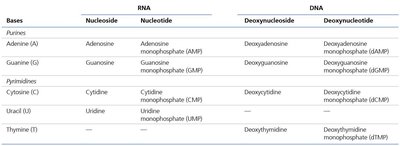
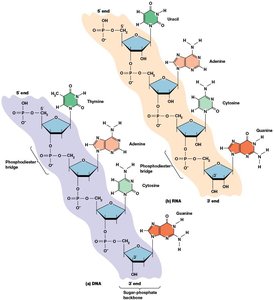
Nucleic acids (DNA and RNA) are polymers of nucleotides that store, transmit, and express genetic information. DNA contains deoxyribose, while RNA contains ribose. Each nucleotide consists of a five-carbon sugar, a phosphate group, and a nitrogenous base (purine or pyrimidine).
Polymerization and Base Pairing
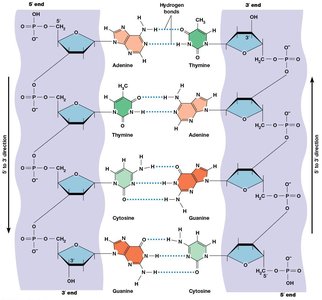
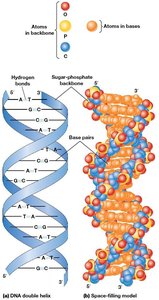
Nucleotides are linked by 3′,5′ phosphodiester bonds, forming a sugar-phosphate backbone with directionality (5′ to 3′). Complementary base pairing (A-T/U, G-C) is fundamental for DNA structure and replication.
Polysaccharides
Structure and Classification
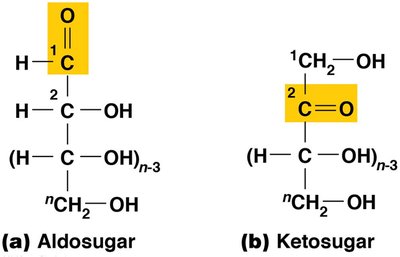
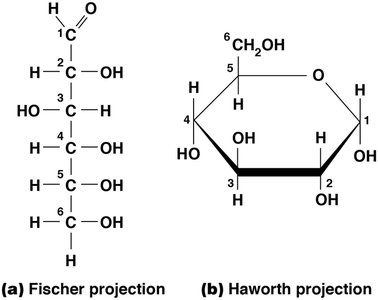
Polysaccharides are long chains of monosaccharides (simple sugars) and serve as energy storage (e.g., starch, glycogen) or structural components (e.g., cellulose, chitin). Monosaccharides are classified by the number of carbons and the position of the carbonyl group (aldose or ketose).
Disaccharides and Glycosidic Bonds
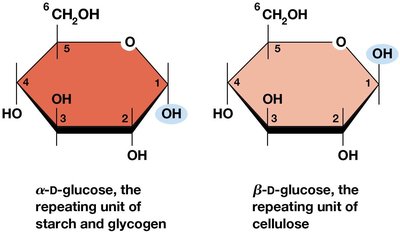
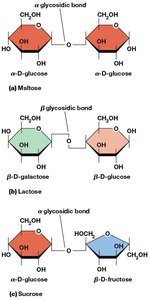
Disaccharides are formed by glycosidic bonds between two monosaccharides. The type of glycosidic bond (α or β) determines the properties of the resulting polysaccharide.
Storage and Structural Polysaccharides
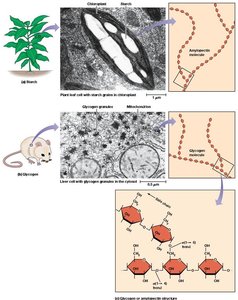
Starch (plants) and glycogen (animals, bacteria) are storage polysaccharides composed of α-D-glucose. Cellulose (plants) and chitin (fungi, arthropods) are structural polysaccharides composed of β-D-glucose or its derivatives.
Lipids
Classification and Properties
Lipids are hydrophobic or amphipathic molecules, not true polymers, but essential for membrane structure, energy storage, and signaling. Major classes include fatty acids, triacylglycerols, phospholipids, glycolipids, steroids, and terpenes.
Fatty Acids and Triacylglycerols
Fatty acids are long hydrocarbon chains with a carboxyl group. They can be saturated (no double bonds) or unsaturated (one or more double bonds). Triacylglycerols (triglycerides) are storage lipids composed of glycerol and three fatty acids.
Phospholipids and Membrane Structure
Phospholipids are amphipathic molecules forming the basis of biological membranes. They include phosphoglycerides and sphingolipids, each with distinct structural features and roles in membrane dynamics.
Glycolipids, Steroids, and Terpenes
Glycolipids contain carbohydrate groups and are important in cell recognition. Steroids, such as cholesterol, have a four-ring structure and serve as membrane components and hormone precursors. Terpenes are derived from isoprene and include vitamins and pigments.
Summary Table: Common Small Molecules in Cells
Kind of Molecule | Number Present | Names of Molecules | Role in Cell |
|---|---|---|---|
Amino acids | 20 | See list in Table 3-2 | Monomeric units of all proteins |
Aromatic bases | 5 | Adenine, Cytosine, Guanine, Thymine, Uracil | Components of nucleic acids |
Sugars | Varies | Ribose, Deoxyribose, Glucose | Energy metabolism; components of RNA, DNA, starch, glycogen |
Lipids | Varies | Fatty acids, Cholesterol | Energy metabolism; membrane structure |
Additional info: This summary integrates and expands upon the provided lecture slides and textbook images, ensuring a comprehensive, exam-ready overview of the macromolecules of the cell for college-level cell biology students.
