Skip to main content
College Algebra
Il mio corso
Impara
Preparazione agli esami
AI Tutor
Guide di studio
Soluzioni per libri di testo
Flashcard
Esplora
Prova l'app
Il mio corso
Impara
Preparazione agli esami
AI Tutor
Guide di studio
Soluzioni per libri di testo
Flashcard
Esplora
Prova l'app
Indietro
Combinatorics definitions
Puoi toccare per girare la carta.
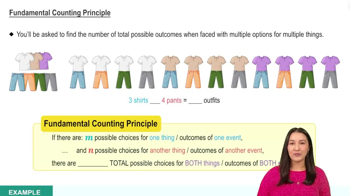
Fundamental Counting Principle
Puoi toccare per girare la carta.
👆
Fundamental Counting Principle
A rule stating that the total number of outcomes is found by multiplying the number of choices for each independent event.
Avanzamenti del tracciato
I pulsanti di controllo sono stati cambiati in modalità "navigazione".
1/15
Flashcard correlate
Pratica correlata
Video consigliati
Combinatorics quiz
Combinatorics
15 Termini
Combinatorics
10. Combinatorics & Probability
4 Problemi
Argomento
Callie
Probability
10. Combinatorics & Probability
3 Problemi
Argomento
Callie
10. Combinatorics & Probability
3 Argomenti
5 Problemi
Capitolo
Justin
3:18
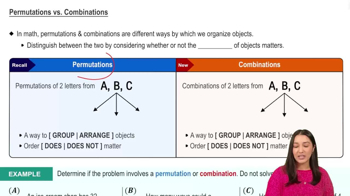
Permutations vs. Combinations
1582
views
2
rank
4:04
Fundamental Counting Principle
1525
views
11
rank
6:37
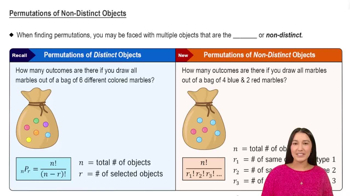
Permutations of Non-Distinct Objects
1099
views
3
rank
Termini in questo insieme (15)
Nascondere definizioni
Fundamental Counting Principle
A rule stating that the total number of outcomes is found by multiplying the number of choices for each independent event.
Permutation
An arrangement of items where the order is important, calculated using factorials and a specific formula.
Combination
A selection of items where the order is irrelevant, found by dividing the permutation count by an additional factorial.
Factorial
A product of all positive integers up to a given number, denoted by an exclamation mark.
Distinct Objects
Items that are all different from each other, requiring no adjustment for repeats in counting.
Non-distinct Objects
Items that include repetitions, requiring division by the factorials of repeated counts in arrangements.
Outcome
A possible result from a choice or event, such as a specific outfit or a coin flip result.
Arrangement
A specific order in which items are placed, relevant in permutation problems.
Selection
A group chosen from a larger set, where order may or may not matter depending on context.
Notation
A symbolic representation, such as P(N, R) for permutations or C(N, R) for combinations.
Order
A property indicating whether the sequence of items affects the outcome, crucial for distinguishing permutations from combinations.
Team Formation
A scenario involving the grouping of individuals, typically solved using combinations when order is irrelevant.
Lineup
An ordered sequence of people or items, often addressed with permutation calculations.
Appetizer-Entree Pairing
A practical example of the fundamental counting principle, involving choices from two categories.
Word Bank
A set of possible answers for fill-in-the-blank questions, used in permutation problems when each answer is unique.
 IndietroIndietro

 3:18
3:18