Skip to main content
College Algebra
Il mio corso
Impara
Preparazione agli esami
AI Tutor
Guide di studio
Soluzioni per libri di testo
Flashcard
Esplora
Prova l'app
Il mio corso
Impara
Preparazione agli esami
AI Tutor
Guide di studio
Soluzioni per libri di testo
Flashcard
Esplora
Prova l'app
Indietro
Combinatorics quiz
Puoi toccare per girare la carta.
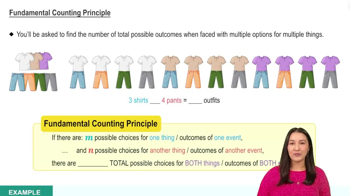
What does the fundamental counting principle state about finding the total number of possible outcomes when faced with multiple options?
Puoi toccare per girare la carta.
👆
What does the fundamental counting principle state about finding the total number of possible outcomes when faced with multiple options?
It states that you multiply the number of choices for each option to get the total number of possible outcomes.
Avanzamenti del tracciato
I pulsanti di controllo sono stati cambiati in modalità "navigazione".
1/15
Flashcard correlate
Pratica correlata
Video consigliati
Combinatorics definitions
Combinatorics
15 Termini
Combinatorics
10. Combinatorics & Probability
4 Problemi
Argomento
Callie
Probability
10. Combinatorics & Probability
3 Problemi
Argomento
Callie
10. Combinatorics & Probability
3 Argomenti
5 Problemi
Capitolo
Justin
3:18
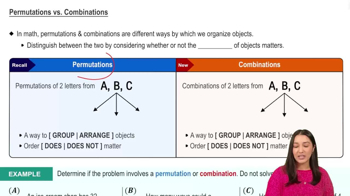
Permutations vs. Combinations
1582
views
2
rank
4:04
Fundamental Counting Principle
1525
views
11
rank
6:37
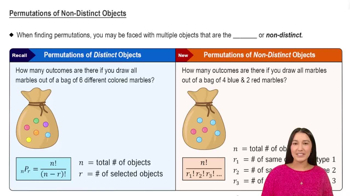
Permutations of Non-Distinct Objects
1099
views
3
rank
Termini in questo insieme (15)
Nascondere definizioni
What does the fundamental counting principle state about finding the total number of possible outcomes when faced with multiple options?
It states that you multiply the number of choices for each option to get the total number of possible outcomes.
How many different outfits can you make with 3 shirts and 4 pairs of pants?
You can make 12 different outfits by multiplying 3 shirts by 4 pairs of pants.
If you have 4 shirts, 5 pairs of pants, and 3 pairs of shoes, how do you calculate the total number of outfits?
Multiply the number of each clothing item: 4 × 5 × 3 = 60 possible outfits.
What is a permutation and when does order matter?
A permutation is an arrangement of items where the order matters.
What is the formula for the number of permutations of n things taken r at a time?
The formula is n! divided by (n - r)!, or n!/(n - r)!
How do you adjust the permutation formula for non-distinct (repeated) objects?
Divide n! by the factorial of each group of identical objects, so the formula is n!/(r1! × r2! × ...).
How many ways can you arrange the letters in the word 'banana'?
There are 60 ways, calculated as 6!/(1! × 3! × 2!) = 60.
What is the main difference between permutations and combinations?
Permutations consider order important, while combinations do not.
How do you determine if a problem is a permutation or a combination?
Ask if the order of selection matters; if yes, it's a permutation; if no, it's a combination.
What is the formula for combinations of n things taken r at a time?
The formula is n! divided by (n - r)! times r!, or n!/(n - r)!r!.
How many ways can you select 2 flavors from 32 ice cream options for a milkshake?
There are 496 ways, calculated as 32!/(30! × 2!) = 496.
How many different teams of 4 can be formed from a group of 9 people?
There are 126 teams, calculated as 9!/(5! × 4!) = 126.
If you have 5 zeros and 3 ones, how many different 8-digit codes can you make?
There are 56 codes, calculated as 8!/(5! × 3!) = 56.
When using the permutations formula, what does 'n' represent?
'n' is the total number of items or options available.
Why do you divide by r! in the combinations formula?
Because order does not matter in combinations, dividing by r! removes duplicate arrangements of the same group.
 IndietroIndietro

 3:18
3:18