 Indietro
Linear Equations and Inequalities in One Variable: Study Notes
Guida di studio - Note intelligenti
 Appunti personalizzati basati sui tuoi materiali, ampliati con definizioni chiave, esempi e contesto.
Linear Equations and Inequalities in One Variable
Introduction to Linear Inequalities
Linear inequalities in one variable are mathematical statements that compare algebraic expressions using inequality symbols. These inequalities are foundational in algebra and are used to describe ranges of possible solutions rather than a single value.
Linear Inequality: An inequality of the form ax + b \leq c, where a, b, and c are real numbers and x is the variable.
Inequality Symbols:
< (less than)
> (greater than)
≤ (less than or equal to)
≥ (greater than or equal to)
Graphing Solutions of Linear Inequalities
The solution set of a linear inequality consists of all real numbers that satisfy the inequality. These solutions are represented visually on a number line.
Graph of an Inequality: Shading on a number line indicates all solutions. Arrows show the direction of the solution set extending to infinity.
Endpoints:
Square brackets [ ] indicate the endpoint is included (for ≤ or ≥).
Parentheses ( ) indicate the endpoint is not included (for < or >).
Example: The inequality x < 4 is graphed by shading all points to the left of 4, with a parenthesis at 4 to show it is not included.
Interval Notation and Set-Builder Notation
Solutions to inequalities can be expressed using interval notation or set-builder notation. Interval notation uses parentheses and brackets to describe the set of solutions, while set-builder notation uses a descriptive statement.
Interval Notation: Uses ( ) for values not included and [ ] for values included.
Set-Builder Notation: Describes the set using a variable and a condition, e.g., {x | x > a}.
Example: The solution to -4 \leq x < 1 is written in interval notation as [-4, 1).
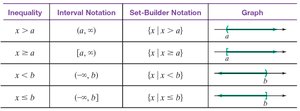
Inequality | Interval Notation | Set-Builder Notation | Graph |
|---|---|---|---|
x > a | (a, \infty) | {x | x > a} | Arrow to the right from a, parenthesis at a |
x \geq a | [a, \infty) | {x | x \geq a} | Arrow to the right from a, bracket at a |
x < b | (-\infty, b) | {x | x < b} | Arrow to the left from b, parenthesis at b |
x \leq b | (-\infty, b] | {x | x \leq b} | Arrow to the left from b, bracket at b |
Properties of Inequalities
Solving linear inequalities relies on several key properties, similar to those used for equations, with special attention when multiplying or dividing by negative numbers.
Addition/Subtraction Property: Adding or subtracting the same value from both sides does not change the inequality's direction.
Multiplication/Division Property: Multiplying or dividing both sides by a positive number keeps the direction; by a negative number, reverses the direction.
Example: To solve x + 6 < 9:
Subtract 6 from both sides:
Simplifies to:
Solving Linear Inequalities: Step-by-Step
Follow these steps to solve a linear inequality:
Simplify both sides of the inequality.
Use the addition property to collect variable terms on one side and constants on the other.
Use the multiplication property to isolate the variable. Reverse the inequality sign if multiplying or dividing by a negative number.
Express the solution in interval or set-builder notation and graph it on a number line.
Example: Solve
Expand:
Simplify:
Subtract from both sides:
Add 8 to both sides: or
Interval notation:
Special Cases: No Solution or All Real Numbers
Some inequalities have no solution or are true for all real numbers. This is determined by simplifying the inequality until the variable is eliminated.
No Solution: Results in a false statement (e.g., ). The solution set is the empty set, .
All Real Numbers: Results in a true statement (e.g., ). The solution set is or {x | x is a real number}.
Example: Solve
Expand:
Subtract from both sides: (False)
No solution:
Example: Solve
Expand:
Subtract from both sides: (True)
All real numbers:
Applications: Solving Real-World Problems with Linear Inequalities
Linear inequalities are used to model and solve real-world problems, such as determining minimum grades needed to achieve a desired average.
Example: To earn a B in a course, a student must have a final average of at least 80%. If the first three exam grades are 82%, 74%, and 78%, and the final counts as two grades, let x be the final exam grade. The average must satisfy:
Solve for x to find the minimum score needed on the final exam.
Conclusion: Linear inequalities are essential tools in algebra for describing ranges of solutions and solving practical problems. Mastery of their properties, notation, and solution methods is foundational for further study in mathematics.
