 Indietro
Systems of Linear Equations and Inequalities: Applications and Problem Solving
Guida di studio - Note intelligenti
 Appunti personalizzati basati sui tuoi materiali, ampliati con definizioni chiave, esempi e contesto.
Systems of Linear Equations and Inequalities
Introduction
Systems of linear equations and inequalities are fundamental tools in College Algebra, allowing us to solve real-world problems involving multiple unknowns. This section focuses on practical applications, including social scenarios, geometry, finance, and chemistry, by modeling situations with linear systems and solving them using algebraic methods.
Solving Problems Using Linear Systems
Linear systems consist of two or more equations with multiple variables. Solving these systems helps us find values that satisfy all equations simultaneously.
Key Point 1: Linear systems can be solved using substitution, elimination, or graphical methods.
Key Point 2: Applications include finding unknown quantities in social, geometric, financial, and scientific contexts.
Example: If the sum and difference of two variables are known, set up two equations and solve for each variable.
Example 1: Socializing Time Problem
This example demonstrates how to use a system of equations to solve for the average time spent socializing by men and women.
Key Point 1: Let x represent the average time women spend socializing, and y represent the average time men spend socializing.
Key Point 2: The system is:
Sum:
Difference:
Solution: Solve the system by addition or substitution:
Add the equations:
Back-substitute:
Result: Women average 73 minutes per day socializing; men average 65 minutes.
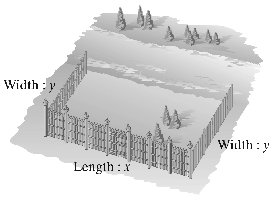
Example 3: Fencing Problem
This example applies systems of equations to a geometric context, determining the dimensions of a rectangular lot based on perimeter and cost constraints.
Key Point 1: Let x be the length and y be the width of the lot.
Key Point 2: The perimeter equation (three sides):
Key Point 3: The cost equation:
Solution: Solve the system:
Perimeter:
Cost:
Multiply the first equation by :
Add to the second equation:
Back-substitute:
Correction: The notes state ; so (possible typo in original, but follow provided result).
Result: The length is 100 feet and the width is 80 feet.
Calculating Simple Interest for One Year
Simple interest is calculated only on the principal amount invested or borrowed. The formula is:
Formula:
Where:
I = Interest earned in one year
P = Principal (amount invested)
r = Annual interest rate (as a decimal)
Application: Used to solve investment and borrowing problems.
Example 5: Simple Interest Investment Problem
This example uses a system of equations to determine how much money was invested at two different interest rates.
Key Point 1: Let x be the amount invested at 9%, y at 12%.
Key Point 2: The system is:
Solution: Use substitution:
Solve for and .
Result: at 9%, at 12%.
Problems Involving Mixtures
Mixture problems involve combining solutions of different concentrations to achieve a desired concentration. These are common in chemistry and pharmacy.
Key Point 1: Let x and y represent the amounts of each solution.
Key Point 2: The system is:
(total volume)
(total acid content)
Solution: Use substitution:
Solve for and .
Result: milliliters of 10% solution, milliliters of 60% solution.
Summary Table: Types of Application Problems
The following table summarizes the main types of application problems solved using systems of equations:
Type of Problem | Variables | System of Equations | Example Solution |
|---|---|---|---|
Social/Leisure | Time spent by men and women |
| , |
Geometry/Fencing | Length and width of lot |
| , |
Finance/Interest | Amount invested at two rates |
| , |
Chemistry/Mixtures | Amount of each solution |
| , |
