Ch. 1 - Equations and Inequalities
Blitzer - College Algebra 8th Edition
Blitzer8th EditionCollege AlgebraISBN: 9780136970514Non è quello che usi tu?Cambia libro di testo
Capitolo 2, Problema 99

In Exercises 99–106, solve each equation. [(3 + 6)2 ÷ 3] × 4 = - 54 x

Guida verificata passo dopo passo
1
First, simplify the expression inside the parentheses: calculate \(3 + 6\).
Next, square the result from the first step: compute \((3 + 6)^2\).
Then, divide the squared result by 3: calculate \(\frac{(3 + 6)^2}{3}\).
Multiply the quotient by 4 as indicated: compute \(\left(\frac{(3 + 6)^2}{3}\right) \times 4\).
Set the expression equal to \(-54x\) and solve for \(x\) by isolating \(x\) on one side of the equation.

Risposta video verificata per un problema simile:

Questa soluzione video è stata consigliata dai nostri tutor come utile per risolvere questo problema.
Durata del video:
2m

Concetti chiave

Ecco i concetti essenziali che devi comprendere per rispondere correttamente alla domanda.

Order of Operations

The order of operations dictates the sequence in which mathematical operations are performed: parentheses first, then exponents, followed by multiplication and division (from left to right), and finally addition and subtraction. Correctly applying this ensures accurate simplification of expressions.
Video consigliato:
8:38
Performing Row Operations on Matrices

Solving Linear Equations

Solving linear equations involves isolating the variable on one side of the equation using inverse operations such as addition, subtraction, multiplication, or division. The goal is to find the value of the variable that makes the equation true.
Video consigliato:
04:02
Solving Linear Equations with Fractions

Distributive Property and Simplification

The distributive property allows you to multiply a sum by multiplying each addend separately and then adding the products. Simplifying expressions using this property helps in reducing complex expressions to simpler forms, making it easier to solve equations.
Video consigliato:
04:15
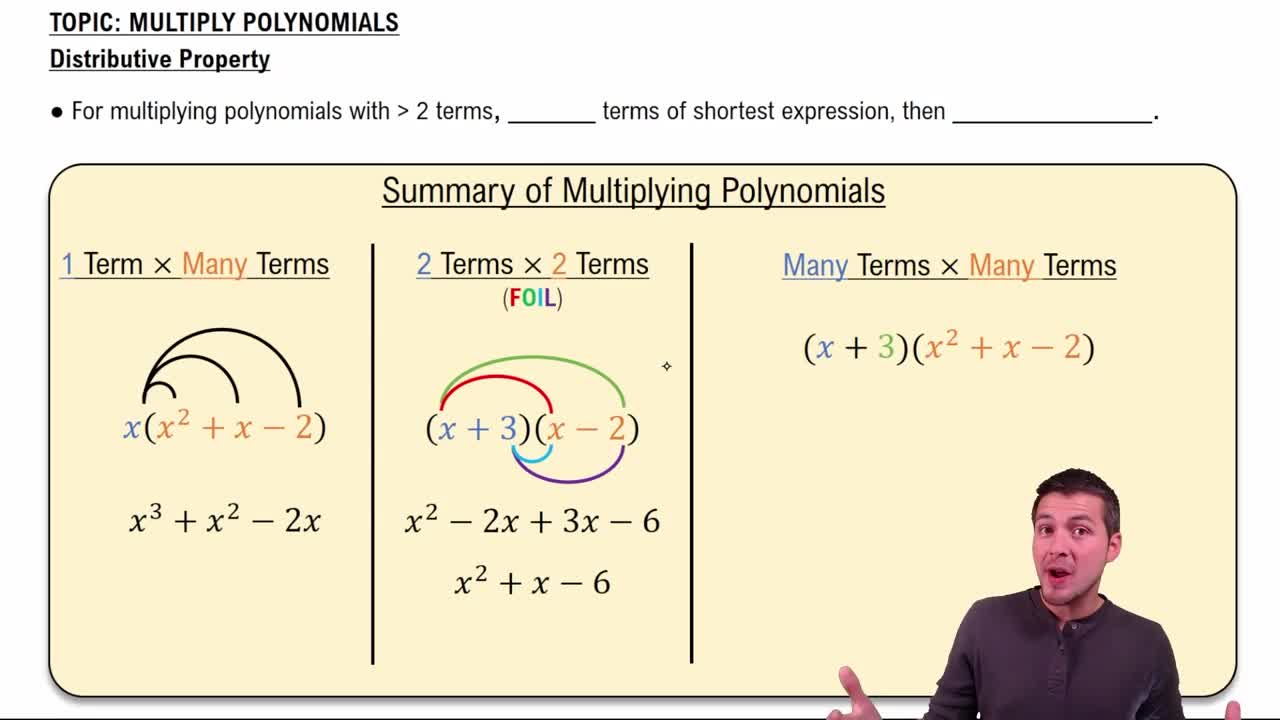
Multiply Polynomials Using the Distributive Property