Ch. 1 - Equations and Inequalities
Blitzer - College Algebra 8th Edition
Blitzer8th EditionCollege AlgebraISBN: 9780136970514Non è quello che usi tu?Cambia libro di testo
Capitolo 2, Problema 13

Solve each equation in Exercises 1 - 14 by factoring. 7 - 7x = (3x + 2)(x - 1)

Guida verificata passo dopo passo
1
Start by expanding the right-hand side of the equation \(7 - 7x = (3x + 2)(x - 1)\) using the distributive property (FOIL method): multiply each term in the first binomial by each term in the second binomial.
After expanding, rewrite the equation so that all terms are on one side, setting the equation equal to zero. This means subtracting the entire right-hand side expression from the left-hand side.
Combine like terms to simplify the equation into a standard quadratic form: $ax^2 + bx + c = 0$.
Factor the quadratic expression obtained. Look for two numbers that multiply to \(a \times c\) and add to \(b\), or use other factoring techniques such as grouping or special products.
Set each factor equal to zero and solve for \(x\) to find the solutions to the original equation.

Risposta video verificata per un problema simile:

Questa soluzione video è stata consigliata dai nostri tutor come utile per risolvere questo problema.
Durata del video:
2m

Concetti chiave

Ecco i concetti essenziali che devi comprendere per rispondere correttamente alla domanda.

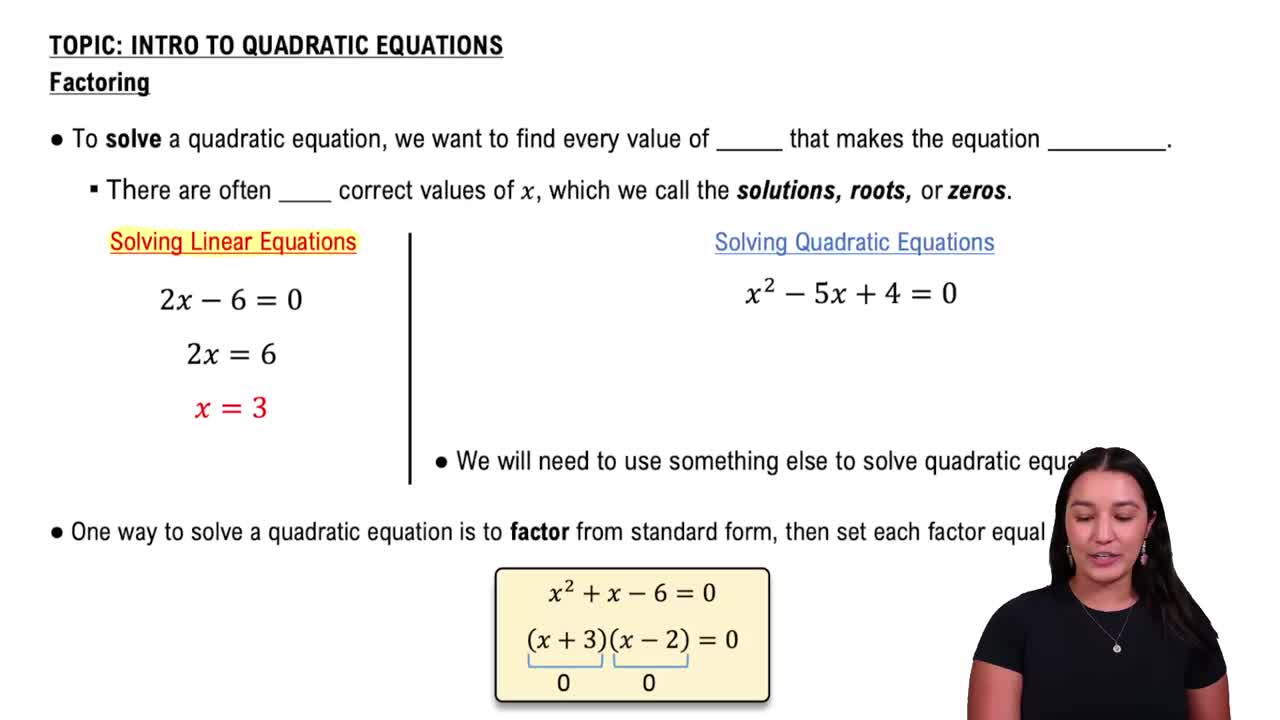
Factoring Quadratic Equations

Factoring involves rewriting a quadratic expression as a product of two binomials or other polynomials. This method is used to simplify equations and find their roots by setting each factor equal to zero.
Video consigliato:
06:08
Solving Quadratic Equations by Factoring

Setting Equations to Zero

To solve polynomial equations by factoring, the equation must be rearranged so that one side equals zero. This allows the use of the zero-product property, which states that if a product equals zero, at least one factor must be zero.
Video consigliato:
03:42
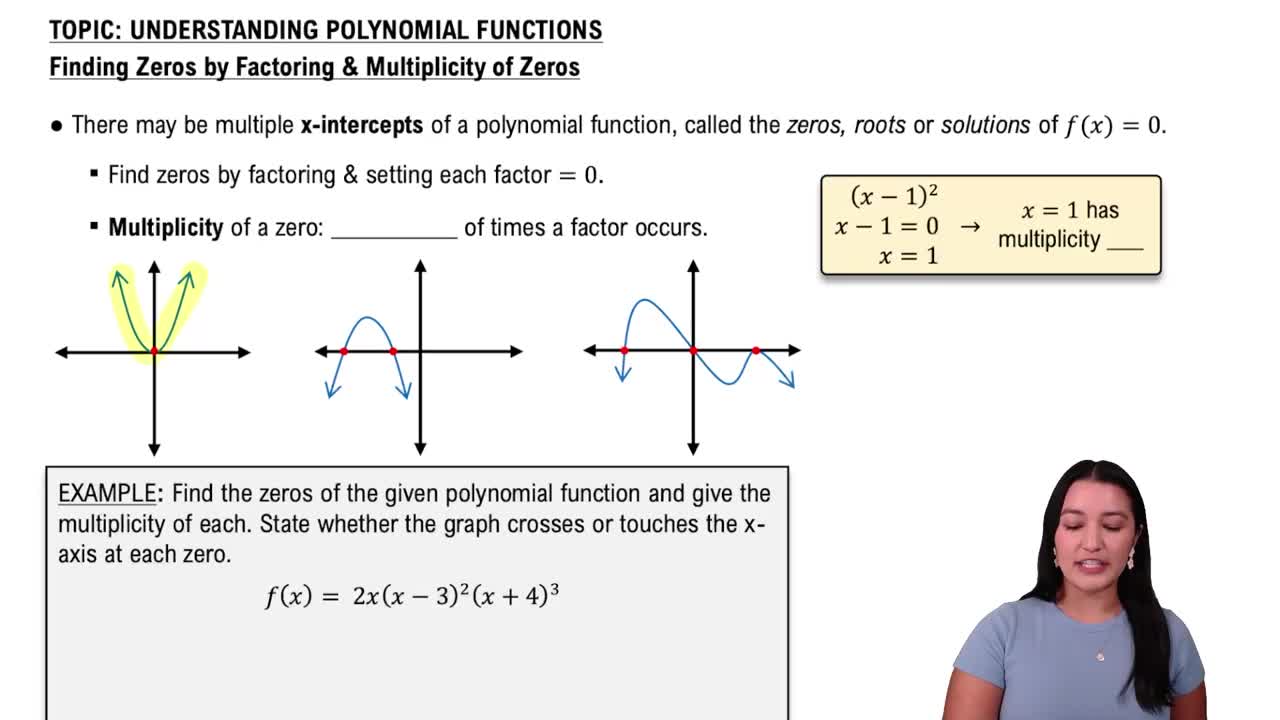
Finding Zeros & Their Multiplicity

Zero-Product Property

The zero-product property states that if the product of two expressions is zero, then at least one of the expressions must be zero. This principle is essential for solving equations after factoring, as it leads to finding the solutions.
Video consigliato:
3:49
Product, Quotient, and Power Rules of Logs