Ch. 1 - Equations and Inequalities
Blitzer - College Algebra 8th Edition
Blitzer8th EditionCollege AlgebraISBN: 9780136970514Non è quello che usi tu?Cambia libro di testo
Capitolo 2, Problema 70

Solve each equation using the quadratic formula. 2x2=3−4x2x^2 = 3-4x

Guida verificata passo dopo passo
1
Rewrite the given equation in standard quadratic form $ax^2 + bx + c = 0$. Start by moving all terms to one side: \(2x^2 + 4x - 3 = 0\).
Identify the coefficients \(a\), \(b\), and \(c\) from the quadratic equation. Here, \(a = 2\), \(b = 4\), and \(c = -3\).
Recall the quadratic formula: \(x = \frac{-b \pm \sqrt{b^2 - 4ac}}{2a}\). This formula will help find the roots of the quadratic equation.
Calculate the discriminant \(\Delta = b^2 - 4ac\) by substituting the values of \(a\), \(b\), and \(c\): \(\Delta = 4^2 - 4 \times 2 \times (-3)\).
Substitute the values of \(a\), \(b\), and the discriminant \(\Delta\) into the quadratic formula to express the solutions for \(x\): \(x = \frac{-4 \pm \sqrt{\Delta}}{2 \times 2}\).

Risposta video verificata per un problema simile:

Questa soluzione video è stata consigliata dai nostri tutor come utile per risolvere questo problema.
Durata del video:
3m

Concetti chiave

Ecco i concetti essenziali che devi comprendere per rispondere correttamente alla domanda.

Quadratic Equation Standard Form

A quadratic equation must be written in the standard form ax² + bx + c = 0 before applying the quadratic formula. This involves rearranging all terms to one side of the equation so that the other side equals zero, allowing identification of coefficients a, b, and c.
Video consigliato:
04:34
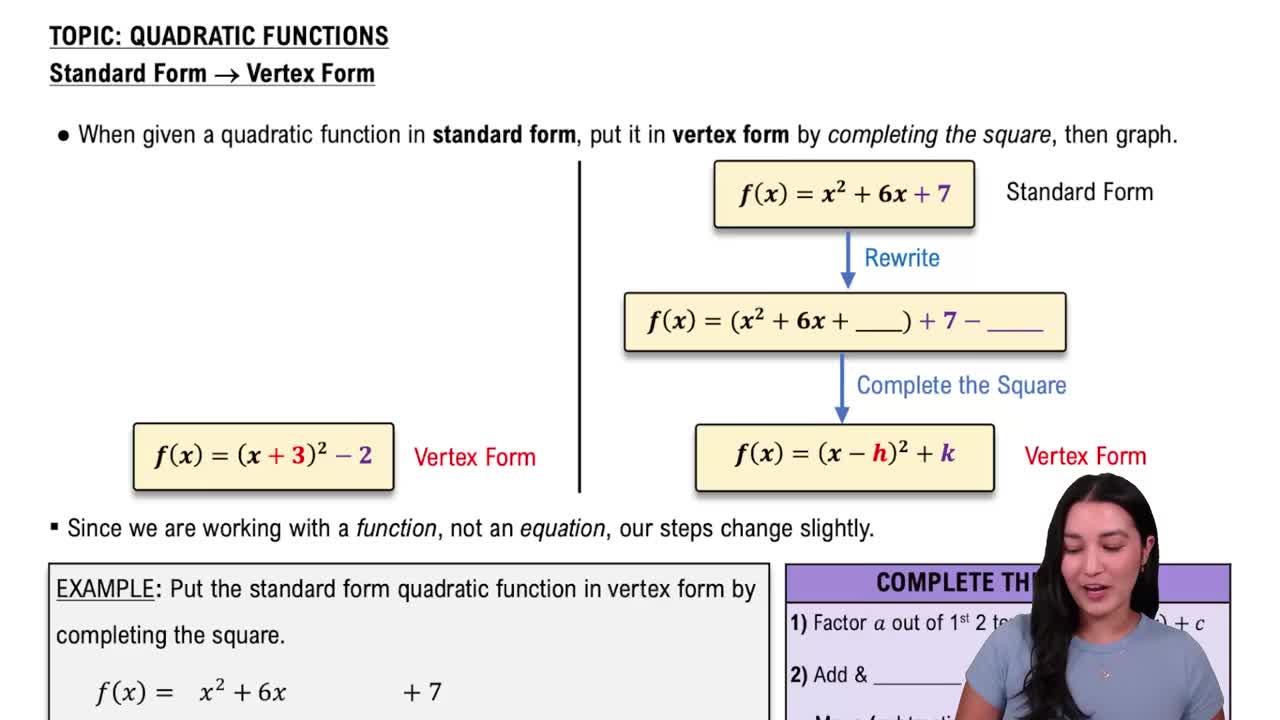
Converting Standard Form to Vertex Form

Quadratic Formula

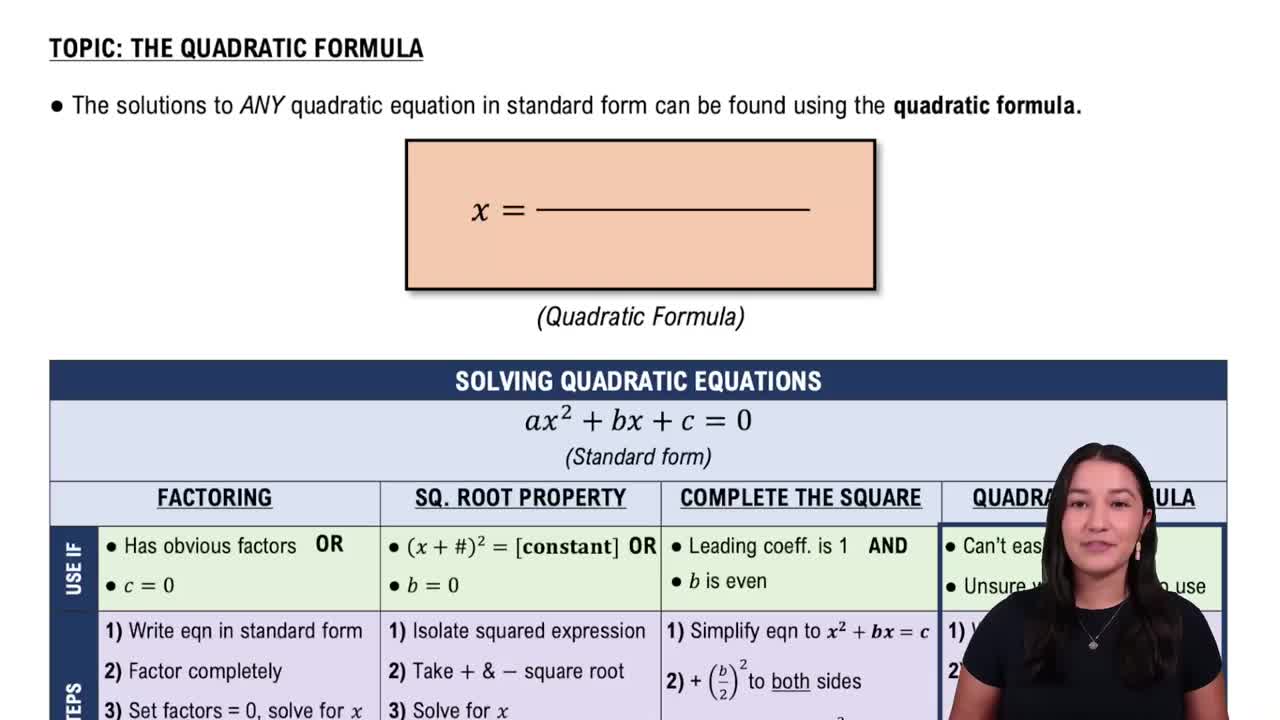
The quadratic formula x = (-b ± √(b² - 4ac)) / (2a) provides the solutions to any quadratic equation ax² + bx + c = 0. It uses the coefficients a, b, and c to calculate the roots, including real and complex solutions depending on the discriminant.
Video consigliato:
06:36
Solving Quadratic Equations Using The Quadratic Formula

Discriminant and Nature of Roots

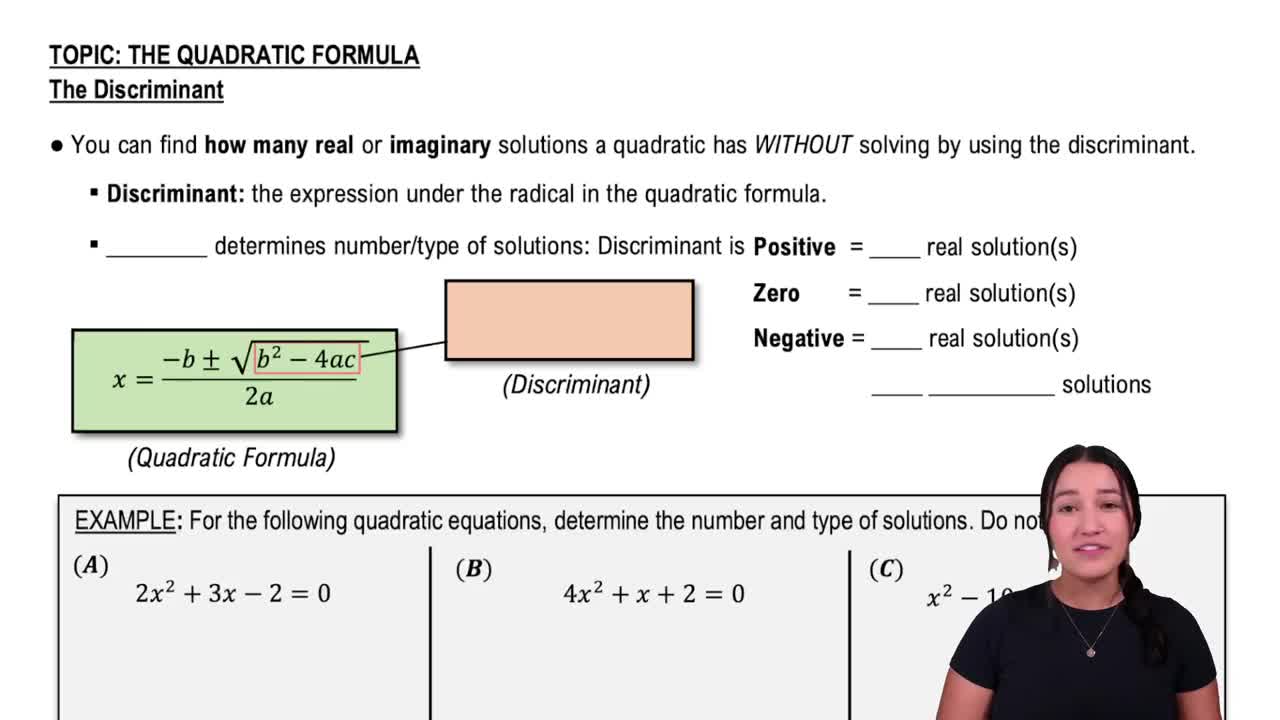
The discriminant, given by b² - 4ac, determines the type of roots of a quadratic equation. If positive, there are two distinct real roots; if zero, one real root; and if negative, two complex conjugate roots. This helps predict the solution's nature before calculation.
Video consigliato:
04:11
The Discriminant