Ch. 1 - Equations and Inequalities
Blitzer - College Algebra 8th Edition
Blitzer8th EditionCollege AlgebraISBN: 9780136970514Non è quello che usi tu?Cambia libro di testo
Capitolo 2, Problema 13

Solve each radical equation in Exercises 11–30. Check all proposed solutions. √(x + 3) = x - 3

Guida verificata passo dopo passo
1
Start by isolating the radical expression, which is already isolated as \( \sqrt{\!x + 3} = x - 3 \).
Square both sides of the equation to eliminate the square root. This gives \( (\sqrt{\!x + 3})^2 = (x - 3)^2 \), which simplifies to \( x + 3 = (x - 3)^2 \).
Expand the right side using the formula \( (a - b)^2 = a^2 - 2ab + b^2 \). So, \( (x - 3)^2 = x^2 - 6x + 9 \). Substitute this back to get \( x + 3 = x^2 - 6x + 9 \).
Rearrange the equation to set it equal to zero: \( 0 = x^2 - 6x + 9 - x - 3 \), which simplifies to \( 0 = x^2 - 7x + 6 \).
Solve the quadratic equation \( x^2 - 7x + 6 = 0 \) by factoring, completing the square, or using the quadratic formula. After finding the solutions, check each one in the original equation to ensure they do not produce extraneous solutions.

Risposta video verificata per un problema simile:

Questa soluzione video è stata consigliata dai nostri tutor come utile per risolvere questo problema.
Durata del video:
5m

Concetti chiave

Ecco i concetti essenziali che devi comprendere per rispondere correttamente alla domanda.

Radical Equations

Radical equations involve variables inside a root, often a square root. To solve them, isolate the radical expression and then eliminate the root by raising both sides to the appropriate power, typically squaring for square roots.
Video consigliato:
05:20
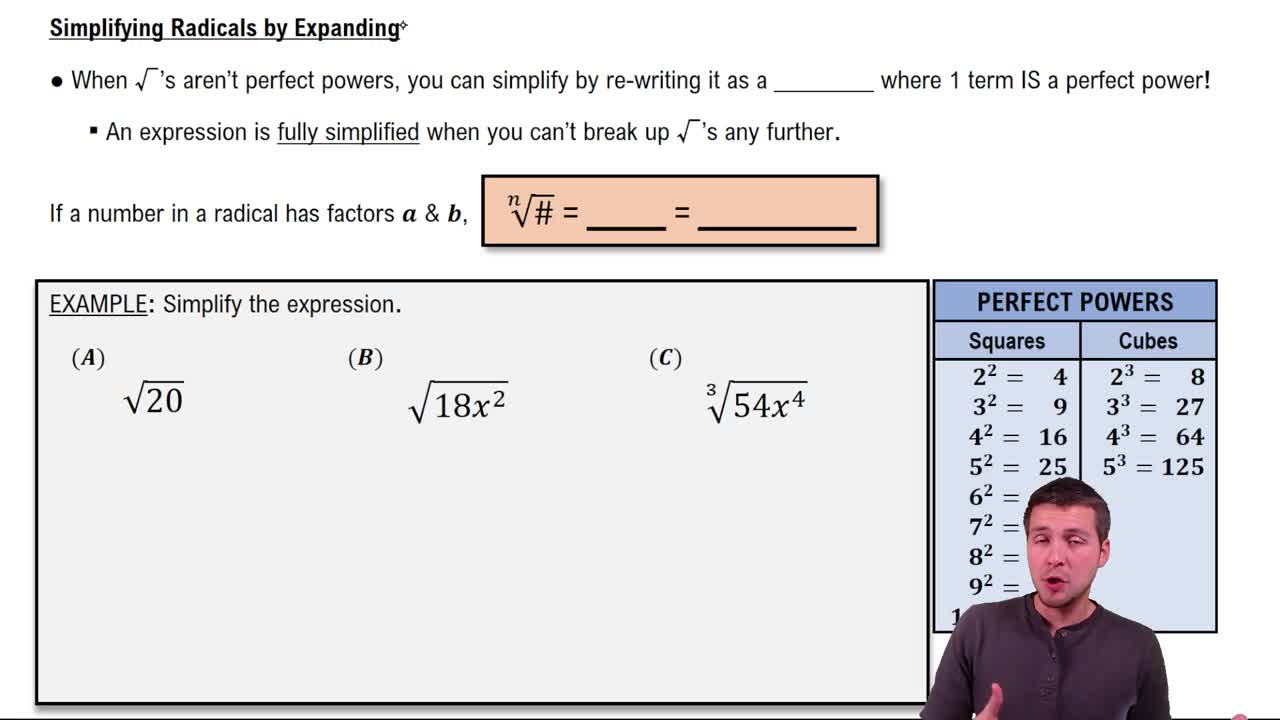
Expanding Radicals

Extraneous Solutions

When solving radical equations by squaring both sides, new solutions may appear that do not satisfy the original equation. These are called extraneous solutions and must be checked by substituting back into the original equation.
Video consigliato:
06:00
Categorizing Linear Equations

Domain Restrictions

The expression inside a square root must be non-negative for real solutions. This restriction limits the domain of the variable and must be considered before solving to avoid invalid solutions.
Video consigliato:
3:51
Domain Restrictions of Composed Functions