Ch. 1 - Equations and Inequalities
Blitzer - College Algebra 8th Edition
Blitzer8th EditionCollege AlgebraISBN: 9780136970514Non è quello che usi tu?Cambia libro di testo
Capitolo 2, Problema 88

Solve each radical equation in Exercises 88–89. √ (2x-3) + x = 3

Guida verificata passo dopo passo
1
Step 1: Isolate the radical expression on one side of the equation. Subtract x from both sides to get: √(2x - 3) = 3 - x.
Step 2: Eliminate the square root by squaring both sides of the equation. This gives: (√(2x - 3))² = (3 - x)². Simplify to get: 2x - 3 = (3 - x)(3 - x).
Step 3: Expand the right-hand side of the equation. Use the distributive property to expand (3 - x)(3 - x), which results in: 2x - 3 = 9 - 6x + x².
Step 4: Rearrange the equation into standard quadratic form. Combine all terms on one side of the equation to get: x² - 8x + 12 = 0.
Step 5: Solve the quadratic equation using factoring, the quadratic formula, or completing the square. After finding the solutions, substitute them back into the original equation to check for extraneous solutions introduced by squaring.

Risposta video verificata per un problema simile:

Questa soluzione video è stata consigliata dai nostri tutor come utile per risolvere questo problema.
Durata del video:
5m

Concetti chiave

Ecco i concetti essenziali che devi comprendere per rispondere correttamente alla domanda.

Radical Equations

Radical equations are equations that involve a variable within a radical (square root, cube root, etc.). To solve these equations, one typically isolates the radical on one side and then squares both sides to eliminate the radical. This process may introduce extraneous solutions, so it's essential to check all potential solutions in the original equation.
Video consigliato:
05:20
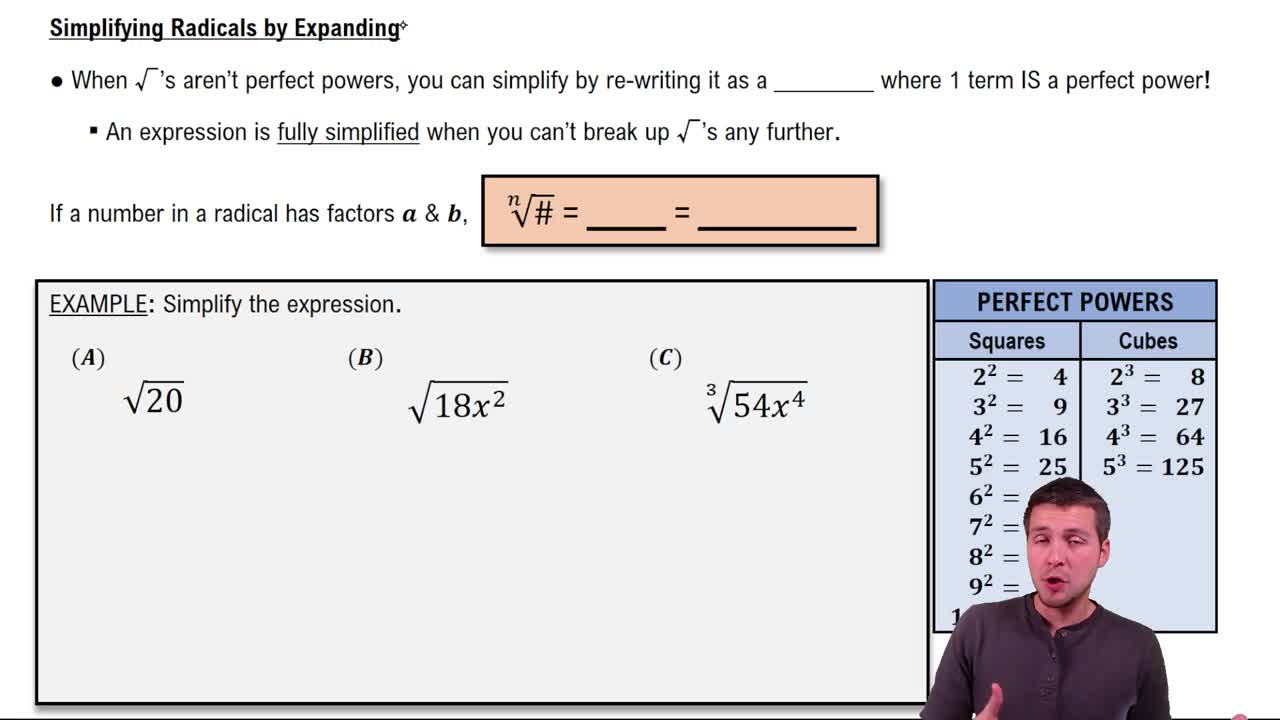
Expanding Radicals

Isolating the Variable

Isolating the variable is a fundamental algebraic technique used to solve equations. This involves rearranging the equation to get the variable on one side and all other terms on the opposite side. In the context of radical equations, isolating the radical before squaring both sides is crucial for correctly solving the equation.
Video consigliato:
05:28
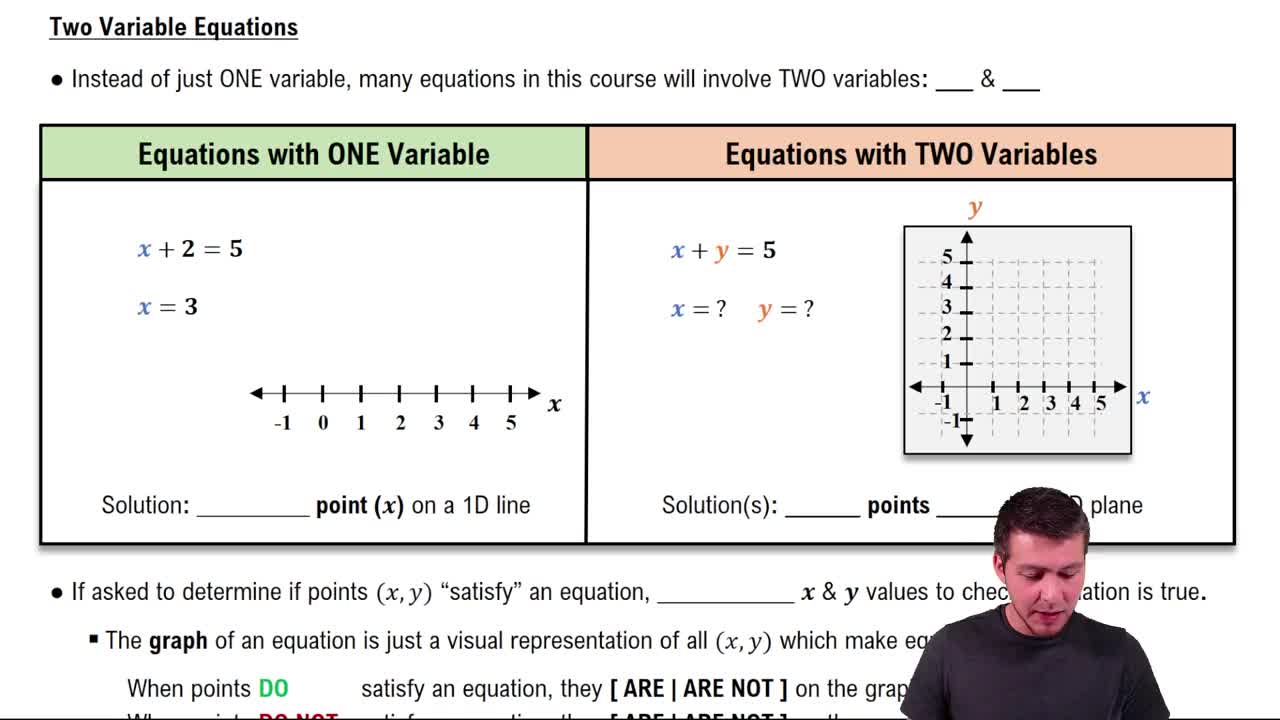
Equations with Two Variables

Extraneous Solutions

Extraneous solutions are solutions that emerge from the process of solving an equation but do not satisfy the original equation. This is particularly common in radical equations, where squaring both sides can introduce solutions that are not valid. Therefore, it is important to substitute any found solutions back into the original equation to verify their validity.
Video consigliato:
06:00
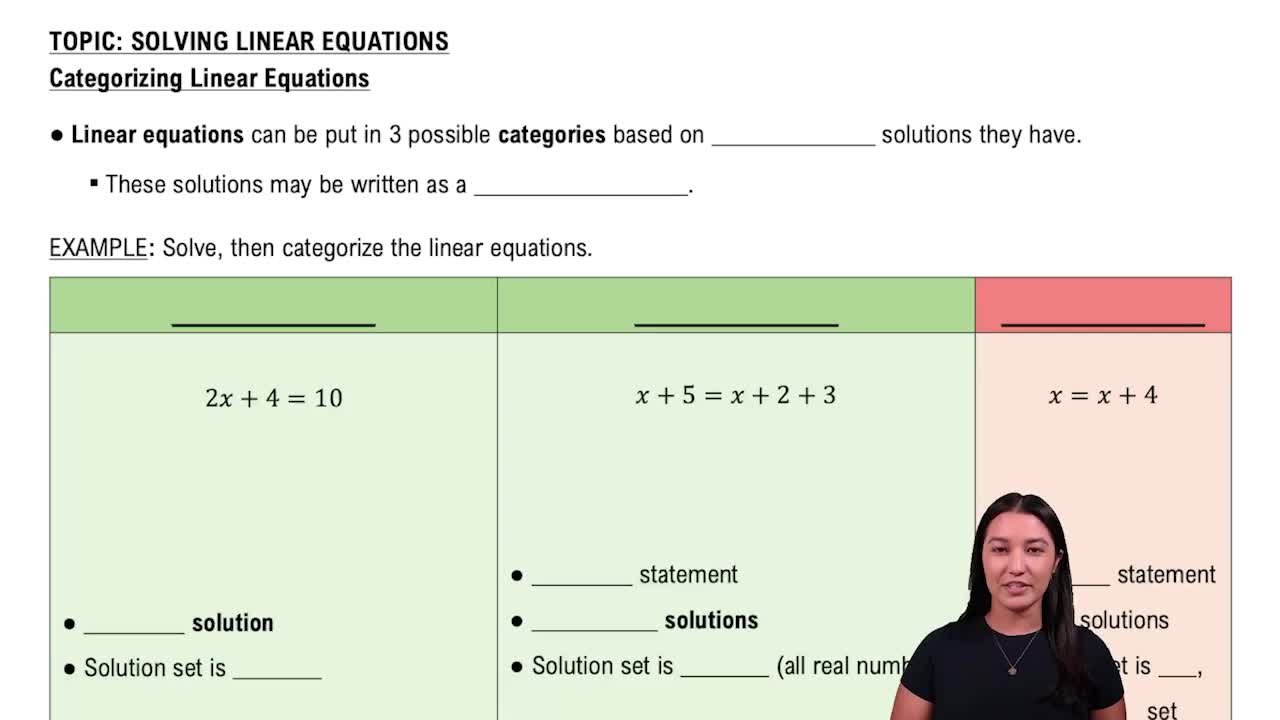
Categorizing Linear Equations