Use the vertical line test to identify graphs in which y is a function of x.
Ch. 2 - Functions and Graphs

Capitolo 3, Problema 15
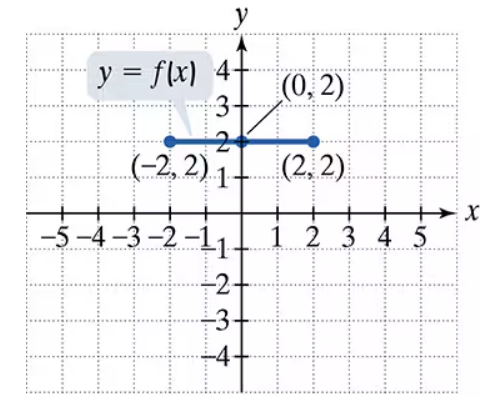
Use the graph of y = f(x) to graph each function g.

g(x) = −ƒ( x/2) +1
Guida verificata passo dopo passo1
Step 1: Analyze the given graph of y = f(x). The graph is a horizontal line segment with endpoints at (1, -3) and (4, -3). This indicates that f(x) = -3 for all x in the interval [1, 4].
Step 2: Understand the transformation g(x) = -f(x/2) + 1. This involves three transformations: (1) horizontal scaling by a factor of 2 (x/2), (2) reflection across the x-axis (-f), and (3) vertical shift upward by 1 (+1).
Step 3: Apply the horizontal scaling. Replace x with x/2 in f(x). This stretches the graph horizontally by a factor of 2. The new domain of f(x/2) becomes [2, 8] because the original domain [1, 4] is scaled by 2.
Step 4: Apply the reflection across the x-axis. Multiply the function values by -1. Since f(x/2) = -3 for x in [2, 8], the reflected values become +3 for the same interval.
Step 5: Apply the vertical shift. Add 1 to the reflected values. The final function g(x) = -f(x/2) + 1 will have values of 3 + 1 = 4 for x in [2, 8]. The graph of g(x) is a horizontal line segment at y = 4 over the interval [2, 8].

Risposta video verificata per un problema simile:
Questa soluzione video è stata consigliata dai nostri tutor come utile per risolvere questo problema.
Durata del video:
2mConcetti chiave
Ecco i concetti essenziali che devi comprendere per rispondere correttamente alla domanda.
Function Transformation
Function transformations involve altering the graph of a function through shifts, stretches, compressions, or reflections. In this case, the function g(x) = -f(x/2) + 1 reflects the original function f(x) across the x-axis, stretches it horizontally by a factor of 2, and shifts it upward by 1 unit.
Video consigliato:
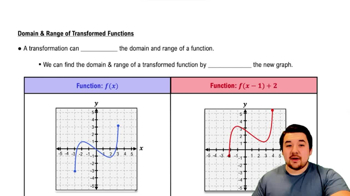
Domain & Range of Transformed Functions
Horizontal Stretch
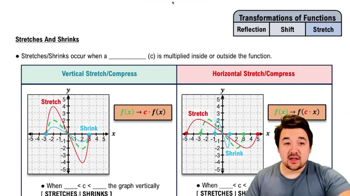
A horizontal stretch occurs when the input of a function is multiplied by a factor less than 1. For g(x) = -f(x/2), the x-values of f(x) are effectively doubled, which means that the graph of g will spread out horizontally, making it wider compared to f.
Video consigliato:
Stretches & Shrinks of Functions
Reflection Across the X-axis
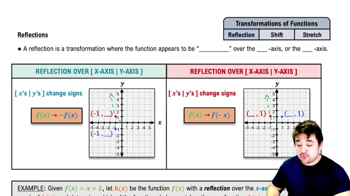
Reflection across the x-axis changes the sign of the output values of a function. In g(x) = -f(x/2), this reflection means that if f(x) has positive values, g(x) will have corresponding negative values, effectively flipping the graph of f over the x-axis.
Video consigliato:
Reflections of Functions
Pratica correlata
Domanda del libro di testo
1939
views
Domanda del libro di testo
Find the average rate of change of the function from x1 to x2. f(x) = x² + 2x from x1 = 3 to x2 = 5
1008
views
Domanda del libro di testo
Use the given conditions to write an equation for each line in point-slope form and slope-intercept form. Slope = 8, passing through (4, −1)
1059
views
1
comments
Domanda del libro di testo
The functions in Exercises 11-28 are all one-to-one. For each function, a. Find an equation for f-1(x), the inverse function. b. Verify that your equation is correct by showing that f(ƒ-1 (x)) = = x and ƒ-1 (f(x)) = x. f(x) = 2x + 3
659
views
Domanda del libro di testo
Find the distance between each pair of points. If necessary, express answers in simplified radical form and then round to two decimal places. (3√3, √5) and (−√3, 4√5)
874
views
Domanda del libro di testo
In Exercises 11–26, determine whether each equation defines y as a function of x. x² + y = 25
102
views