Ch. 2 - Functions and Graphs
Blitzer - College Algebra 8th Edition
Blitzer8th EditionCollege AlgebraISBN: 9780136970514Non è quello che usi tu?Cambia libro di testo
Capitolo 3, Problema 32

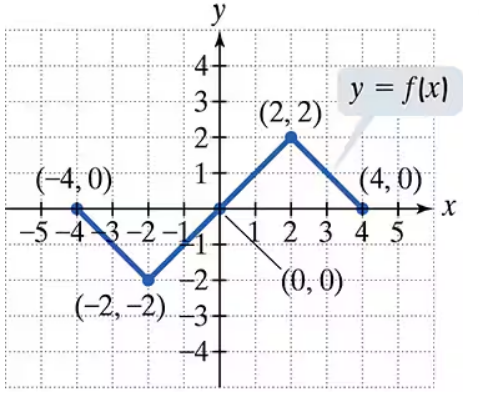
Use the graph of y = f(x) to graph each function g. g(x) = 2f(x+2) − 1

Guida verificata passo dopo passo
1
Start by identifying the transformations applied to the base function f(x). The given function g(x) = 2f(x+2) − 1 involves three transformations: a horizontal shift, a vertical stretch, and a vertical shift.
Analyze the horizontal shift. The term (x+2) inside the function indicates a shift to the left by 2 units. This means every point on the graph of f(x) will move 2 units to the left.
Next, consider the vertical stretch. The coefficient 2 outside the function, multiplying f(x), means that the graph of f(x) will be stretched vertically by a factor of 2. This doubles the distance of each point from the x-axis.
Now, account for the vertical shift. The term −1 at the end of the function indicates a downward shift by 1 unit. This means every point on the graph will move 1 unit down.
To graph g(x), start with the graph of f(x). Apply the transformations in the following order: shift the graph 2 units to the left, stretch it vertically by a factor of 2, and finally shift it 1 unit downward. Plot the resulting points to complete the graph of g(x).

Risposta video verificata per un problema simile:

Questa soluzione video è stata consigliata dai nostri tutor come utile per risolvere questo problema.
Durata del video:
2m

Concetti chiave

Ecco i concetti essenziali che devi comprendere per rispondere correttamente alla domanda.

Function Transformation

Function transformation refers to the changes made to the graph of a function based on modifications to its equation. These transformations include shifts, stretches, compressions, and reflections. Understanding how to manipulate the function's formula allows one to predict how the graph will change, which is essential for graphing functions like g(x) based on f(x).
Video consigliato:
4:22
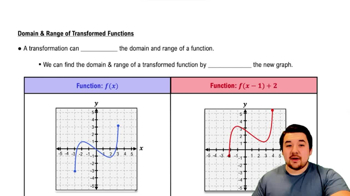
Domain & Range of Transformed Functions

Horizontal Shift

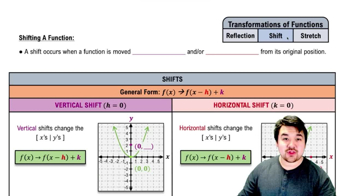
A horizontal shift occurs when a function is adjusted left or right along the x-axis. In the function g(x) = 2f(x+2) − 1, the term (x+2) indicates a shift of the graph of f(x) to the left by 2 units. This concept is crucial for accurately positioning the graph of g(x) relative to f(x).
Video consigliato:
5:34
Shifts of Functions

Vertical Stretch and Shift

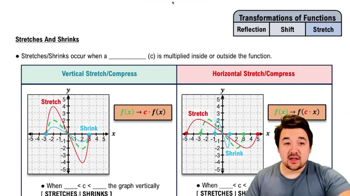
Vertical stretch and shift involve scaling the function vertically and moving it up or down along the y-axis. In g(x) = 2f(x+2) − 1, the coefficient '2' indicates a vertical stretch by a factor of 2, while the '−1' indicates a downward shift of 1 unit. Understanding these transformations helps in accurately graphing the new function g based on the original function f.
Video consigliato:
6:02
Stretches & Shrinks of Functions