Ch. 2 - Functions and Graphs
Blitzer - College Algebra 8th Edition
Blitzer8th EditionCollege AlgebraISBN: 9780136970514Non è quello che usi tu?Cambia libro di testo
Capitolo 3, Problema 27a

In Exercises 27–38, evaluate each function at the given values of the independent variable and simplify.f(x)=4x+5 a. f(6)

Guida verificata passo dopo passo
1
Step 1: Understand the problem. The function f(x) = 4x + 5 is given, and you are asked to evaluate it at x = 6. This means substituting 6 for x in the function.
Step 2: Substitute x = 6 into the function. Replace every occurrence of x in f(x) = 4x + 5 with 6. The expression becomes f(6) = 4(6) + 5.
Step 3: Simplify the multiplication. Multiply 4 by 6 to get 24. The expression now becomes f(6) = 24 + 5.
Step 4: Simplify the addition. Add 24 and 5 to simplify the expression further.
Step 5: The result of f(6) is the simplified value obtained in the previous step. This is the value of the function at x = 6.

Risposta video verificata per un problema simile:

Questa soluzione video è stata consigliata dai nostri tutor come utile per risolvere questo problema.
Durata del video:
1m

Concetti chiave

Ecco i concetti essenziali che devi comprendere per rispondere correttamente alla domanda.

Function Evaluation

Function evaluation involves substituting a specific value for the independent variable in a function. In this case, to evaluate f(6) for the function f(x) = 4x + 5, you replace x with 6, resulting in f(6) = 4(6) + 5. This process is fundamental in understanding how functions operate and yield outputs based on given inputs.
Video consigliato:
4:26
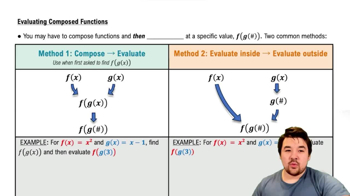
Evaluating Composed Functions

Linear Functions

A linear function is a polynomial function of degree one, which can be expressed in the form f(x) = mx + b, where m is the slope and b is the y-intercept. The function f(x) = 4x + 5 is linear, with a slope of 4 and a y-intercept of 5. Understanding the characteristics of linear functions helps in visualizing their graphs and predicting their behavior.
Video consigliato:
06:07
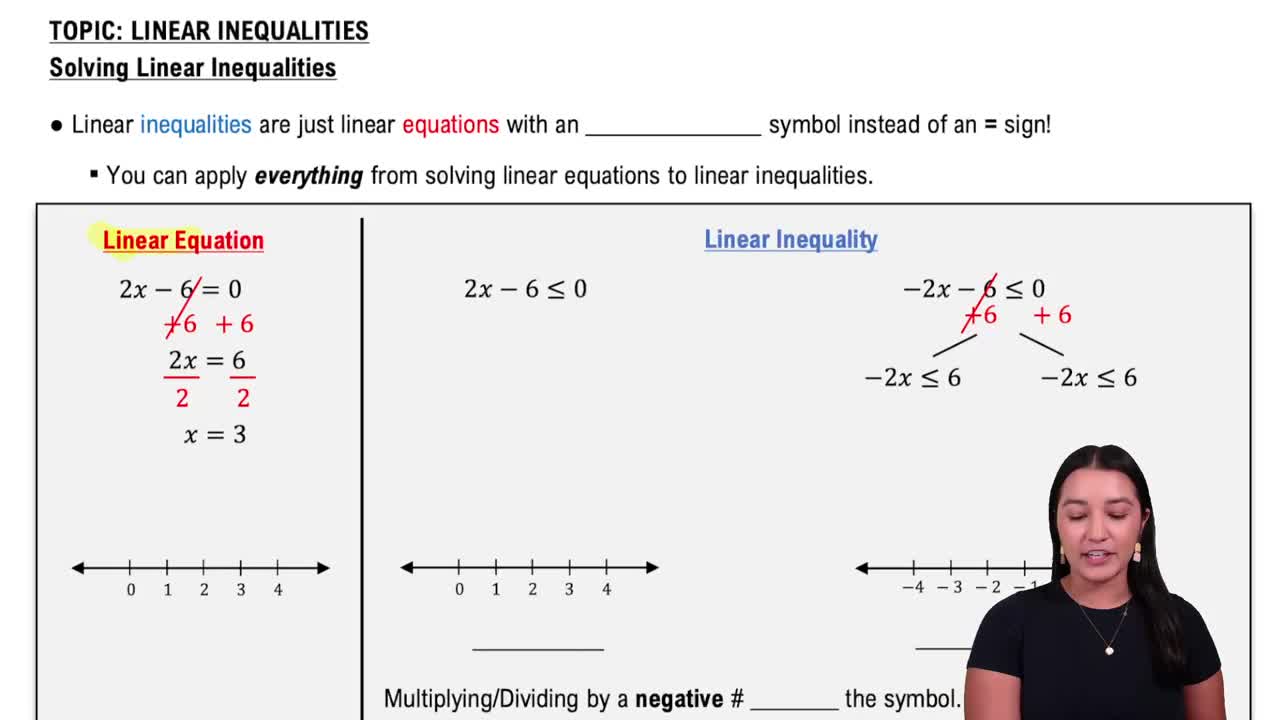
Linear Inequalities

Simplification

Simplification in mathematics refers to the process of reducing an expression to its simplest form. After evaluating the function, the next step is to simplify the result, if necessary. For example, in f(6) = 24 + 5, the simplification leads to f(6) = 29, which is the final output. Mastering simplification is crucial for clear and concise mathematical communication.
Video consigliato:
04:15
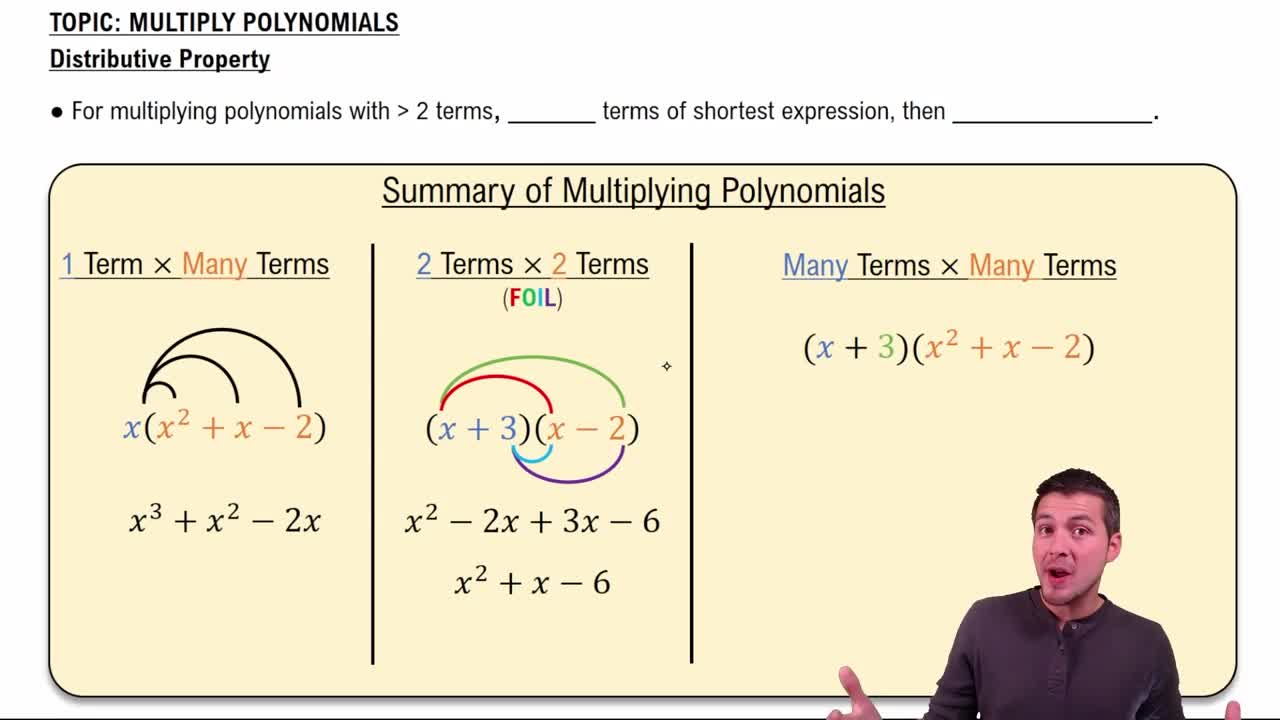
Multiply Polynomials Using the Distributive Property