In Exercises 31–50, find fg and determine the domain for each function. f(x) = √(x +4), g(x) = √(x − 1)
Ch. 2 - Functions and Graphs

Capitolo 3, Problema 47d
In Exercises 31–50, find f/g and determine the domain for each function. f(x) = √(x +4), g(x) = √(x − 1)
Guida verificata passo dopo passo1
Step 1: Understand the problem. You are tasked with finding the quotient of two functions, f(x) and g(x), which is written as (f/g)(x) = f(x)/g(x). Additionally, you need to determine the domain of this quotient function.
Step 2: Write the quotient function. Substitute the given functions into the formula: (f/g)(x) = (√(x + 4)) / (√(x − 1)).
Step 3: Determine the domain of f(x). Since f(x) = √(x + 4), the expression inside the square root, x + 4, must be greater than or equal to 0. Solve the inequality x + 4 ≥ 0 to find x ≥ -4. This means the domain of f(x) is all x such that x ≥ -4.
Step 4: Determine the domain of g(x). Since g(x) = √(x − 1), the expression inside the square root, x − 1, must also be greater than or equal to 0. Solve the inequality x − 1 ≥ 0 to find x ≥ 1. This means the domain of g(x) is all x such that x ≥ 1.
Step 5: Combine the domain restrictions. For the quotient (f/g)(x) to be defined, g(x) cannot be 0 (division by zero is undefined). Therefore, x − 1 > 0, which simplifies to x > 1. Combine this with the domain restrictions from f(x) and g(x). The final domain is all x such that x > 1.

Risposta video verificata per un problema simile:
Questa soluzione video è stata consigliata dai nostri tutor come utile per risolvere questo problema.
Durata del video:
2mConcetti chiave
Ecco i concetti essenziali che devi comprendere per rispondere correttamente alla domanda.
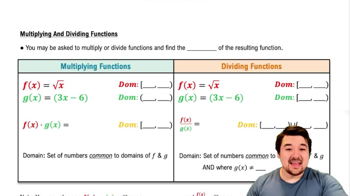
Function Division
Function division involves creating a new function by dividing one function by another. In this case, f/g means we take the function f(x) and divide it by g(x). This operation requires understanding how to manipulate functions and the implications of division, particularly regarding the values that make the denominator zero.
Video consigliato:
Multiplying & Dividing Functions
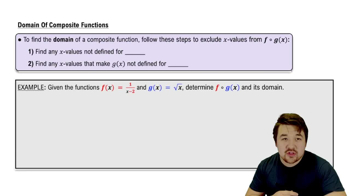
Domain of a Function
The domain of a function is the set of all possible input values (x-values) for which the function is defined. For square root functions, the expression inside the square root must be non-negative. Therefore, determining the domain involves solving inequalities to find the valid x-values for both f(x) and g(x).
Video consigliato:
Domain Restrictions of Composed Functions
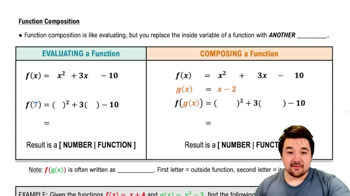
Composite Functions
Composite functions occur when one function is applied to the result of another function. In the context of f/g, we need to consider how the outputs of f and g interact, particularly focusing on the restrictions imposed by g(x) since division by zero is undefined. Understanding how to combine and analyze these functions is crucial for finding the overall domain.
Video consigliato:
Function Composition
Pratica correlata
Domanda del libro di testo
909
views
Domanda del libro di testo
In Exercises 31–50, find f−g and determine the domain for each function. f(x) = √(x +4), g(x) = √(x − 1)
1229
views
Domanda del libro di testo
Use the graph of y = f(x) to graph each function g. g(x) = -f(x + 1) − 1
692
views
Domanda del libro di testo
In Exercises 41–52, give the center and radius of the circle described by the equation and graph each equation. Use the graph to identify the relation's domain and range. x² + (y − 1)² = 1
956
views
Domanda del libro di testo
In Exercises 46–49, give the slope and y-intercept of each line whose equation is given. Then graph the line. 2x + 3y + 6 = 0
1444
views
Domanda del libro di testo
In Exercises 39-52, a. Find an equation for ƒ¯¹(x). b. Graph ƒ and ƒ¯¹(x) in the same rectangular coordinate system. c. Use interval notation to give the domain and the range off and ƒ¯¹. f(x) = (x+2)³
617
views