Give the center and radius of the circle described by the equation and graph each equation. Use the graph to identify the relation's domain and range. (x − 3)² + (y + 1)² = 36
Ch. 2 - Functions and Graphs

Capitolo 3, Problema 43
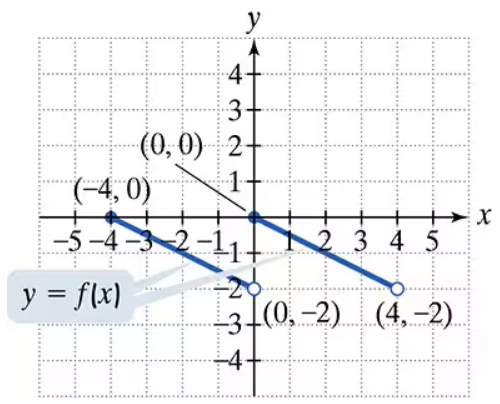
Use the graph of y = f(x) to graph each function g. g(x) = (1/2)f(2x)

Guida verificata passo dopo passo1
Step 1: Understand the transformations applied to the function f(x). The given function g(x) = (1/2)f(2x) involves two transformations: a horizontal compression by a factor of 2 and a vertical scaling by a factor of 1/2.
Step 2: Start with the horizontal compression. The term f(2x) indicates that the graph of f(x) is horizontally compressed by a factor of 2. This means that every x-coordinate of the points on the graph of f(x) is divided by 2.
Step 3: Apply the vertical scaling. The term (1/2)f(2x) indicates that the graph of f(2x) is vertically scaled by a factor of 1/2. This means that every y-coordinate of the points on the graph of f(2x) is multiplied by 1/2.
Step 4: Combine the transformations. To graph g(x), take each point (x, y) on the graph of f(x), apply the horizontal compression to get (x/2, y), and then apply the vertical scaling to get (x/2, y/2).
Step 5: Plot the transformed points on the graph and connect them smoothly to complete the graph of g(x). Ensure that the overall shape of the graph reflects the combined transformations.

Risposta video verificata per un problema simile:
Questa soluzione video è stata consigliata dai nostri tutor come utile per risolvere questo problema.
Durata del video:
6mConcetti chiave
Ecco i concetti essenziali che devi comprendere per rispondere correttamente alla domanda.
Function Transformation
Function transformation refers to the process of altering the graph of a function through various operations, such as stretching, compressing, or shifting. In the case of g(x) = (1/2)f(2x), the function undergoes both a vertical compression by a factor of 1/2 and a horizontal compression by a factor of 2, which affects the shape and position of the graph.
Video consigliato:
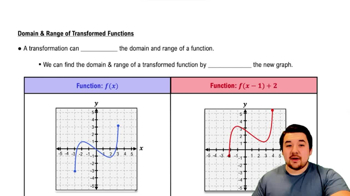
Domain & Range of Transformed Functions
Horizontal Scaling
Horizontal scaling involves changing the input values of a function, which affects how the graph is stretched or compressed along the x-axis. In g(x) = (1/2)f(2x), the '2x' indicates that the function f(x) is being evaluated at twice the rate, resulting in a horizontal compression of the graph by a factor of 2, making it appear narrower.
Video consigliato:
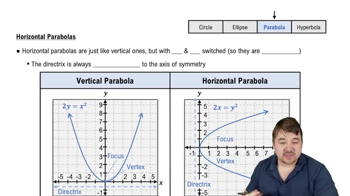
Horizontal Parabolas
Vertical Scaling
Vertical scaling modifies the output values of a function, impacting the graph's height. In the function g(x) = (1/2)f(2x), the factor of 1/2 indicates that the output of f(2x) is halved, leading to a vertical compression of the graph. This means that all y-values of the function g will be half of those of f, effectively lowering the graph.
Video consigliato:
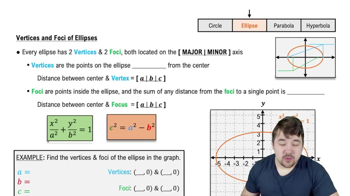
Foci and Vertices of an Ellipse
Pratica correlata
Domanda del libro di testo
811
views
Domanda del libro di testo
Give the slope and y-intercept of each line whose equation is given. Then graph the linear function. f(x) = (3/4)x-2
123
views
Domanda del libro di testo
In Exercises 39-52, a. Find an equation for ƒ¯¹(x). b. Graph ƒ and ƒ¯¹(x) in the same rectangular coordinate system. c. Use interval notation to give the domain and the range off and ƒ¯¹. f(x) = (x − 1)², x ≤ 1
637
views
Domanda del libro di testo
Find f−g and determine the domain for each function. f(x)= = (5x+1)/(x² - 9), g(x) = (4x -2)/(x² - 9)
1196
views
Domanda del libro di testo
Find ƒ+g and determine the domain for each function.
f(x)= = (5x+1)/(x² - 9), g(x) = (4x -2)/(x² - 9)
914
views
Domanda del libro di testo
In Exercises 41–44, use the given conditions to write an equation for each line in point-slope form and slope-intercept form. Passing through (4, -7) and parallel to the line whose equation is 3x + y - 9 = 0.
305
views