Ch. 2 - Functions and Graphs
Blitzer - College Algebra 8th Edition
Blitzer8th EditionCollege AlgebraISBN: 9780136970514Non è quello che usi tu?Cambia libro di testo
Capitolo 3, Problema 45abc

In Exercises 39-52, a. Find an equation for ƒ¯¹(x). b. Graph ƒ and ƒ¯¹(x) in the same rectangular coordinate system. c. Use interval notation to give the domain and the range off and ƒ¯¹. f(x) = x³ − 1

Guida verificata passo dopo passo
1
Step 1: To find the inverse function ƒ¯¹(x), start by replacing f(x) with y. This gives y = x³ - 1. Then, swap x and y to reflect the inverse relationship. The equation becomes x = y³ - 1.
Step 2: Solve for y in terms of x to isolate the inverse function. Add 1 to both sides of the equation to get x + 1 = y³. Then, take the cube root of both sides to solve for y, resulting in y = ∛(x + 1). Thus, the inverse function is ƒ¯¹(x) = ∛(x + 1).
Step 3: To graph both f(x) = x³ - 1 and ƒ¯¹(x) = ∛(x + 1) on the same rectangular coordinate system, plot several points for each function. For f(x), choose x-values, compute f(x), and plot the points. For ƒ¯¹(x), choose x-values, compute ƒ¯¹(x), and plot the points. Remember that the graphs of f and ƒ¯¹(x) are symmetric about the line y = x.
Step 4: Determine the domain and range of f(x) = x³ - 1. Since the cube function x³ is defined for all real numbers, the domain of f(x) is (-∞, ∞). The range of f(x) is also (-∞, ∞) because the cube function can produce all real numbers.
Step 5: Determine the domain and range of ƒ¯¹(x) = ∛(x + 1). The cube root function ∛(x) is defined for all real numbers, so the domain of ƒ¯¹(x) is (-∞, ∞). The range of ƒ¯¹(x) is also (-∞, ∞) because the cube root function can produce all real numbers.

Risposta video verificata per un problema simile:

Questa soluzione video è stata consigliata dai nostri tutor come utile per risolvere questo problema.
Durata del video:
11m

Concetti chiave

Ecco i concetti essenziali che devi comprendere per rispondere correttamente alla domanda.

Inverse Functions

An inverse function reverses the effect of the original function. For a function f(x), its inverse f¯¹(x) satisfies the condition f(f¯¹(x)) = x for all x in the domain of f¯¹. To find the inverse, one typically swaps the roles of x and y in the equation and solves for y.
Video consigliato:
4:30
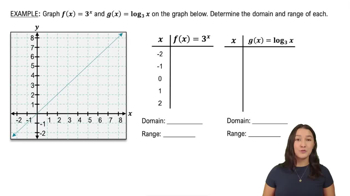
Graphing Logarithmic Functions

Graphing Functions

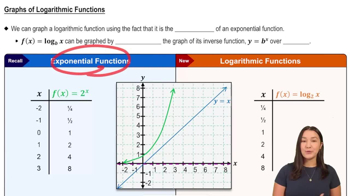
Graphing functions involves plotting points on a coordinate system to visualize the relationship between the input (x) and output (f(x)). When graphing both a function and its inverse, the two graphs will be symmetric with respect to the line y = x, illustrating how each function undoes the other.
Video consigliato:
5:26
Graphs of Logarithmic Functions

Domain and Range

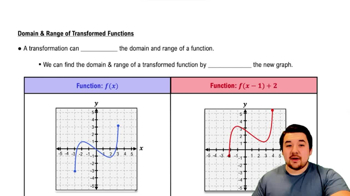
The domain of a function is the set of all possible input values (x) for which the function is defined, while the range is the set of all possible output values (f(x)). For inverse functions, the domain of f becomes the range of f¯¹, and vice versa. Understanding these sets is crucial for accurately describing the behavior of both functions.
Video consigliato:
4:22
Domain & Range of Transformed Functions