In Exercises 39–50, graph the given functions, f and g, in the same rectangular coordinate system. Select integers for x, starting with -2 and ending with 2. Once you have obtained your graphs, describe how the graph of g is related to the graph of f. f(x) = x³, g(x) = x³ +2
Ch. 2 - Functions and Graphs

Capitolo 3, Problema 47
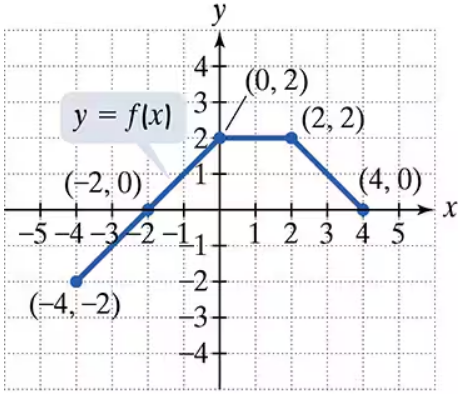
Use the graph of y = f(x) to graph each function g. g(x) = -f(x-1) + 1

Guida verificata passo dopo passo1
Start with the original function \( y = f(x) \). The goal is to graph \( g(x) = -f(x-1) + 1 \) by applying transformations to \( f(x) \).
First, consider the inside of the function argument: \( f(x-1) \). This represents a horizontal shift of the graph of \( f(x) \) to the right by 1 unit.
Next, apply the negative sign in front of \( f(x-1) \), which means reflecting the graph of \( f(x-1) \) across the x-axis (flip it upside down).
Finally, add 1 to the entire function: \( -f(x-1) + 1 \). This shifts the graph vertically upward by 1 unit.
To summarize, start with the graph of \( f(x) \), shift it right by 1 unit, reflect it over the x-axis, then shift it up by 1 unit to obtain the graph of \( g(x) \).

Risposta video verificata per un problema simile:
Questa soluzione video è stata consigliata dai nostri tutor come utile per risolvere questo problema.
Durata del video:
3mConcetti chiave
Ecco i concetti essenziali che devi comprendere per rispondere correttamente alla domanda.
Function Transformations
Function transformations involve shifting, reflecting, stretching, or compressing the graph of a function. In this problem, the function g(x) is derived from f(x) by applying horizontal shifts, reflections, and vertical shifts, which change the graph's position and orientation without altering its shape.
Video consigliato:
Domain & Range of Transformed Functions
Horizontal Shifts
A horizontal shift moves the graph left or right. For g(x) = -f(x-1) + 1, the term (x-1) inside the function indicates a shift of the graph of f(x) one unit to the right. This means every point on f(x) moves right by 1 unit before other transformations are applied.
Video consigliato:
Shifts of Functions
Reflections and Vertical Shifts
The negative sign before f(x-1) reflects the graph across the x-axis, flipping it upside down. The +1 outside the function shifts the entire graph up by one unit. Together, these transformations modify the graph's orientation and vertical position.
Video consigliato:
Graphs of Shifted & Reflected Functions
Pratica correlata
Domanda del libro di testo
102
views
Domanda del libro di testo
Give the center and radius of the circle described by the equation and graph each equation. Use the graph to identify the relation's domain and range. (x + 2)² + (y + 2)² = 4
813
views
Domanda del libro di testo
Find ƒ+g and determine the domain for each function. f(x) = √(x +4), g(x) = √(x − 1)
1050
views
Domanda del libro di testo
In Exercises 31–50, find f−g and determine the domain for each function. f(x) = √(x +4), g(x) = √(x − 1)
1229
views
Domanda del libro di testo
Find ƒ+g, f−g, fg, and f/g. Determine the domain for each function. f(x)= = 9x/(x - 4), g(x) = 7/(x+8)
558
views
Domanda del libro di testo
In Exercises 39-52, a. Find an equation for ƒ¯¹(x). b. Graph ƒ and ƒ¯¹(x) in the same rectangular coordinate system. c. Use interval notation to give the domain and the range off and ƒ¯¹. f(x) = (x+2)³
617
views
